
Ravi Hair Journal
Raw Vietnamese hair: 3 easy ways to check quality before you buy
You do not need laboratory equipment to decide whether a Raw Vietnamese Hair sample deserves a larger order. With one 100g bundle, a comb, brush, shampoo, kitchen scale and a small 10g test section, you can check how the hair looks, how it behaves after washing and whether it survives the same styling or coloring your customers will actually use.
This guide gives you three repeatable tests, so you can compare suppliers with evidence instead of trusting the word “Raw” on a price list.
First, do not assume “raw” automatically means high quality
The term Raw Hair is used differently across the hair market. A supplier may use it for minimally processed hair, while another may use Raw as the name of a particular commercial product line. That means “Raw Vietnamese Hair” is a useful starting description, but it is not enough to prove donor consistency, processing history or actual performance.
The current Raw Vietnamese Hair specification used in Ravi Hair’s product system is a separate weft line rather than the standard Remy range. The reference specification is approximately 100g per bundle, 10–36 inches, with fullness comparable to a Double Drawn direction at roughly 60–75% main-length strands. Those details describe this product line, not a universal Raw Hair standard used by every supplier.
The same source also distinguishes this Raw line from premium one-donor Virgin Hair and notes that its coloring capability should not automatically be treated as unlimited. In particular, a Raw label should not be interpreted as a guarantee that every bundle will safely reach a very light shade such as 613.
This is why your goal should not be to ask:
“Does the supplier call this Raw Hair?”
A much more useful question is:
“Does this exact 100g sample perform well enough for what my customers will do with it?”
The following three checks help you answer that question.
Quick overview: 3 easy raw Vietnamese hair quality tests
| Test | What You Need | What You Learn |
|---|---|---|
| 1. Dry Bundle Check | 100g sample, scale, measuring tape, comb, phone | Whether the delivered product matches the basic specification and whether the ends, weft and dry handling look acceptable |
| 2. 3-Wash Test | Shampoo, conditioner, comb, brush | Whether softness, manageability, shedding, ends and texture remain stable after the first-day finish is removed |
| 3. 10g Real-Use Test | About 10g of hair and your normal salon process | Whether the hair can handle the coloring, heat or styling your actual customers request |
Do all three on the same specification you intend to sell. If you plan to stock 20-inch Natural Wavy Raw Hair, testing a 12-inch Straight sample gives you less useful information because you are changing both length and texture.
Test 1: check the dry 100g bundle before you wash it
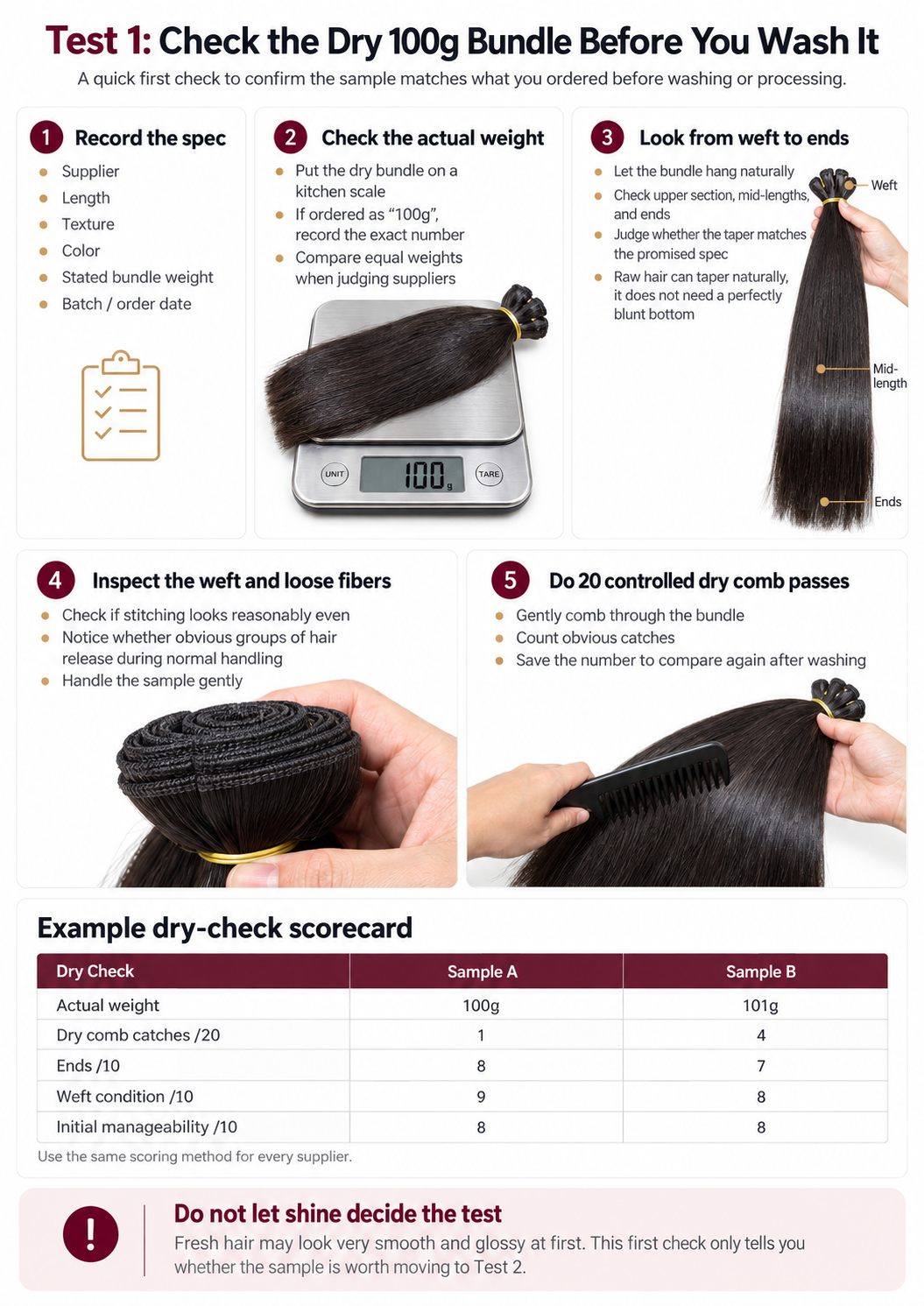
Your first test should take only a few minutes. The purpose is not to decide that the hair is excellent from one touch, but to confirm that what arrived actually matches what you ordered before you spend time washing or processing it.
Start by recording the exact specification. Write down the supplier, length, texture, color, stated bundle weight and batch or order date so you can identify the same product later.
Check the actual weight
If you purchased a bundle sold as approximately 100g, put it on a kitchen scale before washing. Record the number instead of relying on how heavy the bundle feels in your hand.
This matters because comparing a 100g bundle with a heavier bundle can distort almost every visual judgment. A heavier bundle may naturally appear fuller, so you should compare matched weights whenever you are judging two suppliers.
Do not invent your own universal pass/fail tolerance. The useful number is the difference between what you ordered, what you received and what the supplier consistently delivers across later orders.
Look at the hair from weft to ends
Hold the bundle vertically and let the hair hang naturally. Look at the upper section, mid-lengths and final few inches without squeezing the bottom together to make it appear fuller.
Raw Hair does not need every strand to end at exactly the same point. In Ravi Hair’s current commercial Raw specification, the fullness is closer to a Double Drawn direction rather than a perfectly blunt Super Double Drawn bottom.
What you want is a bundle whose taper matches the specification you were promised. If Supplier A sends a visibly fuller sample than Supplier B, that may matter commercially, but compare equal weight, length and texture before deciding which one is better.
Inspect the weft and loose fibers
Look closely along the stitched weft. Check whether the stitching appears reasonably even and whether obvious groups of hair release when the bundle is handled normally.
Then gently run a comb through the hair. Do not yank through resistance, because the goal is to observe the sample rather than damage it during the test.
A useful baseline is 20 controlled dry comb passes. Count obvious catches and save that number because you will repeat the test after washing.
For example, you might record:
| Dry Check | Sample A | Sample B |
|---|---|---|
| Actual weight | 100g | 101g |
| Dry comb catches /20 | 1 | 4 |
| Ends /10 | 8 | 7 |
| Weft condition /10 | 9 | 8 |
| Initial manageability /10 | 8 | 8 |
The scores are your internal comparison method, not an international Raw Hair grading system. What matters is that you use the same scoring method for every supplier.
Do not let shine decide the test
Fresh hair can look extremely smooth and glossy when it first arrives. That can make a weak sample look impressive for five minutes.
Your customer will wash the hair, sleep in it, comb it and style it. That is why this first check should only decide whether the sample is worth moving to Test 2.
Test 2: wash it 3 times and measure what changes
This is the most useful test if you want an easy way to move beyond supplier photos and factory finishing. Washing removes part of the “Day 1” advantage and lets you see how the hair behaves after repeated handling.
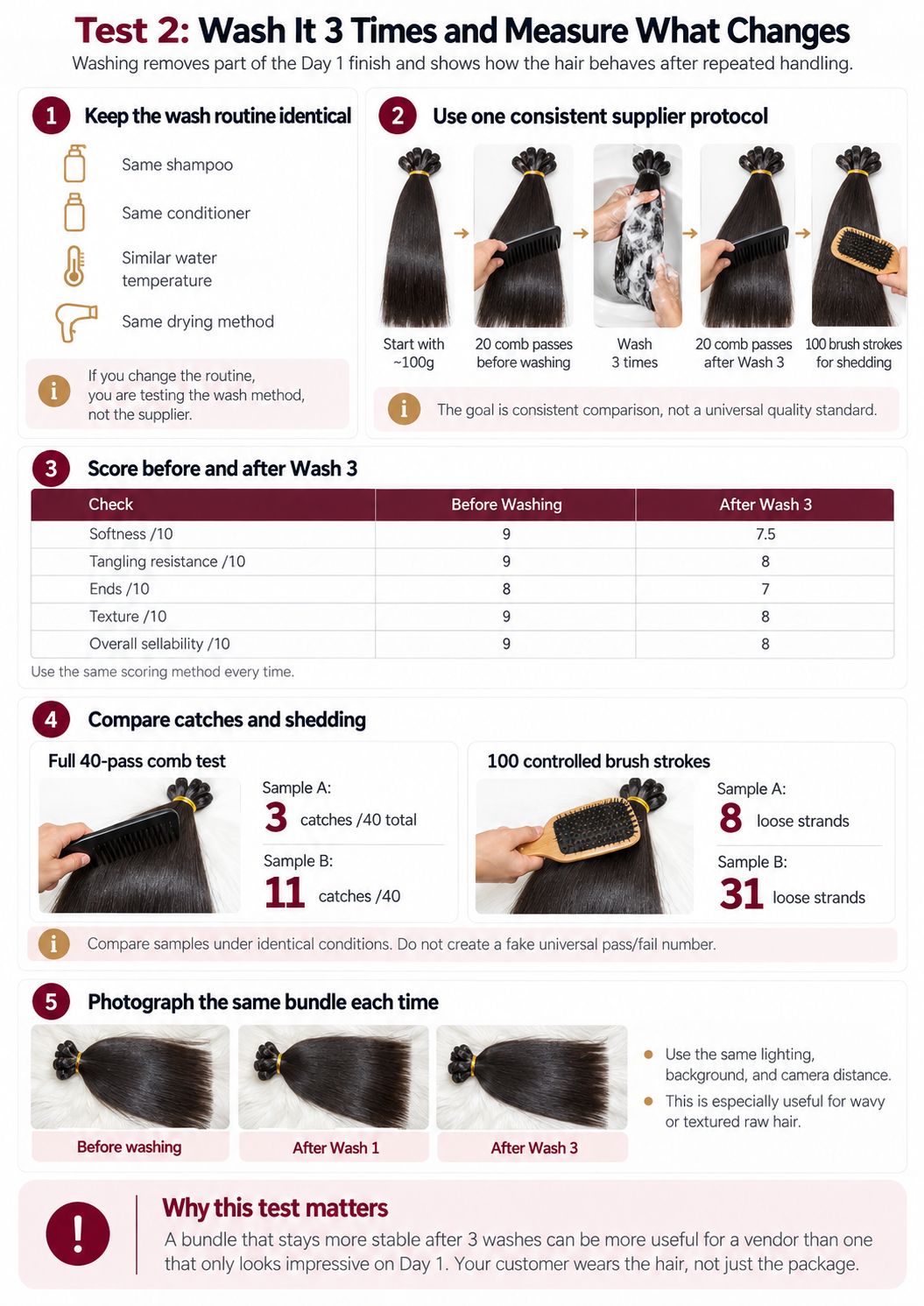
Use the same shampoo, same conditioner, similar water temperature and same drying method for every sample you compare. If Sample A receives a mild moisturizing wash and Sample B receives a harsh clarifying shampoo, you are testing two washing routines instead of two hair suppliers.
A practical supplier protocol is to start with about 100g, wash it three times, complete 20 comb passes before washing and another 20 after washing, then use 100 controlled brush strokes to record shedding. The point is consistent comparison, not creating a universal quality standard.
Score the hair before and after wash 3
Before the first wash, give the sample a simple score for softness, tangling resistance, end condition and texture. Repeat the same scoring after the third wash.
For example:
| Check | Before Washing | After Wash 3 |
|---|---|---|
| Softness /10 | 9 | 7.5 |
| Tangling resistance /10 | 9 | 8 |
| Ends /10 | 8 | 7 |
| Texture /10 | 9 | 8 |
| Overall sellability /10 | 9 | 8 |
Another sample might begin at 9/10 but fall to 5/10 after three washes. A third might look slightly less impressive when new, starting around 8/10, but remain around 7.5–8/10 after repeated washing.
For a vendor, the second behavior can be more useful. Your customer is buying the hair to wear, not simply to open the package.
Complete the full 40-pass comb test
You already completed 20 passes while the sample was dry and new. After Wash 3, let the hair dry using the same method, then perform another 20 controlled comb passes.
Suppose Sample A gives you:
3 catches /40 total
while Sample B gives:
11 catches /40.
That does not prove Sample A is universally “premium” and Sample B is “bad.” It tells you that under the same routine, Sample A created less resistance and deserves further consideration.
Use 100 brush strokes to compare shedding
Next, complete 100 controlled brush strokes and count the loose strands you can reasonably identify. Also inspect whether the hairs appear to be loose fibers already inside the bundle or are releasing from the weft.
For example, one sample may release 8 strands while another releases 31 under the same test. Those numbers become useful because you now have something measurable to compare rather than saying one bundle “seems to shed more.”
Do not create a fake rule such as “more than 10 hairs automatically fails.” There is no universal pass number in this protocol, so compare samples under identical conditions and investigate large differences.
Photograph the same bundle each time
Take a photo before washing, after Wash 1 and after Wash 3. Use the same lighting, background and approximate camera distance.
This is particularly important for Natural Wavy, Body Wave, Deep Wave or other textured Raw Hair. Memory is unreliable, but three comparable photos make it much easier to see whether the pattern, ends or overall appearance changed.
Test 3: process a 10g section the way your customer will actually use it
A bundle can wash beautifully and still fail your business if it cannot handle the service your customers buy it for. Your third test should therefore copy real use, not a random internet “Raw Hair test.”
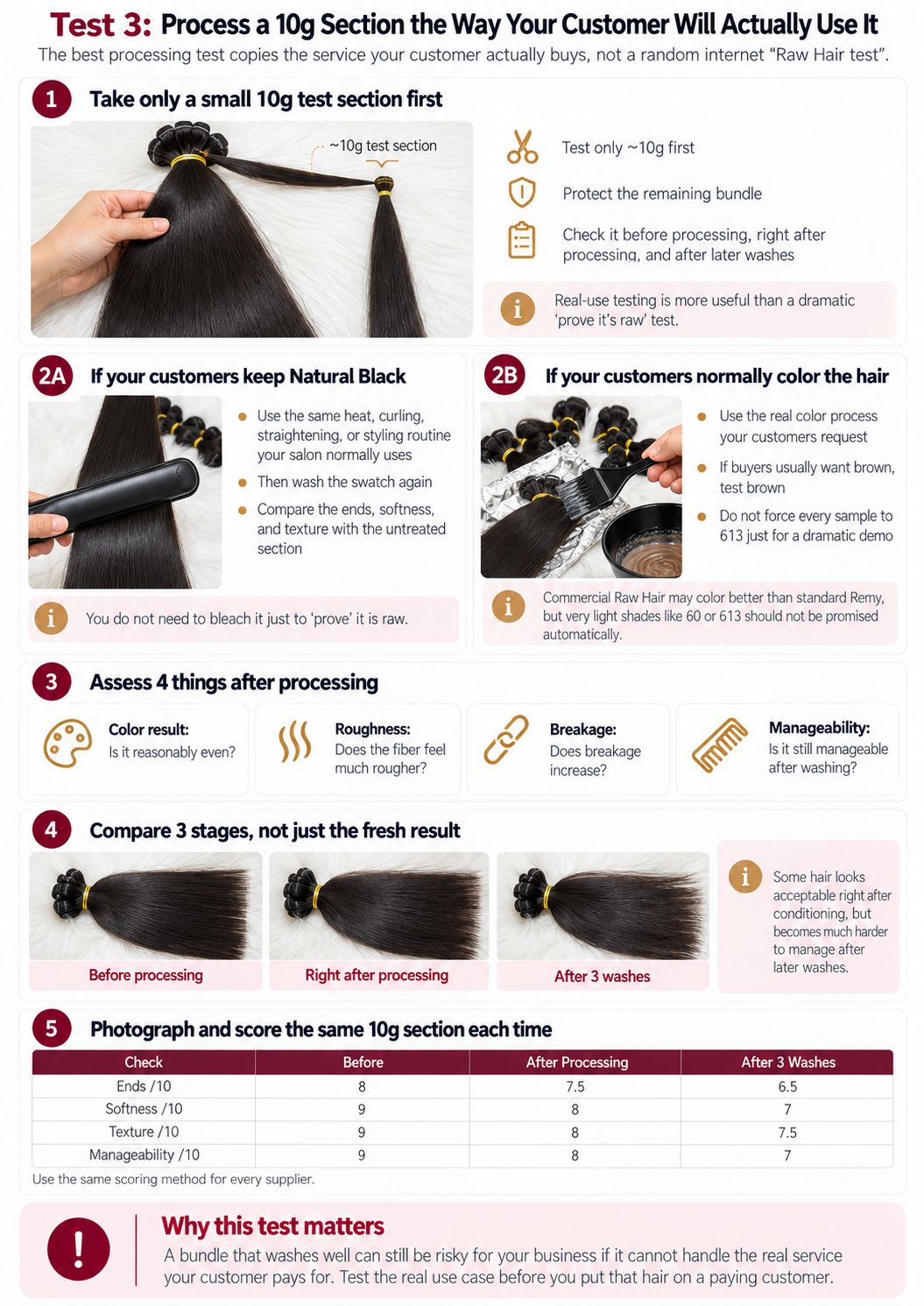
Take approximately 100g from the sample and process only that small section first. This protects the remaining bundle while giving you enough hair to inspect before, immediately after and after several washes.
If your customers keep natural black
You do not need to bleach the swatch simply because you want to “prove” the hair is Raw. Instead, apply the heat, curling, straightening or styling routine that your salon normally uses.
Check whether the hair remains manageable afterward. Then wash the swatch again and compare the ends, softness and texture with the untreated section.
If your customers normally color the hair
Use the actual professional process your customers request. If most buyers want brown, test the brown process instead of forcing every sample toward 613 just to create a dramatic demonstration.
This matters because the current commercial Raw specification should not be treated as a guarantee of successful 613 bleaching. Internal product guidance specifically notes stronger coloring capability than standard Remy in this line, while also warning that very light shades such as 60 or 613 can be difficult and should not be promised automatically.
After processing the 10g section, assess four things: whether the color result is reasonably even, whether the fiber becomes significantly rougher, whether breakage increases and whether the swatch remains manageable after washing. You are testing the customer’s real use case, which is much more valuable than trying to win a theoretical bleach test.
Compare before, after processing and after 3 washes
Do not stop immediately after the stylist finishes the color. Some hair can look acceptable directly after conditioning but become much harder to manage after subsequent washes.
Photograph and score the 10g section before processing, immediately after processing and after three washes. If the ends become extremely rough or comb resistance increases sharply only after processing, you have identified a commercial risk before putting that hair on a paying customer.
How do you decide whether the raw hair passed?
Do not reduce the final decision to one number. The strongest sample is the one that performs well across the things your customer actually cares about.
For example, a salon selling Natural Black sew-ins may prioritize wash stability, manageability, shedding and ends. A color specialist may accept a slightly higher purchase price if the 10g processing swatch gives a more consistent result.
A simple decision sheet can look like this:
| Quality Check | What You Want to See | Reason to Investigate |
|---|---|---|
| Delivered specification | Weight, length, texture and fullness close to what you ordered | Sample does not match the quoted specification |
| Dry handling | Manageable combing and acceptable ends | Repeated catches before washing |
| After 3 washes | Reasonably stable softness, ends and texture | Large deterioration from Day 1 |
| 100 brush strokes | Comparable, controlled shedding | Large increase versus matched sample |
| 10g real-use test | Hair remains commercially usable for your service | Severe roughness, breakage or poor manageability |
| Repeat order | Similar performance to first sample | Second batch behaves very differently |
The word “commercially usable” is important. Your salon, price point and customer expectations determine what you can sell confidently.
Do not make these raw hair testing mistakes
The first common mistake is judging quality only by touch. Very soft new hair can still change after washing, so Day 1 softness should get you to the next test rather than close the buying decision.
Another mistake is comparing unmatched products. A 12-inch Straight bundle from one supplier should not be compared with a 30-inch Deep Wave bundle from another and treated as a fair supplier test.
A third mistake is assuming a successful bleach result proves everything about the hair. Coloring tells you something about processing performance, but it does not tell you whether the weft is consistent, whether shedding increases after repeated washing or whether the next batch will match the first.
Finally, do not let a supplier’s best video replace your own sample. A current-batch video is useful for screening vendors, but the bundle in your hands should make the final decision.
One good sample is not enough for a wholesale order
After a sample passes all three tests, resist the temptation to move immediately from 100g to a very large inventory position. Your first sample answers whether the supplier can provide hair you like, while your second order begins to answer whether the supplier can provide it consistently.
Reorder the same length, texture, color and quality specification. On the second batch, you can use a shorter consistency check such as one wash, 20 comb passes and 50 brush strokes, then compare the result with your original records.
If the first order gives 2 catches in 20 passes and the second gives 3, the two batches are behaving relatively close in your own test. If the second suddenly gives 12, you have a reason to investigate before increasing the order.
For wholesalers, that consistency test can matter more than one perfect showroom bundle. Your customers reorder the product, not your first sample.
What should you ask a raw Vietnamese hair supplier before ordering?
Before paying for the sample, ask for enough detail to reproduce the same product later. You should know the exact length, texture, bundle weight, color, product construction and current-batch appearance before the order is confirmed.
For Ravi Hair’s current Raw line, the reference product is weft-based, approximately 100g per bundle and available across a 10–36 inch range. Because the commercial Raw line is treated separately from both standard Remy and premium one-donor Virgin Hair, you should request the specification directly rather than assuming the three labels mean the same thing.
Ask for a current-batch video first, then request the exact sample you plan to sell. That gives you a faster way to reject an obviously unsuitable texture or fullness before spending money on testing.
Faq about checking raw Vietnamese hair
How Can I Tell If Raw Vietnamese Hair Is Good Quality?
Start with one matched 100g sample and use three checks. Inspect the dry bundle and specification, wash it three times with controlled comb and brush tests, then process about 10g using the same service your customers will request.
The purpose is not to find one magical sign of “real Raw Hair.” You are checking whether the exact product remains sellable under repeatable conditions.
Is Soft Hair Automatically Good Raw Hair?
No. Initial softness is useful, but it tells you very little about how the sample behaves after washing, brushing or processing.
Record the initial feel, then compare it with the same bundle after Wash 3. Stability is often more useful to your business than an impressive first touch.
Should Raw Vietnamese Hair Bleach to 613?
Do not use successful 613 bleaching as a universal definition of Raw Hair. Suppliers use the term Raw differently, and Ravi Hair’s current commercial Raw specification is not positioned as a guarantee that every bundle can safely reach 613.
Test toward the color your customers actually request. If very light blonde is central to your business, choose and test a hair specification specifically suited to that purpose rather than relying on the word Raw.
How Much Raw Hair Do I Need for a Quality Test?
Approximately 100g is a practical starting sample when available. It gives you enough hair for washing, combing, brushing and visual inspection while allowing you to remove a smaller 10g section for processing.
Try to order the same length and texture you intend to stock. Testing the wrong specification creates evidence about a product you may never sell.
Can I Check Raw Hair Quality From a Video?
A video can help you check texture, length, overall fullness and how the bundle looks before you pay. It cannot show you what happens after three washes or how the hair responds to your salon process.
Use video to choose what to sample. Use the physical sample to decide what deserves your money.
Make the sample prove the raw hair claim
Checking Raw Vietnamese Hair does not need to be complicated. Start with one 100g sample, record what arrives, wash it three times and measure how the hair changes, then use approximately 10g for the same styling or coloring process your customers actually buy.
Those three tests answer three different questions. The dry check tells you whether the product matches the specification, the wash test shows whether the first-day appearance survives normal care, and the 10g test tells you whether the hair works for your real service.
If all three results are acceptable, order the same specification again and check consistency before you scale. That gives you much stronger evidence than a supplier saying “100% Raw Vietnamese Hair” in a message or catalog.
The Raw label should get your attention. The sample should earn your order.
Whatsapp: 0818293277
Ask Ravi Hair
Get advice for your next order
Factory support
Make the guide practical
Ask for current stock videos, sample guidance, packing proof, and export support before you approve an order.
- Real product video before shipping
- Sample support before bulk buying
- Clear consultation for your market