Ravi Hair Journal
Vietnamese hair washing: how to wash it without dryness, tangling or losing texture
Good Vietnamese hair can still become dry, tangled or difficult to manage if you wash it the wrong way. In this guide, you will learn a simple 7-step washing routine that helps you clean the hair while protecting softness, ends and texture.
You will also know how to adjust the routine for Straight, Wave, Curly and Blonde Hair, and how to use washing as a quick quality test before you buy more from a supplier.
Why the way you wash Vietnamese hair matters
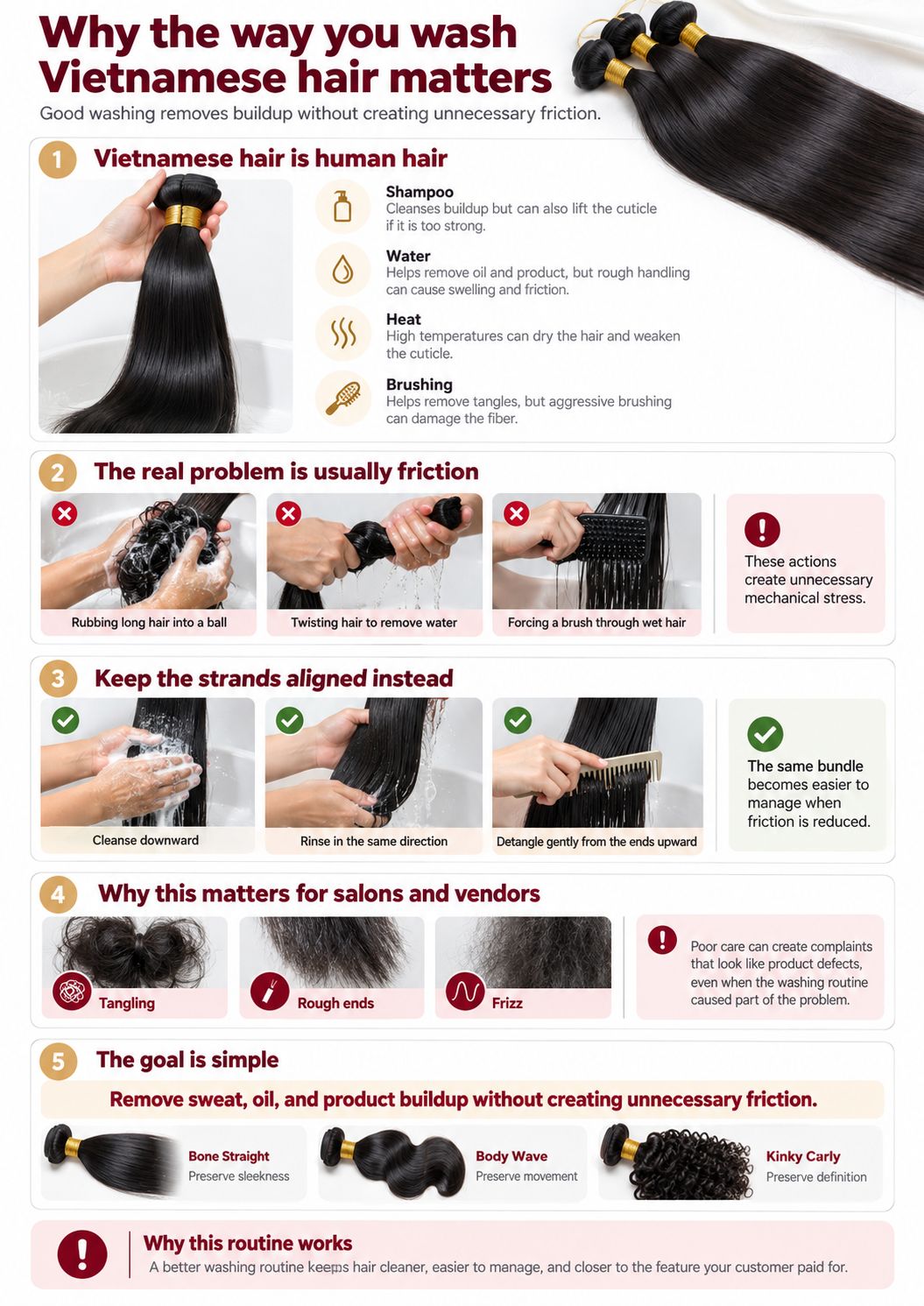
Raw Vietnamese hair is human hair, so shampoo, water, heat and brushing all affect the fiber. The biggest problem is usually not washing itself, but the friction and mechanical stress created when the hair is rubbed, twisted or brushed too aggressively.
If you rub long extensions into a ball, twist them to remove water and then force a brush through the wet hair, you create more friction than necessary. If you keep the strands aligned, cleanse downward and detangle gently, the same bundle is much easier to manage.
For you as a salon or vendor, this matters because poor care can create complaints that look like product defects. A customer may report tangling, rough ends or frizz when part of the problem actually comes from the way the hair was washed.
The goal is therefore simple: remove sweat, oil and product buildup without creating unnecessary friction. A good washing routine should leave the hair clean while helping preserve the feature your customer paid for, whether that is Bone Straight sleekness, Body Wave movement or Kinky Curly definition.
How often should you wash Vietnamese hair?
There is no universal schedule that works for every person. Someone wearing a wig twice per month does not need the same routine as a customer exercising regularly in a sew-in.
For frequently worn Vietnamese human-hair extensions or wigs, roughly every 7–14 days can be a practical starting point. You should then adjust according to sweat, scalp oil, styling products, environment and how often the hair is actually worn.
Wash earlier when the hair feels coated, smells different, has visible buildup or becomes harder to style. If a removable wig has barely been worn, there is no reason to wash it simply because seven days have passed.
More washing is not automatically better care. Repeated strong cleansing, rough handling and high heat can create unnecessary wear, especially on blonde or heavily processed hair.
Wash when the hair needs cleaning, not simply because the calendar tells you to.
Should you wash new Vietnamese hair before installation?
For salons and vendors, a pre-install wash can be very useful. A bundle may look glossy and smooth when it first arrives, but washing lets you see how the hair behaves after some of the first-day presentation is gone.
For a new 100g sample, inspect softness, shine, smell, ends and texture before washing. After washing, check tangling, shedding, texture return, manageability and the condition of the ends.
If you are only preparing hair for one client, one gentle wash may be enough. If you are evaluating a new supplier, use a 3-wash test instead so you can see whether the sample remains reasonably stable after repeated cleansing.
For example, a bundle that feels like 9/10 when new but drops to 5/10 after the third wash gives you useful information. Another bundle may start at 8/10 but remain around 7.5–8/10, which could make it the safer product for your customers.
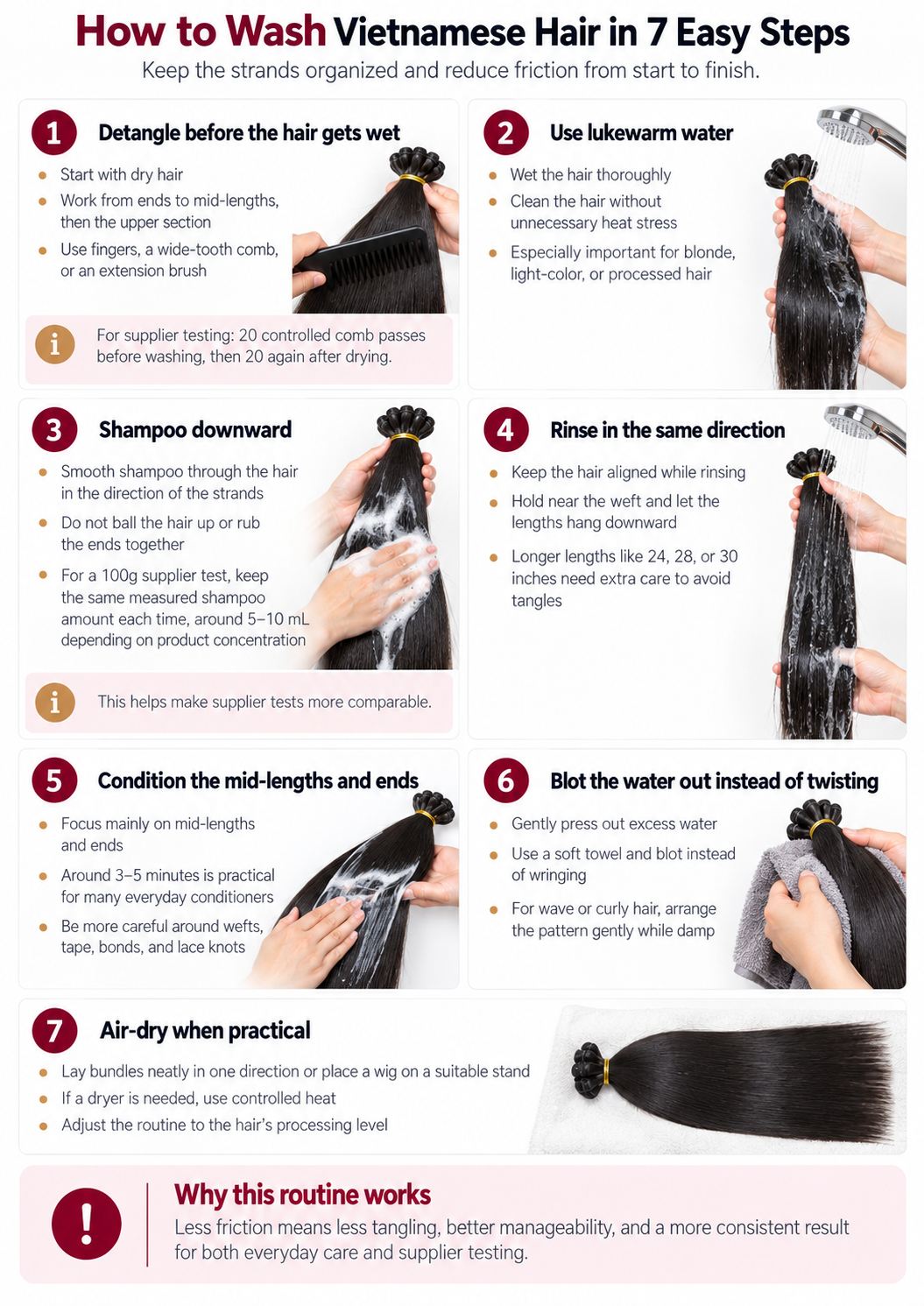
How to wash Vietnamese hair in 7 easy steps
You do not need a complicated routine. The most important principle is to keep the strands organized and reduce unnecessary friction from the beginning to the end of the wash.
Step 1: detangle before the hair gets wet
Start with dry hair and remove obvious tangles before washing. Hold the bundle or installation securely and work from the ends upward toward the mid-lengths and upper section.
Use your fingers, a wide-tooth comb or a suitable extension brush. Starting from the ends lets you release smaller tangles instead of pushing several knots together lower in the hair.
For supplier testing, make this measurable. Complete 20 controlled comb passes before washing and count obvious catches, then repeat another 20 passes after the sample has been washed and dried.
Step 2: use lukewarm water
Wet the hair thoroughly with comfortably lukewarm water. You do not need very hot water to clean Vietnamese human hair.
The reason is simple: your goal is to remove dirt and product buildup without adding unnecessary heat stress. This becomes more important with blonde, light-color and chemically textured hair because those fibers have already experienced more processing.
Step 3: shampoo downward
Apply a small amount of shampoo and smooth it through the hair in the same direction as the strands. Avoid balling the hair up, rubbing the ends together or scrubbing one section against another.
For a standardized 100g supplier test, you can use the same measured amount of shampoo each time, for example around 5–10 mL depending on the concentration of the product. This is not a universal dosage recommendation; it is simply a useful way to make two supplier tests more comparable.
The important part is your hand movement. You want to clean the hair without creating extra hair-to-hair friction.
Step 4: rinse in the same direction
Keep the hair aligned while you rinse. Let the water flow from the upper section through the lengths and down to the ends instead of repeatedly flipping the hair around.
For loose bundles, hold near the weft and let the lengths hang downward. For a wig, support the cap while rinsing instead of twisting the entire unit.
This becomes especially important with 24, 28 or 30-inch hair. The longer the fibers are, the more opportunity they have to cross, wrap and create tangles.
Step 5: condition the mid-lengths and ends
Apply conditioner mainly through the mid-lengths and ends. Follow the instructions on the product, although around 3–5 minutes is a practical routine for many everyday conditioners.
Conditioner is not only there to make the hair feel soft. It can improve combability and reduce friction, which means you need less force during detangling.
Be more careful around wefts, tape, bonds and lace knots. The hair fiber benefits from conditioning, but some constructions rely on stitching, adhesive or knots, so the care routine needs to protect both the hair and the construction.
Step 6: blot the water out instead of twisting
After rinsing, gently press out excess water. Place the hair inside a soft towel and blot instead of wringing or twisting it.
Wet hair plus force creates unnecessary mechanical stress. The towel only needs to remove excess water before drying; it does not need to squeeze out every drop.
For Wave or Curly Hair, gently arrange the pattern while the hair is still damp. Avoid pulling the texture completely straight if you want to see how it naturally returns after drying.
Step 7: air-dry when practical
Air-drying is a simple way to reduce unnecessary heat during normal care. Lay bundles in an organized direction or place a wig on a suitable stand so the strands do not dry in a tangled pile.
If you need a dryer for salon workflow, use controlled heat instead of keeping the hair under maximum heat for a long time. Natural Black hair in good condition may tolerate occasional professional heat styling better than heavily bleached hair, so adjust the routine according to processing level.
How to wash straight Vietnamese hair
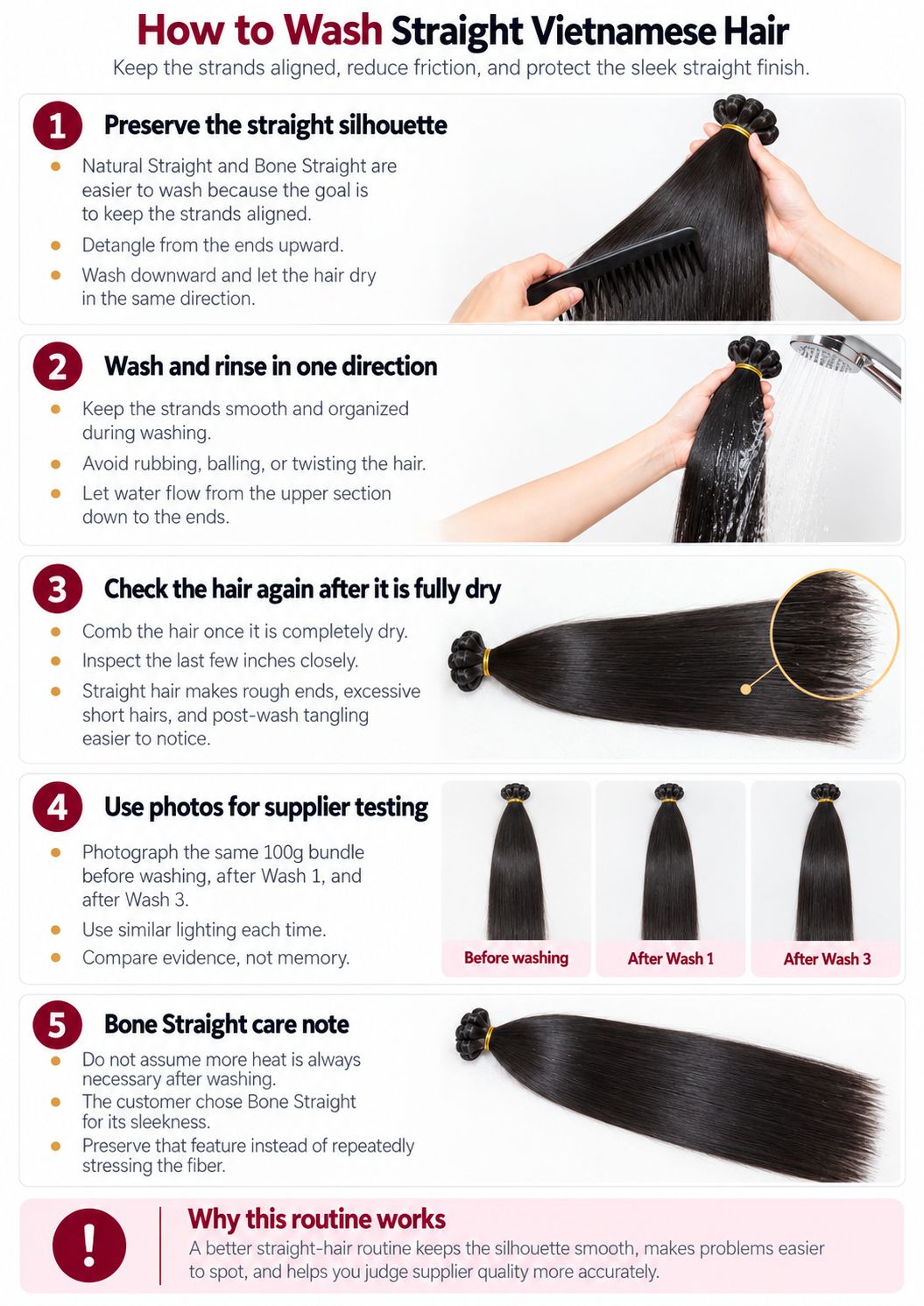
Natural Straight and Bone Straight are relatively easy to wash because the goal is to preserve an aligned straight silhouette. Detangle from the ends upward, wash downward and let the hair dry in the same direction.
Once the hair is completely dry, comb it again and inspect the last few inches. Straight Hair makes rough ends, excessive short hairs and post-wash tangling easier to notice than some fuller textures.
If you are testing a supplier, photograph the same 100g bundle before washing, after Wash 1 and after Wash 3. Use similar lighting each time so you are comparing evidence rather than memory.
For Bone Straight Hair, avoid assuming more heat is always necessary after washing. The customer chose the product for its sleekness, so the care routine should preserve that feature instead of repeatedly stressing the fiber.
How to wash Vietnamese body wave and deep wave
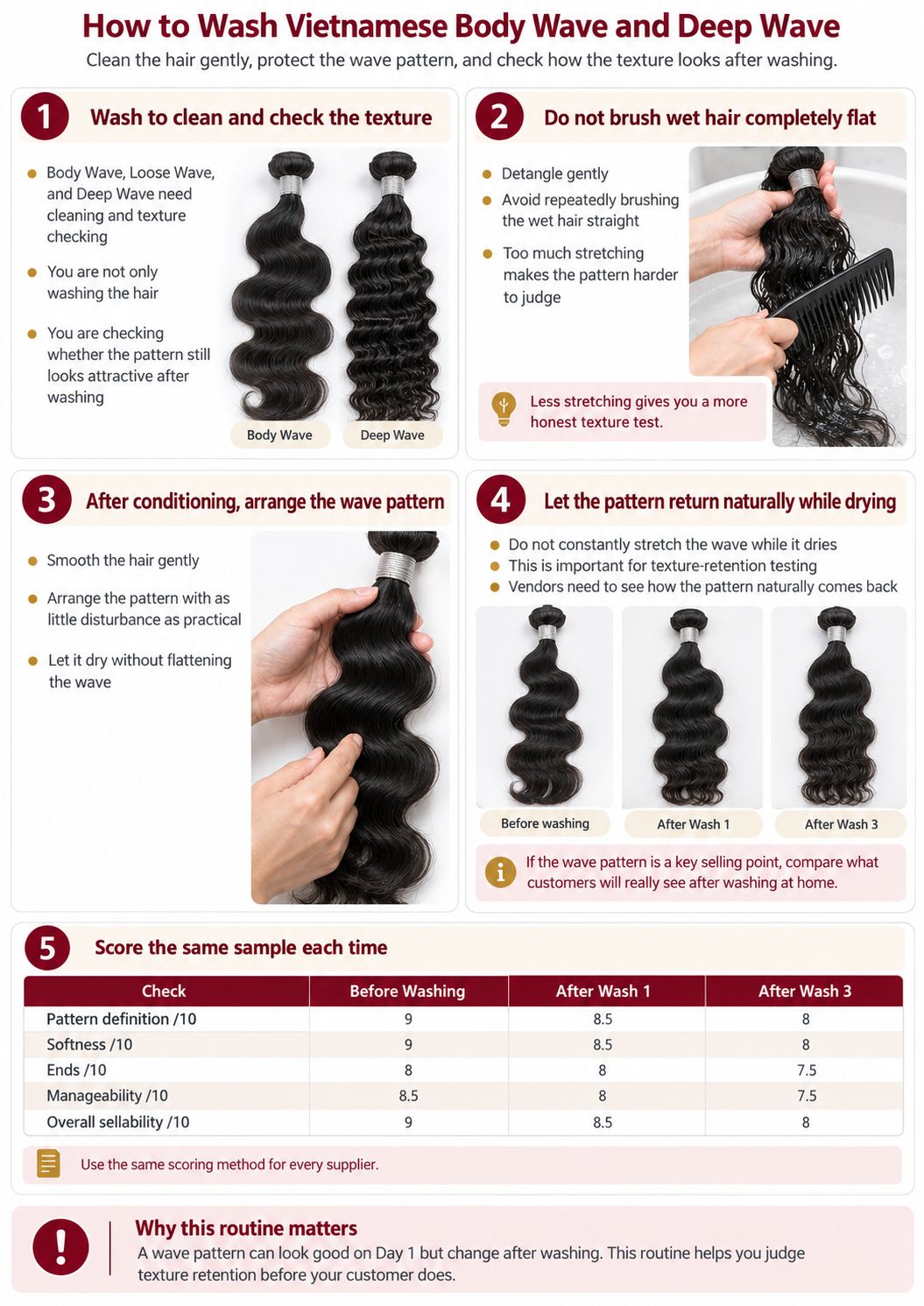
With Body Wave, Loose Wave and Deep Wave, you are not only cleaning the hair. You are also checking whether the texture still looks attractive after washing.
Avoid repeatedly brushing the wet hair completely flat. After conditioning, gently arrange the wave pattern and let it dry with as little disturbance as practical.
If you constantly stretch a wave while it dries, it becomes harder to judge how the pattern naturally returns. For vendors, this makes washing an important texture-retention test.
You can score the same Body Wave sample before washing, after Wash 1 and after Wash 3. If the pattern is one of the main reasons customers buy the product, you need to know what they will see after they wash it at home.
How to wash Vietnamese curly and kinky hair
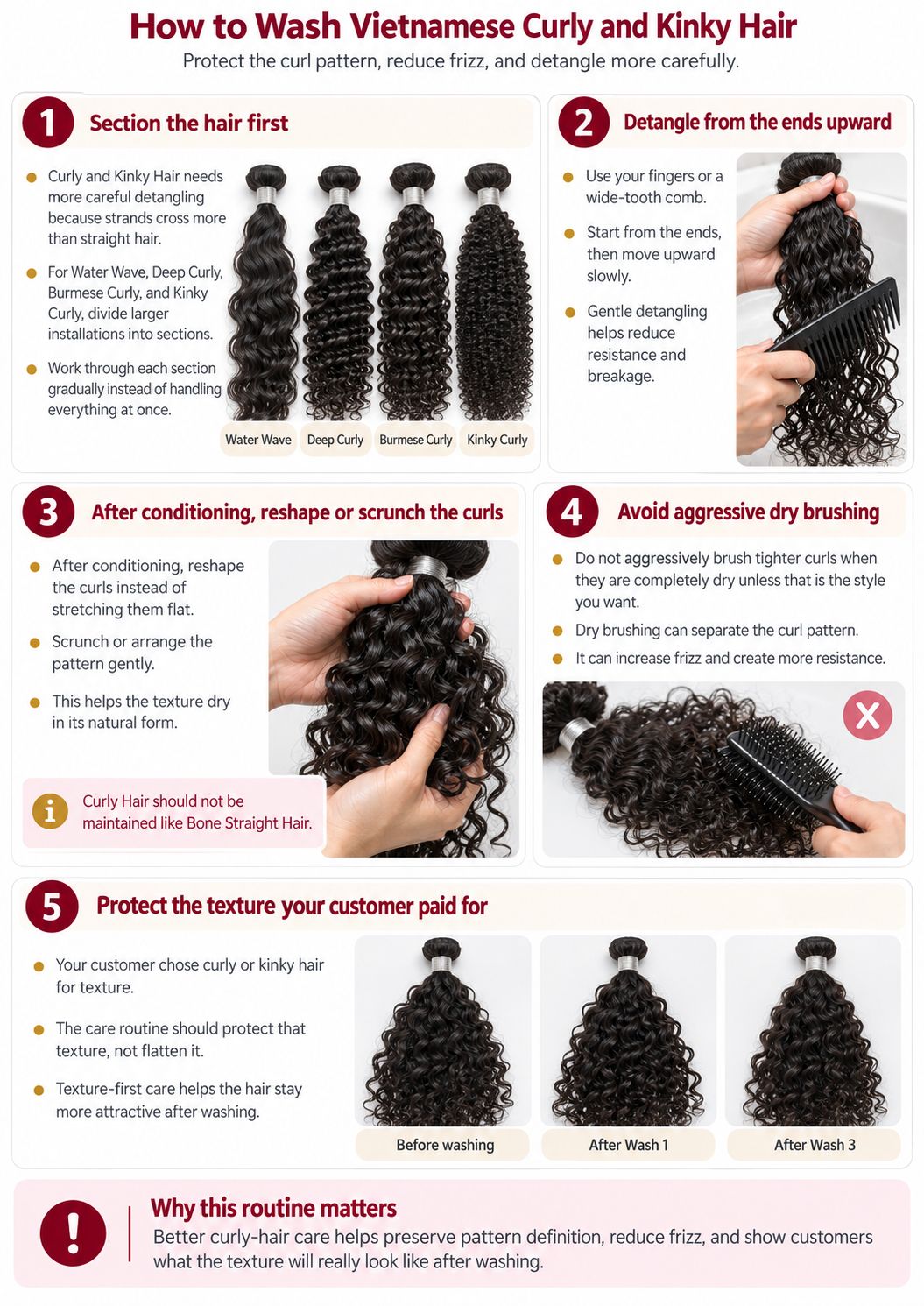
Curly and Kinky Hair needs more careful detangling because the strands naturally cross and interact more than straight fibers. For Water Wave, Deep Curly, Burmese Curly and Kinky Curly, divide larger installations into sections and work through them gradually.
Use your fingers or a wide-tooth comb and start from the ends. After conditioning, reshape or scrunch the curls rather than stretching them flat.
Avoid aggressively brushing tighter curls when they are completely dry unless that is specifically the style you want. Dry brushing can separate the curl pattern, increase frizz and create more resistance.
The reason is straightforward: Curly Hair should not be maintained like Bone Straight Hair. Your customer paid for texture, so the care routine should protect the texture.
Blonde Vietnamese hair needs a gentler routine
Blonde Hair deserves more conservative care because bleaching changes the fiber. The hair may become more fragile, which means rough washing, frequent high heat and aggressive detangling can create problems more quickly.
The combination of blonde plus Wave or Curly texture requires even more attention. You are maintaining both chemically processed color and a finished texture at the same time.
Use gentle cleansing, regular conditioning, careful detangling and lower friction. Reduce unnecessary heat and give the hair more moisture support when it starts feeling dry.
Your salon should explain this before the sale. A customer choosing a highly processed blonde curl is also choosing a product that usually requires more maintenance than Natural Black Straight Hair.
Do you need sulfate-free shampoo?
You do not need to turn “sulfate-free” into an absolute rule. What matters more is whether the shampoo cleans effectively without leaving the hair excessively dry, rough or difficult to detangle.
For everyday care, a mild moisturizing shampoo is a sensible starting point. A strong clarifying shampoo can be useful when there is heavy buildup, but that does not mean you should use it at every wash.
If you are comparing supplier samples, use the same shampoo for every bundle. Otherwise, Sample A may look better simply because it received a gentler product than Sample B.
Should you deep condition Vietnamese hair?
Deep conditioning depends on the condition of the hair. Natural Black Straight Hair that remains soft and easy to detangle may not need an intensive treatment after every wash.
Blonde, curly and frequently heat-styled hair may benefit from more conditioning support. Start with normal conditioning first, then increase moisture support only when the hair actually needs it.
Too much product can create its own problem. Excess buildup may lead you to cleanse more aggressively, which can create a cycle of too much product → buildup → stronger washing → dryness → more product.
Use enough care to solve the problem in front of you. More product is not automatically better care.
7 washing mistakes that can make Vietnamese hair feel worse
1. Washing hair that is already tangled
Water does not remove knots. Detangle the hair before it becomes wet so you are not trying to separate several tangles at once during washing.
2. Scrubbing the hair against itself
Your goal is cleansing, not maximum friction. Smooth shampoo through the lengths instead of rubbing sections of hair together.
3. Using very hot water
Hotter water does not automatically mean cleaner hair. Comfortable lukewarm water is enough for routine washing and avoids adding unnecessary heat stress.
4. Twisting the hair after rinsing
Do not wring long extensions like fabric. Gently press out excess water and blot the hair with a soft towel instead.
5. Aggressively brushing wet hair
Wet and chemically processed hair deserves careful handling. Detangle gradually instead of forcing a brush through strong resistance.
6. Treating blonde hair like natural black hair
Bleached hair has already experienced more chemical processing. It usually benefits from gentler washing, more careful conditioning and more conservative heat use.
7. Treating kinky curly like bone straight
Flattening, dry-brushing and repeatedly straightening a curl pattern works against the feature your customer bought. Maintenance should protect the texture rather than constantly trying to remove it.
Washing Vietnamese hair is also a supplier quality test
If you sell hair, washing is not only maintenance. It is also one of the simplest ways to test a new supplier before you move from one sample to a larger wholesale order.
A practical internal test uses one bundle of approximately 100g, three washes, the same shampoo each time, 20 comb passes before washing, 20 passes afterward and 100 controlled brush strokes. You can also score the ends and texture before Wash 1 and again after Wash 3.
| Test | Protocol |
|---|---|
| Sample | 1 bundle, approx. 100g |
| Washes | 3 |
| Shampoo | Same product every wash |
| Dry comb test | 20 passes |
| Post-wash comb test | 20 passes |
| Shedding test | 100 brush strokes |
| Texture check | Before, Wash 1 and Wash 3 |
| Ends | Score /10 |
| Overall sellability | Score /10 |
For example, Supplier A might release 8 strands after your 100-stroke test while Supplier B releases 30. Supplier A might also give you 3 catches across 40 comb passes while Supplier B gives you 12.
Those numbers are not universal grading standards. They give you a repeatable way to compare two products under the same conditions, which is much more useful than saying one sample simply “feels premium.”
What if Vietnamese hair tangles after washing?
Do not immediately decide that the hair is defective. First check whether it was detangled before washing, rubbed together, twisted, cleansed too aggressively or brushed while wet.
Also check whether conditioner was used and whether Curly Hair was treated like Straight Hair. Previous bleaching or coloring can also affect how easily the hair detangles.
If the customer followed a reasonable routine and the hair still becomes unusually difficult after one or two gentle washes, test another bundle from the same batch. If the same problem appears again, you have stronger evidence that the batch or product itself needs investigation.
The goal is not to blame the customer or factory immediately. Reproduce the problem under controlled conditions first.
What if Vietnamese hair sheds after washing?
A few loose hairs do not automatically prove poor quality. Check whether the strands were already loose inside the bundle or are actually releasing from the weft.
You can make this measurable by using the same 100-brush-stroke test before and after washing. For example, 6 strands before washing and 9 after Wash 3 is a very different pattern from 7 before and 42 after Wash 3.
Again, those numbers are not universal pass/fail limits. They help you identify a major change that deserves further investigation.
Give your customers a washing routine they can actually follow
Do not simply tell your customer to “take good care of the hair.” Give her a routine she can remember and repeat.
- Detangle from the ends upward before washing.
- Use lukewarm water.
- Shampoo gently in a downward direction.
- Condition the mid-lengths and ends.
- Rinse without twisting or rubbing.
- Blot excess water with a soft towel.
- Air-dry when practical or use controlled heat.
- For curls and waves, reshape the pattern instead of aggressively dry-brushing it.
Clear aftercare helps your customer get closer to the result you intended her to have. It can also reduce avoidable complaints and make genuine product problems easier for you to diagnose.
How washing changes with Vietnamese hair type
You should not give every customer exactly the same advice. The care routine should protect the main reason she chose that product.
| Hair Type | Washing Priority |
|---|---|
| Natural Straight | Keep strands aligned and reduce friction |
| Bone Straight | Preserve sleekness and avoid unnecessary heat |
| Body / Loose Wave | Clean gently and let the wave return |
| Deep Wave | Protect stronger wave definition |
| Water Wave | Maintain moisture and reshape the pattern |
| Kinky Straight | Preserve body instead of repeatedly flattening it |
| Deep / Kinky Curly | Section, condition and detangle gently |
| Blonde Hair | Use gentler cleansing and more moisture support |
A Bone Straight buyer is paying for sleekness, while a Kinky Curly buyer is paying for curls. Your care advice should protect the feature she actually purchased.
Faq about Vietnamese hair washing
Can You Wash Vietnamese Hair?
Yes. Vietnamese human hair should be washed when sweat, oils and styling products begin to build up. The important issue is how you wash it, so keep friction low and choose care appropriate to the texture and processing level.
How Often Should I Wash Vietnamese Hair?
For frequently worn extensions or wigs, roughly every 7–14 days can be a useful starting point. It is not a fixed rule, so wash sooner when there is obvious buildup and less often when the hair has barely been worn.
Should I Wash Vietnamese Hair Before Installing It?
A pre-install wash can be useful, especially when you are working with a new supplier. It lets you check texture, shedding, ends and manageability before the product reaches the customer.
For supplier evaluation, use a three-wash test rather than judging the hair only from the unwashed bundle.
What Shampoo Should I Use?
Start with a mild shampoo that cleans without leaving the hair excessively dry or difficult to detangle. For blonde or chemically treated hair, use a product intended for processed hair.
When comparing suppliers, use the same shampoo and washing routine for every sample.
Can I Wash Vietnamese Curly Hair?
Yes. Detangle it gently, use conditioner and work in smaller sections when the installation is large.
After washing, reshape the curls instead of aggressively brushing them flat. The goal is to clean the hair while preserving the texture.
Can I Wash Vietnamese Blonde Hair?
Yes, but bleached hair should be handled more conservatively. Use gentle cleansing, conditioning, careful detangling and avoid unnecessary repeated high heat.
Why Does My Vietnamese Hair Tangle After Washing?
Tangling can come from rough washing, existing knots, strong cleansing, aggressive wet brushing or previous chemical damage. The hair itself can also contribute.
Reproduce the wash under controlled conditions and compare another bundle before deciding where the problem comes from.
How Do I Test Vietnamese Hair After Washing?
Start with approximately 100g and wash it three times. Complete 20 comb passes before washing and another 20 after drying, then use 100 controlled brush strokes and record what changes.
Photograph the texture before Wash 1 and after Wash 3. If your customers normally color the hair, test around 10g separately using the same salon process.
Wash the hair the way your customer will actually wear it
Vietnamese hair can look beautiful when it first arrives, but Day 1 is not the only day that matters. Your customer will eventually wash, comb, style and possibly color the hair, so your care routine should prepare the product for real use rather than only preserve the factory finish.
If you are wearing the hair yourself, focus on low friction, gentle detangling and care that matches the texture. If you are a salon or vendor evaluating a supplier, use washing as a controlled test before committing to a larger quantity.
Start with the exact texture and length you plan to sell. Wash approximately 100g three times, compare the hair before and after, run 40 comb passes and record shedding with a controlled brush test.
The first touch may attract you to Vietnamese hair. The first few washes tell you much more about how it will perform for your customer.
Contact support with Ravi hair: 0818293277
Ask Ravi Hair
Get advice for your next order
Factory support
Make the guide practical
Ask for current stock videos, sample guidance, packing proof, and export support before you approve an order.
- Real product video before shipping
- Sample support before bulk buying
- Clear consultation for your market