Ravi Hair Journal
Is Vietnamese hair good quality? 5 real tests before you buy
Is Vietnamese hair good quality? Yes, it can be an excellent choice for salons, wig makers and hair vendors. Vietnamese hair comes from a region where Asian hair is generally known for relatively large strand diameter, dark pigmentation and strong mechanical properties.
Vietnam also has a warm, humid climate, long-established hair-collection networks and specialized hair-processing villages where hair is sorted and prepared by condition, length and color.
But origin alone is never enough. Before you buy 1kg, 10 bundles or a larger wholesale order, start with a sample and make the hair prove its quality in your own hands.
Is Vietnamese hair good quality?
If you are considering Vietnamese hair for your salon or hair business, there are good reasons to put it on your shortlist.
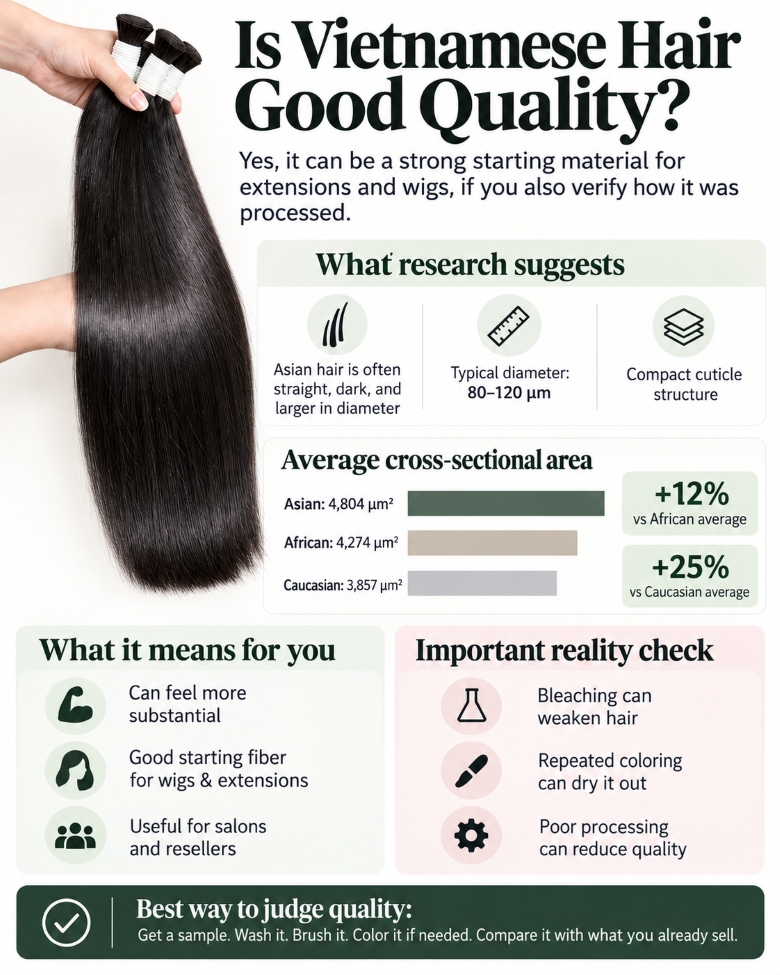
Scientific research on Asian hair gives you one useful starting point. A review describes Asian hair as generally straight, darkly pigmented and relatively large in diameter. Another dermatology review reports typical Asian hair diameters of approximately 80–120 µm, while also noting a more compact cuticle structure with a greater number of cuticle layers.
A separate review summarized average cross-sectional areas of approximately:
| Hair group | Average cross-sectional area |
| Asian hair | 4,804 ± 159 µm² |
| African hair | 4,274 ± 215 µm² |
| Caucasian hair | 3,857 ± 132 µm² |
In that dataset, the Asian average was around 12% larger than the African average and about 25% larger than the Caucasian average.
What does that mean for you?
It helps explain why many Asian hair fibers can feel substantial and why Vietnamese hair can make a strong starting material for extensions and wigs.
But it does not mean:
“Every Vietnamese bundle is 25% better.”
A strong original fiber can still become dry, weak or difficult to manage if it is heavily bleached, repeatedly colored, poorly sorted or aggressively processed.
So when you buy hair, you need to evaluate two things:the original source hair and what happened to it before it reached you.
That is why the best answer to “Is Vietnamese hair good?” is not just a country claim.
Get a sample. Wash it. Brush it. Color it if necessary. Compare it with what you already sell.
Why Vietnam can be a strong hair source
Vietnam has several characteristics that make it interesting for human-hair sourcing.
One is its environment.
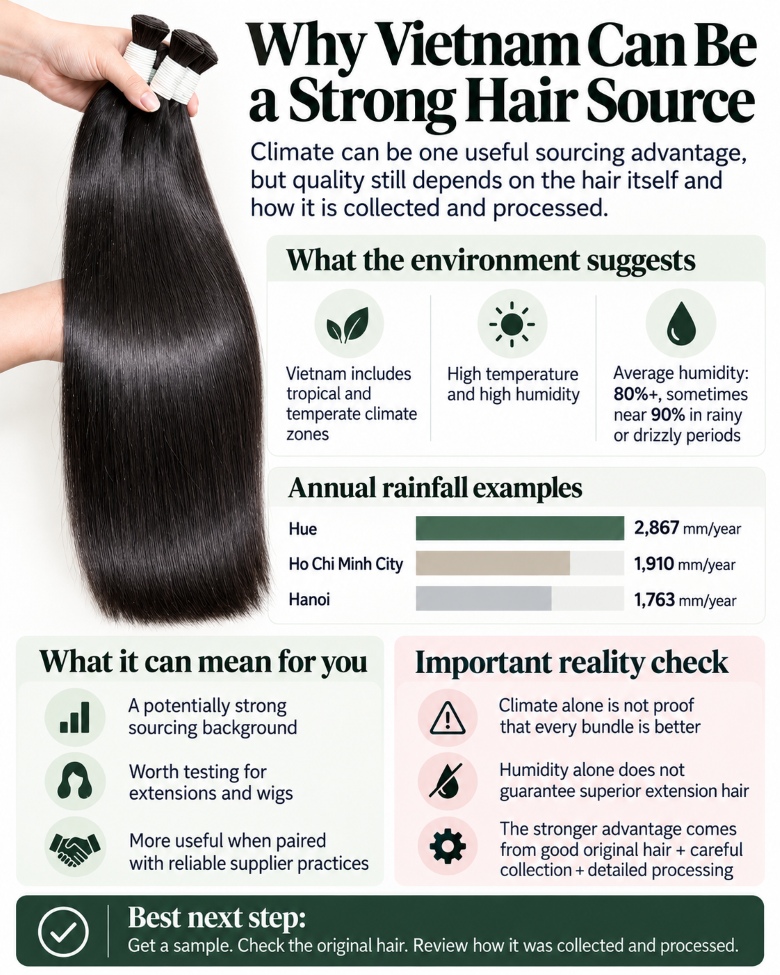
Vietnam has tropical and temperate climate zones characterized by high temperatures and high humidity, particularly during the rainy season. Average air humidity is reported at over 80%, sometimes reaching around 90% in rainy or drizzly periods.
Annual rainfall examples include approximately:
Hanoi: 1,763 mm/year
Hue: 2,867 mm/year
Ho Chi Minh City: 1,910 mm/year
This warm, humid environment is part of the background in which Vietnamese donors live.
However, climate should be treated as a sourcing advantage to investigate, not scientific proof that every Vietnamese strand is stronger.
There is not good evidence showing that Vietnam’s humidity alone makes commercial extension hair superior to hair from every other country.
For you, the stronger advantage comes when that environment is combined with good original hair, careful collection and detailed processing.
Vietnamese hair has a long collection and sorting tradition
Vietnam does not only have hair factories.
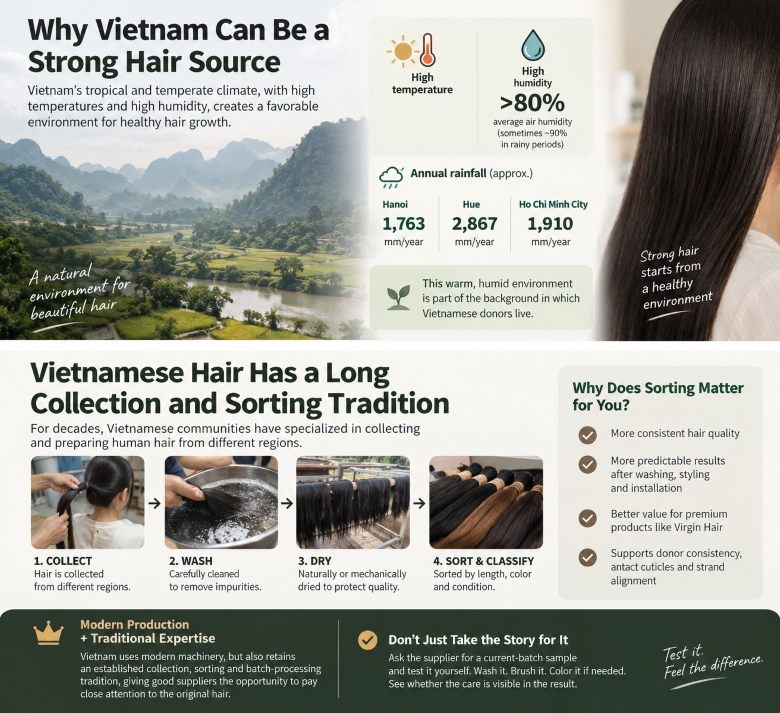
It also has established communities that have specialized in collecting and preparing human hair for decades.
In Vietnamese hair-trading villages, hair may be collected from different regions and then washed, dried and classified by characteristics such as length, color and condition.
Longer, thicker and less chemically treated hair can command a higher value than hair that has already been dyed, straightened or chemically processed.
That detail matters.
Why should you care?
A 100g bundle is not one uniform piece of material. It contains a large number of individual strands.
Before you receive it, somebody has to decide:
Which hair goes together?
Which strands are too short?
Which hair has already been chemically treated?
Which colors match?
Which lengths belong in the same product?
Better sorting gives the manufacturer a better starting point.
For you, that can mean more predictable hair after washing, styling and installation.
Vietnamese hair can compete differently
Vietnam does use machinery and modern production equipment. It would be misleading to describe the entire industry as handmade.
The advantage is that Vietnam also retains an established collection, sorting and batch-processing tradition, giving good suppliers the opportunity to pay close attention to the original hair before it becomes a finished extension.
That is particularly valuable if you are buying premium Virgin Hair and care about donor consistency, intact cuticles and strand alignment.
But do not simply believe the story.
Ask the supplier for a current-batch sample and test whether that care is visible in the result.
Vietnamese hair vs chinese hair
China has a very different position in the global hair industry. It operates at enormous scale.
In 2023, China reported about 12.8 million kg of imports under HS 670300, a trade category covering dressed human hair and related hair materials, with a reported import value of about $1.1 billion.
China also exported approximately 2.25 million kg under the same category, worth about $210 million.
That scale gives Chinese manufacturers real advantages.
They can process large volumes and offer huge ranges of colors, textures, wigs and extension constructions.
But it also illustrates why China functions as a major international processing hub, rather than every Chinese-made product necessarily starting from locally collected Chinese donor hair.
For example, reported shipments to China in this category included approximately:
India: 4.88 million kg
Myanmar: 4.51 million kg
Why should you care?
If origin matters to your brand, you need to understand what is inside the finished bundle.
Vietnamese suppliers can compete differently when they use a shorter sourcing chain, more identifiable batches and closer sorting before manufacturing.
That does not mean:
Vietnamese = good and Chinese = bad.
The useful distinction for you is:
large-scale processing versus the opportunity for more closely controlled sourcing and batch-level preparation.
So instead of arguing about which country is better, take:
1 × 20-inch Vietnamese sample, approx. 100g
1 × 20-inch Chinese sample, approx. 100g
Then test them exactly the same way.
The sample that performs better for your customers should earn your order.
5 real tests to check Vietnamese hair quality
You do not need a laboratory.
You need repeatable conditions.
If you are comparing two suppliers, use the same length, similar weight, same color and comparable quality tier.
Then make both samples go through exactly the same test.
Test 1: wash the hair 3 times
Do not judge hair only when it comes out of the package.
A fresh bundle may feel extremely smooth because of conditioning products and finishing treatments.
Your customer will eventually wash it.
So you should too.
Wash the sample 3 times, using the same shampoo, water temperature and drying method each time.
| Check | Before Wash | Wash 1 | Wash 2 | Wash 3 |
| Softness /10 | — | — | — | — |
| Tangling resistance /10 | — | — | — | — |
| Ends /10 | — | — | — | — |
| Texture retention /10 | — | — | — | — |
Imagine this result:
Supplier A: 9/10 before washing → 5/10 after Wash 3.
Supplier B: 8/10 before washing → 7.5/10 after Wash 3.
Supplier A looked better on Day 1.
Supplier B may be the better hair to sell.
Why this test matters to you
Your customer does not buy hair to wear it for one product photo.
She will wash it.
If quality collapses after a few washes, you may be dealing with complaints instead of repeat orders.
So before placing a larger order, buy the sample and wash it yourself.
Test 2: run 40 comb passes
“Minimal tangling” is difficult to verify.
40 comb passes are easier.
Use the same comb and perform:
20 passes dry
20 passes after washing and drying
Count clear catches.
| Sample | Dry catches /20 | After-wash /20 | Total |
|---|---|---|---|
| Sample A | 1 | 2 | 3/40 |
| Sample B | 2 | 7 | 9/40 |
Now you have a reason behind your opinion.
Sample A did not simply “feel better.”
It caught 3 times, compared with 9 times for Sample B.
Why does this matter?
The hair surface and cuticle condition influence friction and manageability.
Asian hair research describes its cuticle as comparatively thick and compact, but commercial processing can change the condition you actually receive.
That is why you need to test the finished bundle instead of relying only on the characteristics of untreated Asian hair.
Test 3: brush it 100 times and count shedding
You will frequently see:
“No shedding.”
That is not a useful purchasing standard.
Some loose strands may occur with human-hair extensions.
Instead, compare samples under the same conditions.
Detangle the hair, use the same brush and complete 100 normal brush strokes.
Collect what comes out.
Imagine:
Sample A: 8 loose strands
Sample B: 31 loose strands
That does not mean 8 is an international “premium hair standard.”
No universal consumer threshold makes that true.
But if you perform exactly the same test on both products, the difference is worth investigating.
Repeat it after the third wash.
For weft hair, inspect the stitching too.
If shedding increases significantly after washing, you want to discover that before your customers do.
Before buying 1kg
Run the 100-stroke test.
One standard 100g sample can protect you from making a much larger inventory mistake.
Test 4: check 20 individual strands
The bundle may look good overall while still containing weaker fibers.
Take approximately 20 loose strands from several parts of the bundle.
Use:
10 dry strands
10 wet strands
Compare how consistently they handle gentle tension.
| Sample | Dry breaks /10 | Wet breaks /10 |
| A | 1 | 1 |
| B | 2 | 3 |
| C | 5 | 5 |
This is not a laboratory tensile-strength test.
You are simply asking:
Does one sample repeatedly show more weak strands than another under the same handling?
Testing 20 strands is more useful than pulling one strand on camera and declaring that the entire batch is strong.
Take strands from the top, middle and ends.
You want to understand the hair your customer actually receives.
Test 5: process a 10g swatch
This may be the most important test for salons.
If your customers keep Natural Black, test the hair under the washing, heat and styling conditions they normally use.
If your customers buy Virgin Hair because they want blonde or other demanding colors, take approximately 10g from the sample and perform the professional color process you actually use.
| Test | Before | After Processing | After 3 Washes |
|---|---|---|---|
| Softness /10 | |||
| Tangling resistance /10 | |||
| Ends /10 | |||
| Breakage /10 | |||
| Overall sellability /10 |
Why test after coloring?
The starting condition is only half of the story.
Your customer cares about the hair after you create her finished style.
If Supplier A looks excellent in Natural Black but becomes brittle after the color process you routinely sell, that hair may not be right for that part of your business.
Do not ask only:
“Can it bleach?”
Ask:
“How does it behave after bleaching and three washes?”
Then answer the question yourself with the sample.
Vietnamese hair vs indian hair
If you search Vietnamese hair vs Indian hair, you will find strong opinions on both sides.
Be careful.
There is not enough reliable evidence to say every commercial Vietnamese bundle is exactly X% stronger than every Indian bundle.
Indian hair itself can be excellent human hair.
The better comparison is between equivalent products.
Suppose you are considering a new supplier.
20″ Vietnamese Hair, approximately 100g
20″ Indian Hair, approximately 100g
Keep the color, texture and quality tier as similar as possible.
Then perform:
3 washes → 40 comb passes → 100 brush strokes → 20-strand test → 10g color test if relevant.
Imagine the result:
| Test | Vietnamese | Indian |
| Comb catches /40 | 3 | 5 |
| Shed strands /100 | 9 | 12 |
| Weak strands /20 | 2 | 3 |
| After-process score | 8/10 | 8/10 |
That result would tell you the products are relatively close under your own conditions.
Now price, customer preference and margin become important.
But if the result is:
3 catches vs 15
or
8 shed strands vs 35
you have a clearer reason to investigate the difference.
What should you do?
Do not buy Vietnamese because somebody tells you Vietnam is better.
Do not buy Indian because somebody tells you Indian hair is more flexible.
Order both samples and make them compete on your table.
Vietnamese hair vs brazilian hair
When comparing Vietnamese hair vs Brazilian hair, first make sure you know what the supplier means by “Brazilian.”
The safest buying approach is simple.
Ask the supplier to give you five clear pieces of information:
| Question | Answer |
| Actual source of the donor hair? | Your answer |
| Remy or Virgin? | Your answer |
| One donor or mixed donor? | Your answer |
| Previous chemical processing? | Your answer |
| Can you test the same quality in a sample? | Your answer |
You can give the supplier 1 point for each clear answer.
That gives you a simple Transparency Score /5.
A 5/5 score does not prove high quality.
It simply means you understand more about what you are buying.
Then use your physical sample tests to judge performance.
Vietnamese hair vs chinese hair
Chinese manufacturing is one area where numbers help explain the difference.
In 2023, China reported about 12.8 million kg of imports under HS 670300 and around 2.25 million kg of exports in that category.
Vietnam’s industry is much smaller.
That can give Vietnamese suppliers a different competitive position: closer sourcing, more identifiable batches and detailed sorting can matter more than enormous production scale.
Vietnamese hair-trading villages have documented practices of collecting hair, washing it, drying it and sorting it by length, color and condition before sale or further processing.
For you, that can be useful when you want to know exactly what kind of original hair you are buying.
But small scale alone does not make a supplier better.
And industrial production alone does not make Chinese hair worse.
Your test decides
Compare:
20″ Vietnamese, approx. 100g
20″ Chinese, approx. 100g
Then run the same protocol.
If Vietnamese produces 3 catches /40 and Chinese produces 10 /40, that tells you something.
If the Chinese sample produces 2 /40, that tells you something too.
Buy according to the result, not the flag on the package.
Vietnamese hair vs cambodian hair
Vietnamese and Cambodian hair are often positioned differently in commercial hair catalogs.
Vietnamese hair is commonly selected when buyers want a naturally dark, straighter starting base.
Cambodian hair is frequently sold to customers looking for more visible natural texture.
But there is not strong enough independent evidence to responsibly state:
“Cambodian hair is exactly 20% coarser than Vietnamese hair.”
So do not base your stock order on that kind of claim.
Instead, take two equivalent samples and photograph them:
before washing
after Wash 1
after Wash 3
Then compare how the natural texture returns.
If your customers mainly buy Straight, Bone Straight or sleek wigs, the Vietnamese sample may fit your collection better.
If your buyers prefer a more visibly textured result, a Cambodian sample may work better.
Why?
Because “good quality” and “right texture” are different questions.
Your customers decide which appearance sells.
Get both samples, wash them and let your own market decide.
Peruvian hair vs Vietnamese hair
Use the same logic when comparing Peruvian hair vs Vietnamese hair.
Do not compare only product names.
Compare:
20 inches to 20 inches
100g to approximately 100g
Virgin to Virgin
or
Remy to Remy
Then use:
3 washes
40 comb passes
100 brush strokes
and your real salon process.
That removes much of the guesswork.
If the Vietnamese sample costs $5 more but performs much better after your color test, the premium may be worth paying.
If both perform similarly and the alternative has a better landed cost, that matters too.
Your goal is not to prove that Vietnam beats every country.
Your goal is to find the hair that makes sense for your customer and your margin.
Remy vs virgin Vietnamese hair: do you need to pay more?
Quality level matters just as much as origin.
Remy and Virgin Hair solve different needs.
Remy Vietnamese Hair gives you real human hair at a more accessible price and can be a practical choice for Natural Black and moderate-color customers.
Virgin Hair gives you a premium one-donor specification, intact cuticles, consistent alignment and greater customization potential.
The difference becomes easier to understand with actual pricing.
At 20 inches:
Double Drawn Remy Natural Straight: about $44.50 per 100g
Virgin Straight/Wavy: about $70.50 per 100g
Difference:
$26 per bundle.
For three bundles:
Remy: $133.50
Virgin: $211.50
Your customer is paying approximately $78 more.
Why should she spend the extra $78?
Not because Virgin has a more expensive name.
If she wants Natural Black and does not plan demanding color work, Remy may already give her what she needs.
If she specifically needs premium one-donor sourcing and stronger customization potential, the additional investment has a clearer purpose.
Before stocking either one in volume, order a sample from the exact quality tier and test it.
One test most hair vendors forget: order the same hair twice
Passing the first sample is not enough.
Your business needs consistency.
Imagine your first 20-inch sample produces:
2 catches /20 passes.
You reorder the same product and the second batch produces:
3 catches /20.
That looks relatively close.
But if the second order suddenly produces:
12 catches /20
your business has a consistency problem.
Your customer does not care that the sample you tested three months ago was excellent.
She cares about the hair she receives today.
So after a supplier passes your first test, place another trial order from a later batch.
Run a shorter check:
1 wash
20 comb passes
50 brush strokes
If performance stays close, you have stronger evidence that the supplier can reproduce the product.
Your Vietnamese hair sample test sheet
| Test | Your Target |
| Sample size | Approx. 100g |
| Wash test | 3 washes |
| Detangling test | 40 comb passes |
| Shedding test | 100 brush strokes |
| Strand test | 20 strands |
| Color test | Approx. 10g swatch if relevant |
| Reorder test | 1 wash + 20 comb passes + 50 strokes |
| Comparison | Same length, color and quality tier |
Do this for your Vietnamese sample and your current supplier.
Write down the result.
Now you can make a buying decision using evidence you produced yourself.
Faq about Vietnamese hair quality
Is Vietnamese Hair Really Good Quality?
It can be.
Broader scientific research describes Asian hair as having relatively large strand diameter, dark pigmentation, compact cuticle structure and strong mechanical characteristics.
Typical Asian hair diameter has been reported around 80–120 µm.
However, those properties describe populations of natural hair, not the condition of every commercial extension.
The supplier’s collection, sorting and processing still matter.
That is why you should order a sample before buying wholesale.
Does Vietnam’s Climate Make Vietnamese Hair Better?
Vietnam has a warm, humid climate. Average air humidity is reported above 80%, sometimes reaching around 90% during rainy and drizzly weather.
That is part of Vietnam’s sourcing environment, but climate alone does not scientifically prove that a commercial bundle is superior.
For you, the more meaningful advantage is the combination of original hair characteristics, domestic collection networks, careful sorting and how the supplier processes the hair afterward.
Test the finished sample instead of buying solely because of the climate story.
Is Vietnamese Hair Processed by Hand?
Vietnam has both manual processing traditions and modern machinery.
Established Vietnamese hair-trading communities document activities such as collection, washing, drying and sorting by characteristics including length, color and condition.
Modern businesses also use machinery to improve preparation and production.
The advantage is therefore not “100% handmade.”
It is the opportunity for careful batch-level inspection combined with modern processing.
Ask your supplier to show the production process and send a sample.
Is Vietnamese Hair Better Than Indian Hair?
Not automatically. For your business, compare matched 20-inch, approximately 100g samples and run the same 3-wash, 40-comb-pass and 100-brush-stroke test.
Your own results are more useful than a universal country ranking.
Is Vietnamese Hair Better Than Chinese Hair?
The two industries operate differently.
China is a huge international processing hub.
Vietnam has a smaller industry with established local collection and sorting networks.
That can make Vietnamese hair attractive when you value sourcing transparency and closer batch control.
But the actual sample still needs to prove itself.
Can Vietnamese Hair Be Bleached?
Premium Virgin Vietnamese Hair is the more relevant option when your customers need demanding color customization.
But no human hair is immune to chemical damage.
So if blonde is important to your business, remove approximately 10g from the sample and perform your actual salon process.
Then wash it three times before deciding.
The hair after processing is more relevant than the supplier saying, “Yes, it can bleach.”
How Much Vietnamese Hair Should I Test First?
A standard 100g bundle is a practical starting point when available.
It gives you enough hair to examine the bundle, wash it repeatedly, test shedding and remove a small swatch for color testing.
If you are unsure about the supplier, starting small allows you to learn before committing to a larger wholesale quantity.
So, Is Vietnamese Hair Worth Buying?
Vietnamese hair has several reasons to deserve serious consideration.
Asian hair research gives it a strong biological starting context: relatively large fiber dimensions, compact cuticles and strong mechanical characteristics.
Vietnam also provides a warm, humid sourcing environment, with average humidity reported above 80%, together with established hair-collection and processing communities.
And unlike a purely industrial-scale story, good Vietnamese suppliers can compete through closer sourcing, detailed sorting and greater attention to individual batches.
But none of those advantages should make you buy blindly.
Make the hair earn your order.
Start with approximately 100g.
Wash it 3 times.
Run 40 comb passes.
Brush it 100 times.
Check 20 strands.
If your customers color their hair, process a 10g swatch.
Then place it beside your current supplier and compare the results.
If Vietnamese hair performs better, you have a reason to switch.
If the difference is small but the price is better, you have another reason to consider it.
If it performs worse, you discovered that before committing more money.
If you are considering Vietnamese Hair from Ravi Hair, do not take our quality claim on faith. Request the texture and length you actually plan to sell, test the sample under your own salon or business conditions, and compare it directly with your current hair. If it earns your trust in your own test, then increase your order.
Your own test is more valuable than any supplier simply telling you their hair is “premium.”
Ask Ravi Hair
Get advice for your next order
Factory support
Make the guide practical
Ask for current stock videos, sample guidance, packing proof, and export support before you approve an order.
- Real product video before shipping
- Sample support before bulk buying
- Clear consultation for your market