Ravi Hair Journal
Vietnamese hair review: is Ravi hair factory worth testing for wholesale?
Good raw Vietnamese hair is worth paying more for when you want fuller hair, more styling freedom and better reuse. But you should not pay a premium just because a vendor puts “raw” on the label. Check the weight, ends, wash performance and batch consistency first.
If you are buying raw Vietnamese hair, you will see plenty of big promises: 100% human hair, 100g per bundle, single donor, minimal shedding, bleachability to #613, a 3–5 year lifespan and thick ends. Some of those claims may be true, but most of them cannot be verified from a product photo.
A bundle can feel soft on day one and become difficult after washing. It can be sold as 100g but arrive underweight. It can also be labeled 24 inches even though only part of the bundle actually reaches the full length. So this review focuses on one question: what do you actually get for the extra money?
Quick verdict: yes, raw Vietnamese hair can be worth it
You should consider raw Vietnamese hair if you plan to reinstall it, make a premium wig, straighten or curl it repeatedly, professionally color it, or sell it to customers who expect consistent quality. In those cases, you are not simply paying for a nicer first impression. You are paying for more usable life and more flexibility after purchase.
If you only need hair for one short-term style, you may not need the premium. A good Remy option may already give you the result you need at a lower cost.
The most important rule is simple: buy measurable quality, not the word “raw.” Start with the easiest measurement: put the bundle on a scale. A Vietnamese machine-weft bundle is commonly sold at around 100g, so weight gives you a fast way to check whether you received what you paid for.
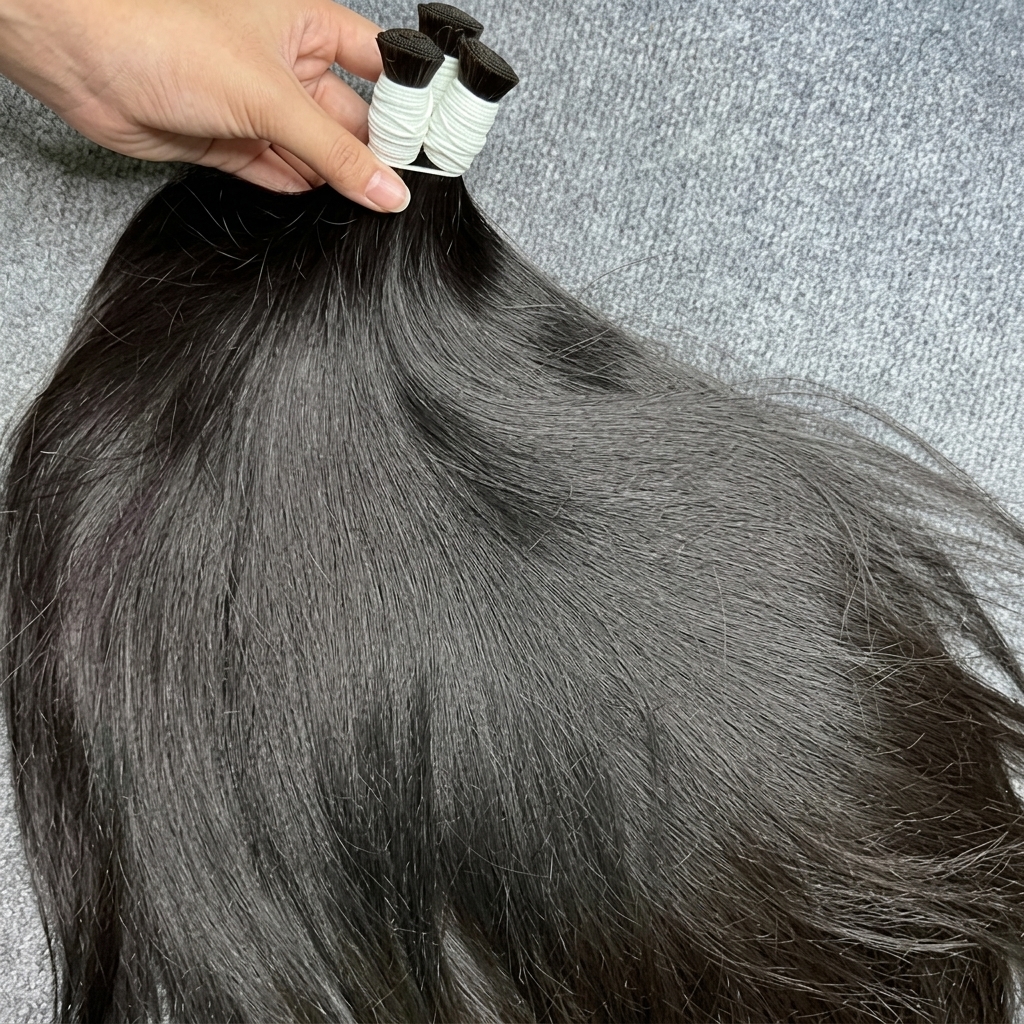
A 10g shortage becomes expensive fast
Suppose you order a 100g bundle but receive only 90g. That means you are missing 10g, or 10% of the hair you paid for. On one bundle, you may barely notice the difference.
Now scale that same shortage across a larger order. Three bundles leave you 30g short. One hundred bundles leave you 1,000g short, which equals 1kg of hair or roughly 10 full 100g bundles.
This is why bundle weight matters to you. You are not checking a technical specification for the sake of it. You are checking whether the quantity on your invoice matches the quantity in your hand.
If you are buying wholesale, ask the supplier to place your current batch on a digital scale before shipping. A generic factory video from an older order does not prove the weight of your batch.
Do not expect a 26-inch bundle to look as full as a 14-inch bundle
A common mistake is comparing long and short bundles visually. A 14-inch bundle and a 26-inch bundle can both weigh 100g, but the 26-inch hair has to spread the same amount of mass across much longer strands.
That means the longer bundle naturally contains fewer individual strands. As a result, a 26-inch 100g bundle usually looks less dense than a 14-inch 100g bundle, even when both are good quality.
A fair comparison therefore needs the same length, same weight, same drawn grade and same texture. Otherwise, you are comparing different specifications and calling the difference “quality.”
This also explains why you often need more bundles as your chosen length increases. If you are shopping online, do not judge a 24- or 26-inch order using a photo of a short, naturally denser bundle. Ask to see the exact length you intend to buy.
Want fuller hair? check the bottom 20–30%
Most bundles look thick beside the weft. That area tells you very little about how full your finished wig or sew-in will look. Instead, check the final 20–30% of the bundle, where thin ends become obvious.
Two bundles can both weigh 100g but produce very different results because the lengths inside those 100 grams are distributed differently. One bundle may contain many shorter strands, while another may have a much larger percentage of hairs reaching close to the stated full length.
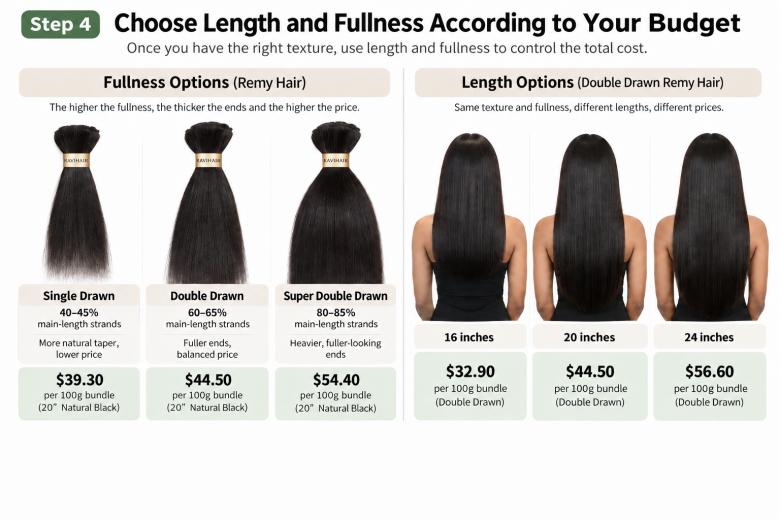
Ravi Hair, for example, separates its drawn grades approximately like this:
| Grade | Approx. full-length strands | What you get |
|---|---|---|
| Single Drawn | 40–45% | Natural taper, thinner ends |
| Double Drawn | 60–65% | Fuller ends without maximum density |
| Super Double Drawn | 80–85% | Much fuller root-to-tip appearance |
These percentages are Ravi Hair’s own product grading specification, not a universal industry standard. But they show you why drawn grade matters.
Imagine two 24-inch bundles that both weigh 100g. If one has around 45% full-length strands and the other around 80%, the scale will show the same weight, but your finished wig will not look the same.
If you like a natural tapered install, Single Drawn may be enough. If you want a dense premium straight wig with full ends, Double Drawn or Super Double Drawn gives you more usable long hair. So do not ask only, “Is it raw Vietnamese hair?” Ask, “How full are the last few inches?”
Vietnamese hair can feel thick for a real reason
Vietnamese hair is often described as thick and substantial, and there is a real biological reason behind that impression. Research on Asian hair populations commonly reports relatively large fiber diameters, with published measurements often falling around roughly 70–100 micrometers, depending on the study and measurement method.
That does not mean every Vietnamese strand measures 100 μm. Donor age, genetics and individual strand variation all affect thickness. Still, the research helps explain why Vietnamese and other Asian-origin hair can feel denser and more substantial than finer hair types.
For you, this can be a major advantage if you want a dense straight wig, visible body, substantial bundles or fuller-looking ends. But the same characteristic can also become a drawback.
If your natural hair is very fine and you plan to leave some of it out, a noticeably thicker extension fiber may be harder to blend. So do not ask whether thicker hair is automatically better. Ask whether that thickness matches the finished look you want.
Do not review the hair before you wash it
The first wash tells you more than the first five minutes after opening the package. When your hair arrives, it has not faced normal use yet. It has not been shampooed, air-dried, detangled wet, installed, slept in or repeatedly heat styled.
Any temporary finishing effect is also still on the hair. That means a comment such as “it was unbelievably soft out of the package” tells you very little about long-term quality.
You need to put water on it. Community buyers who test Vietnamese hair repeatedly often use wash testing for this reason, because it gives them a more consistent way to compare products after the initial factory presentation is removed.
Use this simple 3-wash test
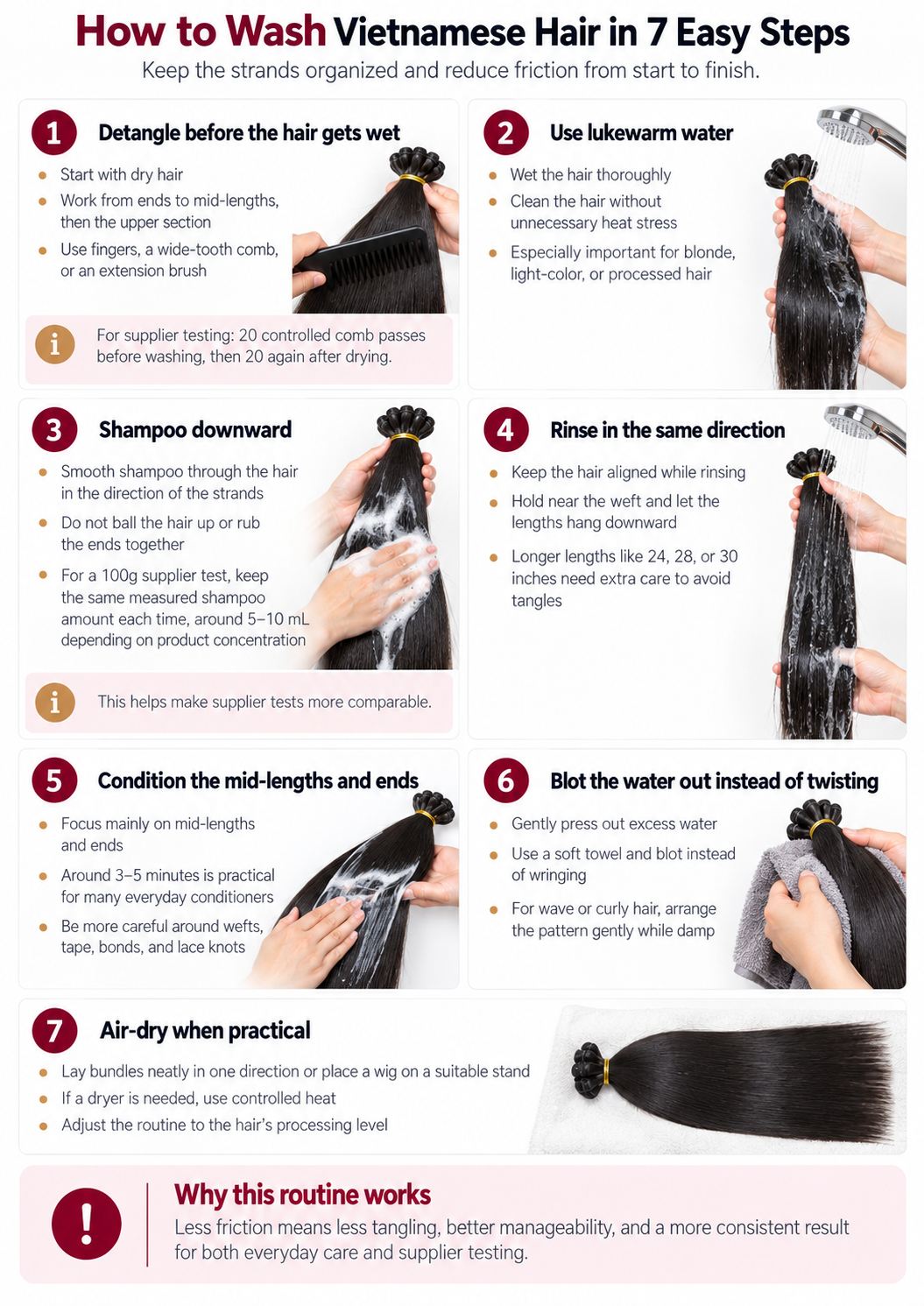
Before washing, record the bundle weight, length, end fullness, texture and weft condition. Then wash and air-dry the bundle and repeat the process three times.
Three washes do not magically certify premium hair. They simply give you more information than an unboxing. You can see whether the hair becomes more tangled, whether the ends dry out, whether the texture changes dramatically and whether shedding increases.
If the bundle looks good only before its first shampoo, that matters to you. Your hair needs to perform in your bathroom, not just in the vendor’s photo studio.
Stop saying “minimal shedding.” count it
“Minimal shedding” sounds reassuring, but it tells you almost nothing because there is no number attached to it. Instead, use the same procedure every time so you can compare one sample with another.
For example, perform 20 comb passes, followed by 50 brush strokes. Use the same comb, the same brush, the same direction and the same technique, then record how much hair comes out.
You do not need to invent a universal rule such as “under 10 strands means premium.” There is no reliable industry standard supporting a number like that. What you need is a consistent baseline.
If Sample A sheds much less than Sample B under the same test, you now have useful evidence. If your first order performs well but your next batch sheds far more under the same test, you also have something concrete to show your supplier.
You have turned “this batch feels worse” into “this batch performs differently under the same conditions.” That is much more useful.
Can raw Vietnamese hair bleach to #613?
Some batches can, but you should never assume all of them will. More importantly, do not ask only whether the hair can become #613. Ask what condition the hair will be in after it reaches that level.
Bleaching changes the hair fiber. The result depends on starting pigment, previous processing, bleach formula, developer strength, processing time, temperature and the number of sessions.
Hair can technically reach a very light blonde and still become too dry or damaged for the product you intended to sell. That is why a successful color result is not just about the final shade. It is also about how much quality remains afterward.
If you sell blonde wigs, test a small section from the actual batch first. You do not need to bleach an entire expensive bundle to get the answer.
The stronger claim is not “raw hair always reaches #613.” It is “this batch passed my color test.” That tells you something real about the hair you are about to use.
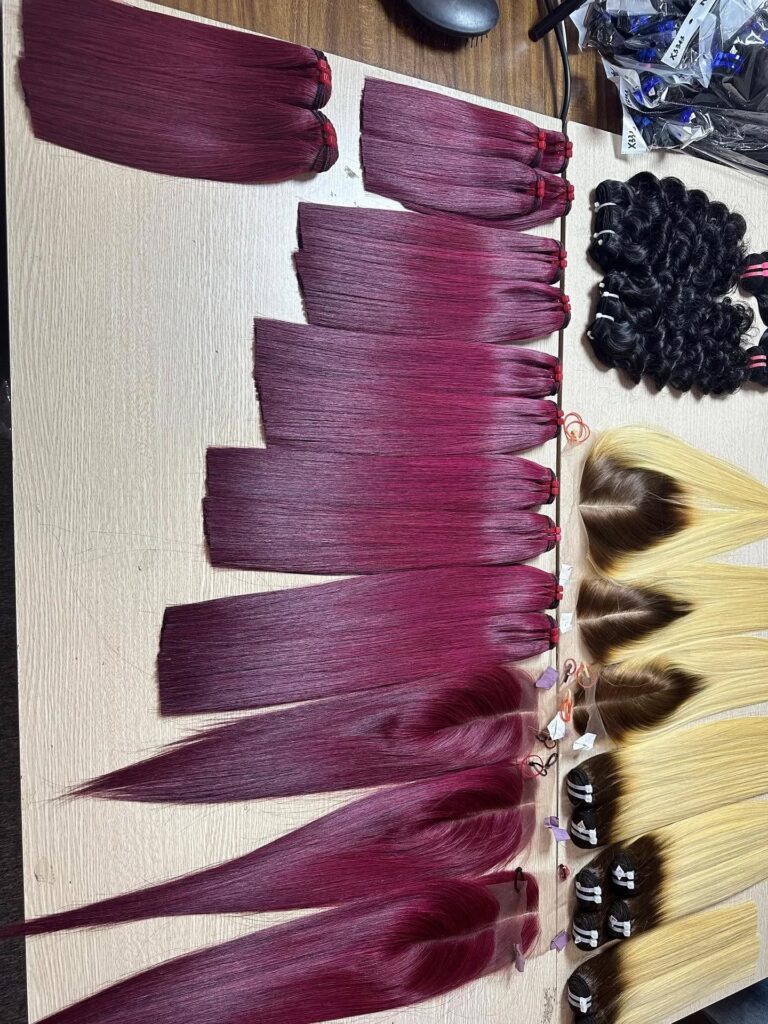
Will raw Vietnamese hair really last 3–5 years?
Raw Vietnamese hair can last a long time, but you should not buy it based on a guaranteed five-year promise. The number means very little unless you know how the hair was used.
Someone may own a wig for five years but wear it only a few times each month. Another person may wear the same unit every day, wash it weekly, use heat frequently, bleach it and sleep in it. Those two wigs do not experience the same amount of wear.
A more conservative independent reference for human-hair wigs is up to around two years with good care. You will also find buyers who report keeping quality raw hair for much longer, but those experiences should be treated as possible outcomes rather than guaranteed lifespans.
For you, there is a better metric: how many good wears or installations can you get from the hair? That number tells you far more about value.
A $300 wig can cost you less than a $180 wig
Suppose Hair A costs $300 and gives you six satisfactory uses. Your hair cost is $50 per use.
Now suppose Hair B costs only $180, but after two installations you no longer like the ends, manageability or appearance. Your cost becomes $90 per use.
Hair A costs 67% more upfront, but your cost per successful use is about 44% lower. This is where premium hair can make financial sense.
You are not paying more simply because the product sounds luxurious. You are paying more because you expect to get more useful life from it.
If you buy for yourself, think in terms of cost per wear. If you own a salon, think in terms of cost per install. If you sell hair, think in terms of cost per satisfied order.
The lowest purchase price is not always the lowest real cost.
Raw does not automatically mean single donor
Do not let one premium word answer four different questions. Raw, single donor, Remy and drawn grade describe different characteristics.
Raw describes how little processing the hair has received. Single donor tells you whether one donor supplied the hair. Remy refers to keeping strands aligned in the same root-to-tip direction. Drawn grade tells you how much of the bundle reaches the longer lengths.
So if you want one-donor hair, ask whether the exact bundle is from one donor. If you care about processing, ask whether it has been dyed, bleached or chemically textured. If you want a natural wave or curl, ask whether the texture comes from the donor or was created later.
Those questions protect you because they tell you exactly which premium feature you are paying for. Do not pay for three claims after asking only one question.
Your second order tells you whether you found a good supplier
Your first sample can be excellent, but that is not enough. It proves only that the supplier can send you one excellent bundle.
Now order the same specification again. For example, choose Vietnamese Straight, 20 inches, 100g, Double Drawn and Natural Color, then compare the second order with your approved sample.
Check the weight, true length, end fullness, texture, natural color, weft construction, wash performance and shedding. If these remain stable, you are getting evidence of repeatability rather than one lucky sample.
This matters even more if you are buying for your business. Your customer does not receive the sample that convinced you to place the order. Your customer receives the production batch.
That is why consistency matters more than one perfect bundle.
A small inconsistency becomes a big loss at wholesale volume
Suppose you order 100 bundles × 100g. You expect to receive 10,000g, or 10kg of hair.
If the average bundle actually weighs 90g, you receive only 9kg. You are short 1kg, which is roughly the equivalent of 10 missing 100g bundles.
The same logic applies to end fullness. Your new batch may still weigh 100g, but if the ends are much thinner than the approved sample, you may need extra hair to make the same wig look full.
Your supplier did not raise the quoted price, but your cost per finished wig just increased. That is why a vendor charging $2 less per bundle can still cost your business more overall.
Judge price together with weight, end fullness, consistency and usable life. That combination tells you your real cost.
Use this 10-minute check before you buy more
You do not need special equipment. A small digital scale, tape measure and phone are enough.
First, weigh the bundle and record the result instead of estimating by hand. Then measure the true length and check the final 20–30% to see how full the ends really are.
Inspect the weft for loose hair, poor stitching or unnecessary bulk. Wash and air-dry the bundle so you can see how the texture behaves without factory styling.
Use the same combing and brushing test each time, and record shedding instead of describing it vaguely. Heat-test the hair only if heat styling matters to you, and strand-test it before coloring if you plan to sell blondes or light colors.
Most importantly, repeat the same checks on your second order. That final step tells you whether you found a reliable supplier rather than one impressive bundle.
Who should buy raw Vietnamese hair?
Buy it if you plan to reuse the hair
The more times you reinstall it, the more opportunity you have to recover the higher initial price. You are not simply buying prettier hair. You are buying usable life.
Buy it if you make premium wigs
Thin ends can force you to use more hair, while inconsistent texture can weaken the finished result. If the wig itself sells at a premium, saving a small amount on lower-quality raw material often makes little financial sense.
Buy it if you restyle your hair
If you regularly straighten, curl or professionally color your units, starting with better hair gives you more room to work. You are paying for flexibility after the first install.
Buy it if your customers reorder
Your repeat customer expects the second order to perform like the first. That makes consistency more valuable than one impressive sample.
Skip it if you need one temporary style
If you will wear the hair once and never reinstall or recolor it, you may not use the advantages you are paying for. A good Remy option may give you enough quality at a lower cost.
Raw Vietnamese hair review: final verdict
Good raw Vietnamese hair is worth the premium when you can see where the extra money goes. You should see it in accurate bundle weight, fuller usable length, better ends, natural movement, stable wash performance, styling flexibility and consistent repeat orders.
A 100g bundle gives you an easy quantity check. The final 20–30% tells you whether the ends justify the grade. Repeated washes tell you more than an unboxing, while a strand test tells you more about coloring than a generic #613 promise.
Your second order may tell you the most. A beautiful sample proves the supplier can send one good bundle. A beautiful repeat order shows that the quality may actually be consistent.
If you plan to reuse, restyle or resell the hair, those differences can justify paying more. If you only need one temporary install, they may not.
So before you buy, stop asking only, “Is this real raw Vietnamese hair?” Ask instead, “What exactly am I getting for my money, and can I verify it?”
The premium should show up on your scale, after your wash test and in your second order, not only in the word “raw” on the product page.
Ask Ravi Hair
Get advice for your next order
Factory support
Make the guide practical
Ask for current stock videos, sample guidance, packing proof, and export support before you approve an order.
- Real product video before shipping
- Sample support before bulk buying
- Clear consultation for your market