Ravi Hair Journal
Vietnamese hair texture: 12+ types and how to choose the right one
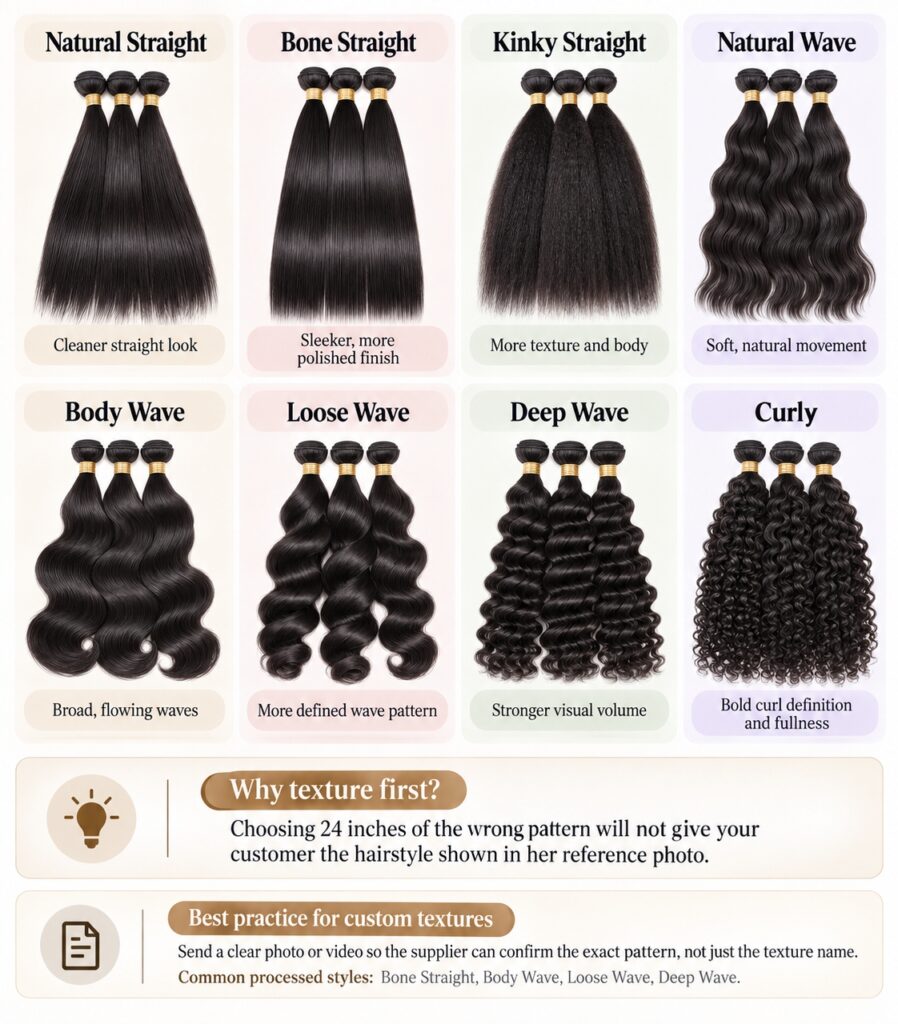
Vietnamese hair texture is not limited to straight hair. Depending on how your customers want the finished hairstyle to look, you can choose from Natural Straight, Bone Straight, Kinky Straight, Natural Wavy, Body Wave, Loose Wave, Deep Wave, Water Wave, Loose Curly, Deep Curly, Burmese Curly, Kinky Curly and other customized patterns.
The important point is that texture describes the finished look, while Remy, Virgin and Raw describe different aspects of the hair quality or product specification. If you separate those decisions, it becomes much easier to buy the right hair instead of simply choosing the most expensive option.
What is Vietnamese hair texture?
Vietnamese hair texture refers to the shape and visual pattern of the finished hair, such as straight, wavy, curly or kinky.
It should not be confused with hair quality, fullness, length or bundle weight.
| Specification | What It Tells You |
|---|---|
| Remy | Hair-quality and sourcing category |
| Virgin | Premium one-donor quality specification |
| Natural Straight | Texture |
| Body Wave | Texture |
| Kinky Curly | Texture |
| Double Drawn | End fullness |
| 20 inches | Length |
| 100g | Bundle weight |
A customer could therefore order:
20-inch Vietnamese Remy Double Drawn Body Wave, approximately 100g or: 20-inch Vietnamese Virgin Kinky Curly, approximately 100g.
Those are two very different products even though both are Vietnamese human hair. This distinction matters because a premium Virgin bundle will not satisfy your customer if she wanted Kinky Curly and you ordered Natural Straight.
Texture determines what she sees first. The underlying hair specification determines what kind of hair sits underneath that texture and how appropriate it is for her intended customization.
Quick guide to Vietnamese hair textures
If you only need a fast starting point, use the customer’s desired finished look.
| Your Customer Says | Start With | Visual Direction |
|---|---|---|
| “I want natural straight hair.” | Natural Straight | Clean straight look with natural movement |
| “I want it super sleek.” | Bone Straight | Very sleek and polished |
| “I want straight hair with more volume.” | Kinky Straight | Straight silhouette with visible texture |
| “I want just a little wave.” | Natural Wavy | Soft natural movement |
| “I want soft, flowing volume.” | Body Wave | Broad, smooth waves |
| “I want visible waves.” | Loose Wave | More repeated wave definition |
| “I want strong wave definition.” | Deep Wave | Deeper, more prominent waves |
| “I want loose curl-and-wave movement.” | Water Wave | Flowing wave-and-curl pattern |
| “I want softer curls.” | Loose Curly | Open curl pattern |
| “I want clearly defined curls.” | Deep Curly | More defined curls |
| “I want a fuller curly style.” | Burmese Curly | Fuller curly direction |
| “I want tighter textured curls.” | Kinky Curly | Tighter, stronger texture |
This table is only a starting point.
Your customer’s reference image and the supplier’s current-batch video should have the final say.
Natural donor texture vs commercial Vietnamese hair texture
Not every texture name in a Vietnamese hair catalog represents the exact way the donor’s hair naturally grew.Vietnamese donor hair naturally varies between individuals, including straighter and wavier directions. Commercial products such as:
Body Wave, Deep Wave, Kinky Straight, Water Wave and Kinky Curly
can also be created through styling and production processes.
So a Deep Wave bundle should primarily be understood as a finished commercial texture, not proof that the donor naturally had that exact Deep Wave pattern.
This matters to you because finished texture affects: how the hair should be maintained, how it behaves after washing, how well the pattern returns and what your customer should expect after installation. Commercial texture names can also vary slightly from one supplier to another.
That is why:
Body Wave from Supplier A may not look exactly like Body Wave from Supplier B.
Always ask to see the actual hair before buying bulk.
Vietnamese straight hair textures
Straight hair does not give you only one finished look. Natural Straight, Bone Straight and Kinky Straight can solve three very different customer requests.
Natural straight for natural movement
Natural Straight is the easiest Vietnamese hair texture to understand. The overall silhouette is straight, but the hair is not intended to look aggressively flat.
Choose it when your customer wants:
clean straight hair, natural movement and a versatile everyday look.
If she tells you:
“I want straight hair, but I don’t want it to look too flat.”
Natural Straight is a useful starting point.
It also works well as a core inventory texture because buyers can immediately understand what they are purchasing.
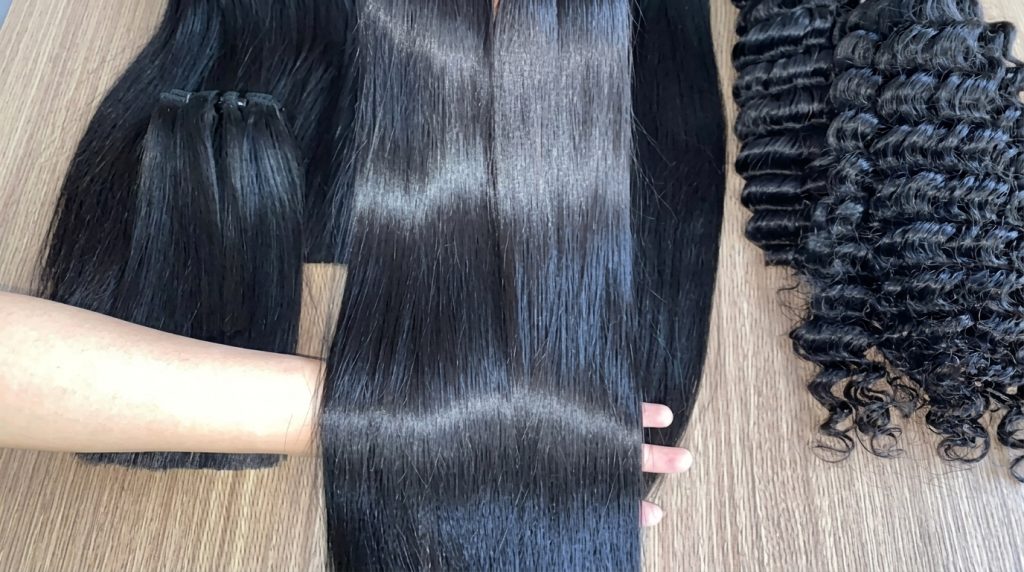
Natural straight price example
A 20-inch Double Drawn Remy Natural Straight bundle is approximately:
$44.50 per 100g.
Three bundles would be:
3 × $44.50 = $133.50.
This gives you a useful reference when comparing other finished textures.
Bone straight for a sleeker finish
Bone Straight is for the buyer who does not simply want straight hair.
She wants it:
very sleek, flat and polished.
The easiest distinction is:
Natural Straight = straight with more natural movement
Bone Straight = straighter, sleeker and more polished
For Remy Hair, Bone Straight currently adds approximately $1.50 per 100g bundle to the Natural Color base.
At 20 inches Double Drawn:
Natural Straight: $44.50
Bone Straight: approximately $46.00
Across three bundles:
Natural Straight: $133.50
Bone Straight: $138.00
Difference:
$4.50.
If the customer’s desired hairstyle is already extremely sleek, paying another $4.50 across three bundles can make more sense than buying Natural Straight and repeatedly forcing the hair into a different look with heat.
Kinky straight for more texture and body
Kinky Straight maintains an overall straight silhouette but gives you considerably more visible texture and body.
It can be useful when your customer says:
“I want straight hair, but I still want volume.”
Compared with Natural Straight, Kinky Straight looks less sleek and more substantial.
Compared with Kinky Curly, it still reads visually as straight.
This distinction can also help with budget conversations.
A customer asking for “more hair” may actually want more visual volume.
A texture with more body may solve part of that need before you automatically add another 100g bundle.
Vietnamese wavy hair textures
A practical way to explain the wavy family is:
Natural Wavy → Body Wave → Loose Wave → Deep Wave
This is a useful buying guide rather than a universal industry grading scale. Suppliers can interpret commercial texture names differently, so always compare actual product videos or samples.
Natural wavy for relaxed movement
Natural Wavy gives you the softest wavy direction.
It sits closer to naturally flowing hair instead of showing an obviously repeated wave pattern.
Choose it when your customer wants:
more movement than Straight Hair, but less visible definition than Body Wave.
It can work particularly well for buyers who want an effortless look rather than a strongly styled wave.
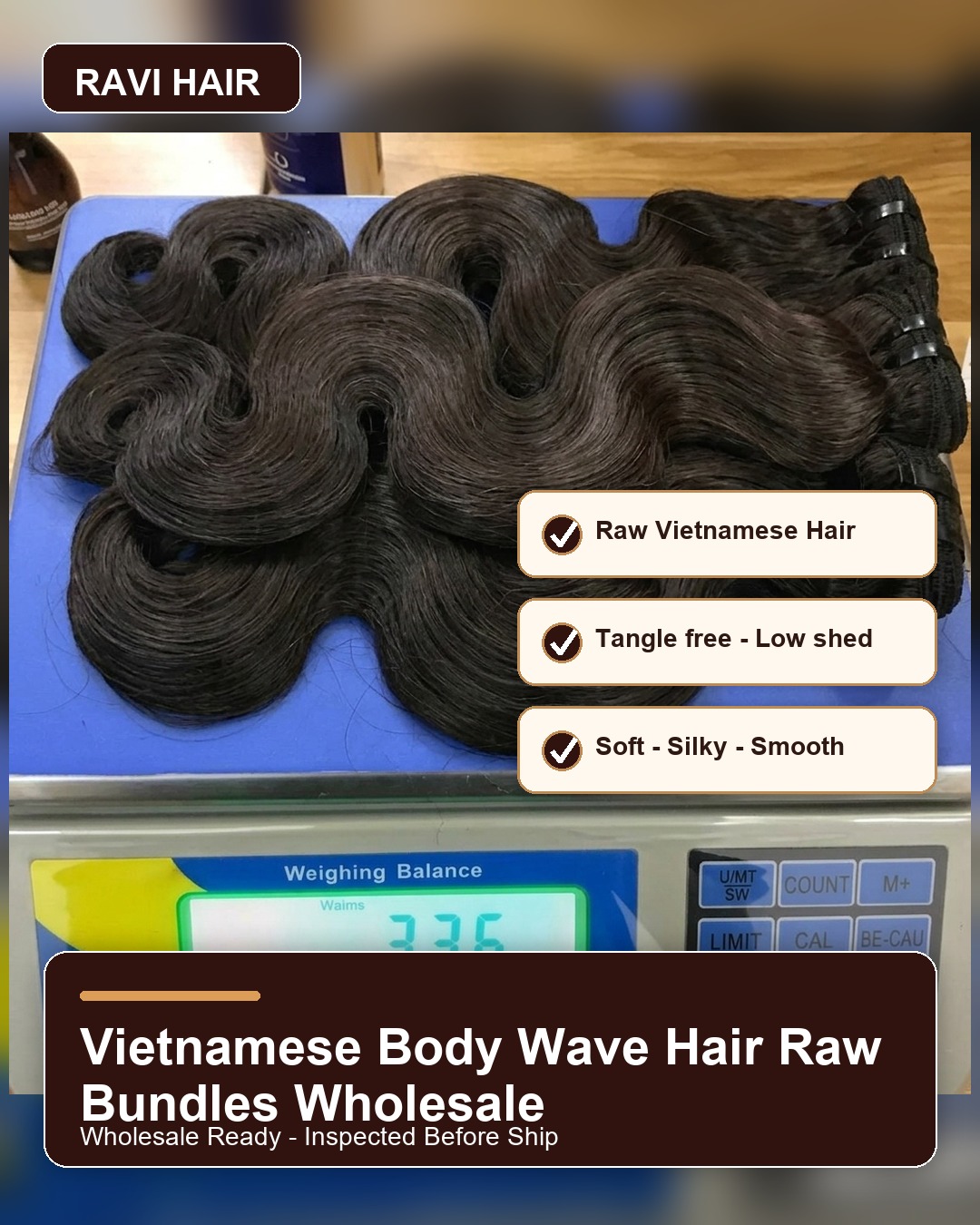
Body wave for soft volume
Body Wave creates broad, flowing curves.
The pattern is more noticeable than Natural Wavy but remains soft.
If your customer says:
“I want my hair to look fuller, but I don’t want curls.”
Body Wave can be a useful place to start.
The curves occupy more visual space than Straight Hair, which can make the finished hairstyle look fuller.
That does not mean every customer automatically needs fewer bundles.
It means you should consider texture before automatically increasing quantity.
Body wave price example
A 20-inch Double Drawn Remy Natural Straight bundle is approximately:
$44.50.
For processed Remy wave/curl textures such as Body Wave, the current reference adjustment is approximately:
+$3.50 per 100g.
That puts a 20-inch Double Drawn Remy Body Wave at approximately:
$48.00 per bundle.
For three bundles:
3 × $48 = $144.
Compared with three Natural Straight bundles:
$144 – $133.50 = $10.50 more.
If Body Wave is already the style your customer wants, that additional $10.50 has a clear reason behind it.
Loose wave for more visible waves
Loose Wave creates more visible definition than Body Wave without becoming as strong as Deep Wave.
A practical distinction is:
Body Wave = broad and soft
Loose Wave = more visible repeated waves
This can work when the inspiration photo shows obvious waves through the length but the pattern remains relatively open.
Before confirming the order, show your customer a current product photo or video, especially when the difference between Body Wave and Loose Wave is important to her decision.
Deep wave for stronger definition
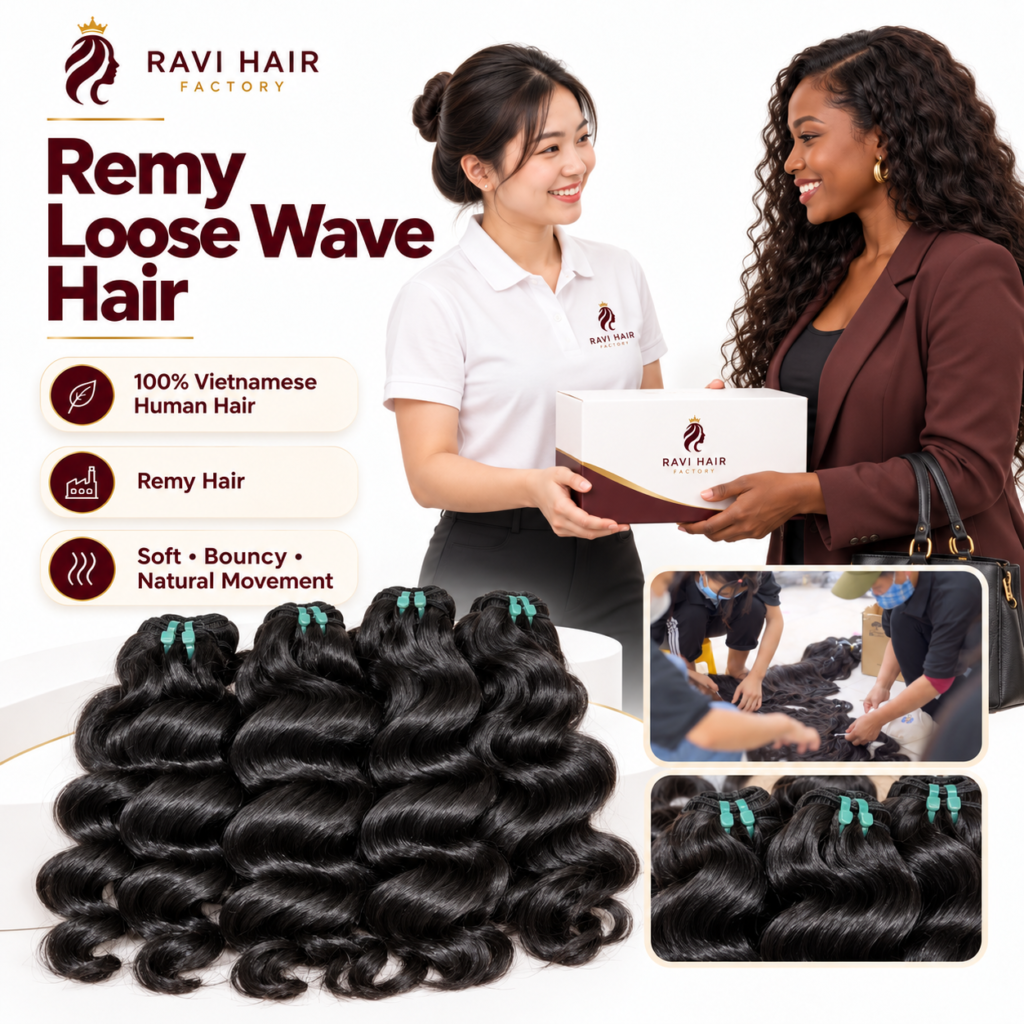
Deep Wave moves further toward strong texture.
The wave pattern becomes more repeated and visually prominent than Body Wave or Loose Wave.
Choose it when the wave itself should be one of the major features of the hairstyle.
Remember:
more bundles increase quantity.
Deep Wave increases texture intensity.
Those are not the same thing.
If your customer’s reference already shows strong repeated waves, adding another Body Wave bundle will not turn Body Wave into Deep Wave.
Choose the correct texture first.
Then decide how much hair is needed.
Water wave for wave-and-curl movement
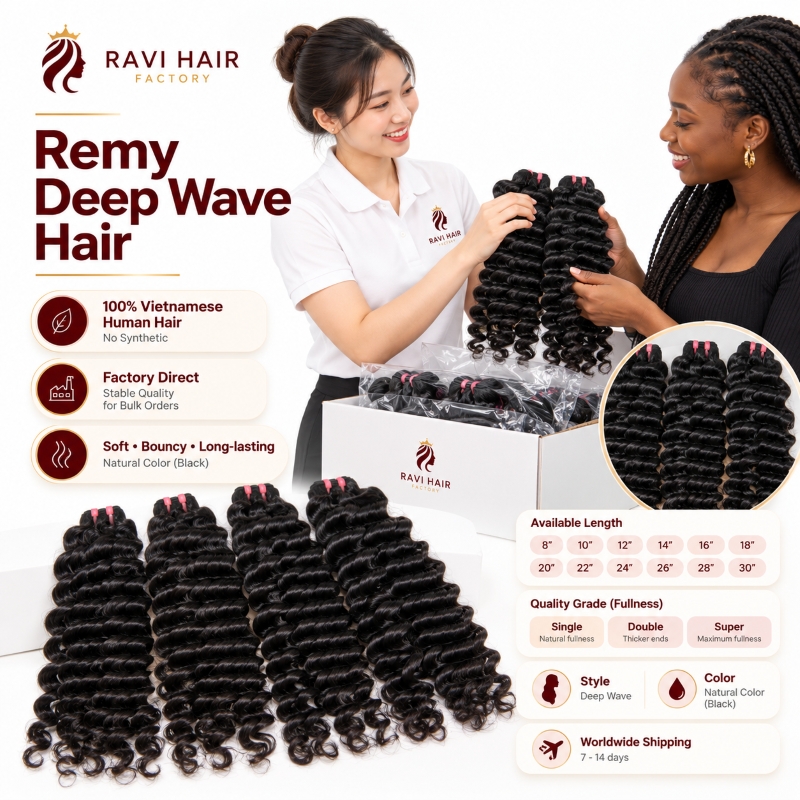
Water Wave sits between strongly wavy and softer curly looks.
It combines flowing waves with curl-like movement, creating more texture than Body Wave without moving directly into a tight curl pattern.
It can work when your customer says:
“I want curly hair, but I still want it loose and flowing.”
A practical comparison is:
Deep Wave: stronger repeated wave structure.
Water Wave: softer wave-and-curl movement.
Do not rely only on the name.
Ask for a current-batch Water Wave video before placing a bulk order.
Vietnamese curly hair textures
Once you move into curly textures, the curl itself becomes a major part of the finished hairstyle.
A practical commercial progression is:
Loose Curly → Deep Curly → Burmese Curly / fuller curly directions → Kinky Curly.
This is not a universal curl-grading system. Actual patterns should always be checked from current samples because commercial names can vary between suppliers.
Loose curly for softer open curls
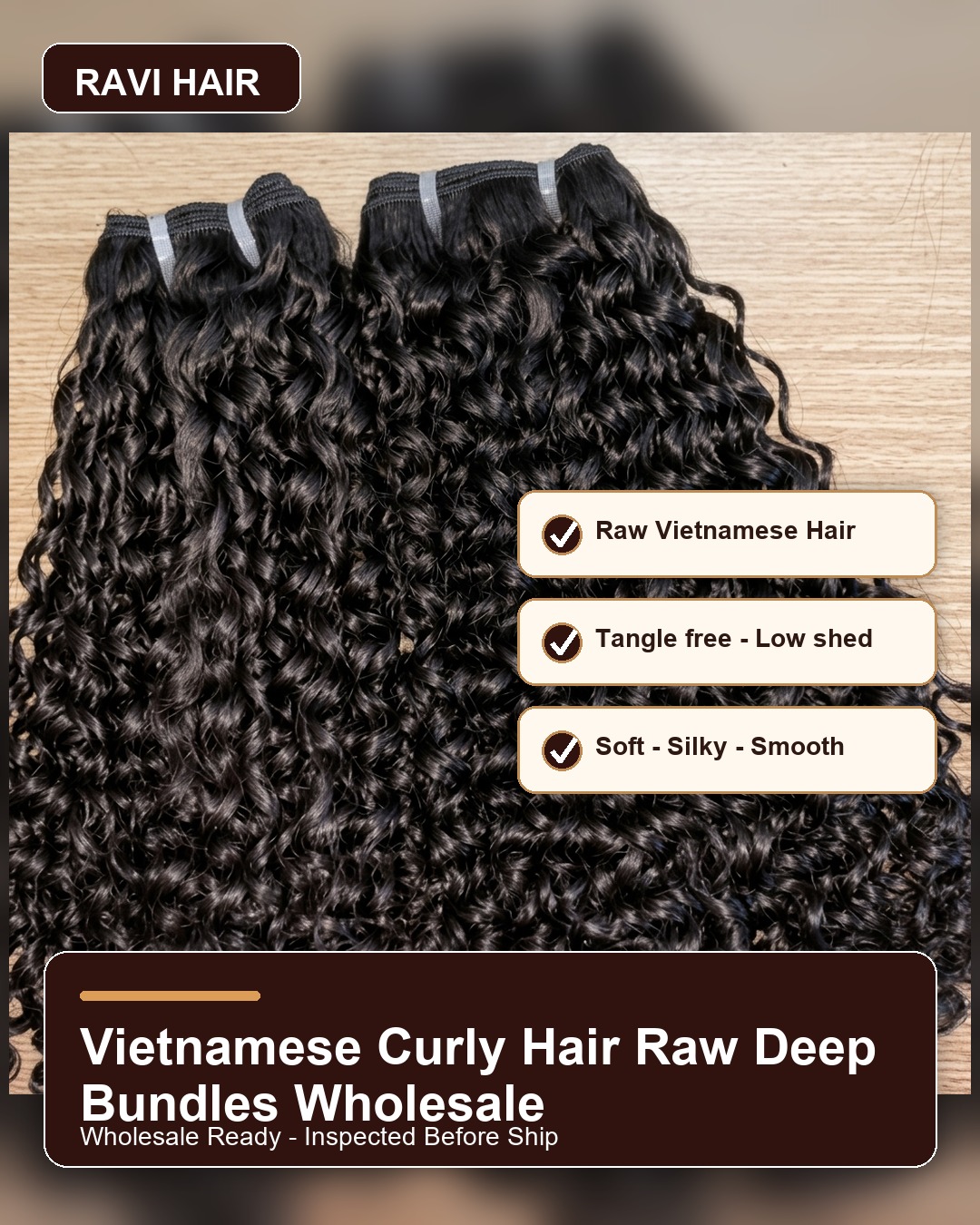
Loose Curly works for customers who want the hairstyle to clearly look curly without moving into a tight curl pattern.
Compared with Loose Wave, Loose Curly is more clearly curl-dominant.
Compared with Kinky Curly, the curls remain more open.
That makes it useful as a bridge between wave-focused products and tighter curls.
Deep curly for defined curls
Deep Curly gives stronger curl definition.
The curl pattern becomes one of the dominant features of the hairstyle and can create a fuller-looking silhouette than Straight Hair.
If your customer tells you:
“I want bigger hair.”
ask another question:
“Do you want more actual hair, or do you want stronger texture?”
If her reference already shows Deep Curly, much of the volume she wants may come from the curl pattern itself.
Bundle quantity still matters, but it is not the only variable affecting the final look.
Burmese curly for a fuller curly direction
Burmese Curly should not automatically be treated as another name for Deep Curly.
The safest buying approach is visual.
Ask your customer for a reference photo.
Then compare that reference with current:
Burmese Curly
Deep Curly
and:
Loose Curly
samples or videos.
Commercial texture names help organize products, but they cannot tell you exactly how every curl will look on a particular production batch.
Kinky curly for tighter texture
Kinky Curly moves toward tighter, more texture-dominant curls.
It is suitable for customers who want the curl pattern to create a strong visual identity.
| Texture | Visual Direction |
|---|---|
| Loose Curly | Soft, open curls |
| Deep Curly | More defined curls |
| Burmese Curly | Fuller curly direction |
| Kinky Curly | Tighter, stronger texture |
Tighter does not automatically mean better.
Choose Kinky Curly when tighter curls are actually what your customer wants.
If she sends you a soft, open-curl reference and you sell her Kinky Curly because you think it sounds more premium, the stronger texture becomes a problem rather than a benefit.
Why curly and kinky virgin hair can cost more
Premium Virgin pricing also varies by texture family.
At 20 inches:
Virgin Straight/Wavy: approximately $70.50 per 100g
Virgin Curly/Kinky/Pixie: approximately $73.50 per 100g
Difference:
$3 per bundle.
For three bundles:
Straight/Wavy: $211.50
Curly/Kinky: $220.50
Difference:
$9.
This difference is relatively small compared with the jump from Remy to Virgin.
That gives you an important buying insight.
If your customer has already decided that Virgin Hair is necessary, changing between some premium texture families may affect her total much less than changing the underlying quality tier.
How Vietnamese hair texture changes with length
The same texture can look different at different lengths.
A 12-inch Deep Wave and a 30-inch Deep Wave may belong to the same texture family, but the finished appearance will not necessarily read the same once installed.
Longer waves and curls can appear more elongated than shorter versions of a similar pattern.
That is why you should avoid showing a customer only a 14-inch sample when she plans to buy 30 inches.
Whenever possible, ask for:
the same texture in a similar length
or:
a current video showing the actual length range she plans to buy.
This reduces expectation gaps before the order.
How texture and length change your budget
Texture affects pricing, but length can change the total much more dramatically.
Take Virgin Curly/Kinky Hair as an example:
| Length | Approx. Price per 100g |
|---|---|
| 16″ | $56.50 |
| 20″ | $73.50 |
| 24″ | $90.50 |
| 30″ | $115.00 |
Three 20-inch bundles:
3 × $73.50 = $220.50.
Three 24-inch bundles:
3 × $90.50 = $271.50.
Difference:
$51.
Three 30-inch bundles:
3 × $115 = $345.
Compared with three 20-inch bundles:
$345 – $220.50 = $124.50 more.
If your customer loves Kinky Curly but the 30-inch price is above her budget, you do not necessarily need to change the texture or immediately give a discount.
You could keep:
Virgin quality + Kinky Curly texture
and change:
30″ → 24″
or:
24″ → 20″.
Now she keeps the features she values most while adjusting the variable driving a large part of the total.
Which Vietnamese hair texture should you choose?
There is no universal best texture.
The right choice depends on the finished look your customer wants.
Use this decision process:
1. Ask for the inspiration photo.
2. Decide whether the look is mainly Straight, Wavy or Curly.
3. Identify how much texture intensity she wants.
4. Choose Remy or Virgin according to intended customization.
5. Choose length and bundle quantity.
6. Ask for a current-batch video before confirming bulk quantity.
This sequence prevents a common mistake:
buying expensive hair first and asking whether it creates the right hairstyle later.
Ask for a current-batch video before you order a sample
Texture names alone cannot show you the exact product.
Before spending money on a trial order, ask the supplier to show the current batch.
For example, if you want Body Wave, ask for a video showing:
the full bundle from weft to ends,
the hair hanging naturally,
the pattern without the seller constantly holding it in position,
and ideally more than one bundle from the same batch.
If you are comparing:
Body Wave vs Loose Wave
or:
Deep Wave vs Water Wave,
ask to see them side by side.
This lets you eliminate clearly unsuitable textures before paying for samples.
But video is still not enough for wholesale verification.
The next step is to test the actual hair.
Test the texture before you buy bulk
A texture name tells you what the supplier intends to produce.
A sample shows you what the product actually does.
Before ordering 1kg or a larger quantity, request approximately 100g in the exact texture and a similar length to what you plan to sell when a sample order is available.
Wash it 3 times
Take photos:
before washing
after Wash 1
and:
after Wash 3.
Compare the texture.
If Deep Wave looks strong when the bundle arrives but loses too much of the commercial appearance after several washes, you need to know that before your customer does.
Run 40 comb passes
Use:
20 passes before washing
and:
20 passes after washing and drying.
Record obvious catches.
For example:
Sample A: 3 catches /40
Sample B: 12 catches /40
Those numbers do not create an international grading standard.
They simply give you a consistent way to compare the two samples under the same conditions.
Brush it 100 times
Complete 100 controlled brush strokes and count obvious loose strands.
Inspect the weft as well.
Again, there is no universal number that makes one bundle “premium.”
The value comes from using the same method across matched samples.
Test a 10g color swatch when relevant
If your customers normally color the hair, take approximately 10g from the sample and use the same professional process you would use in your salon.
Then wash the swatch again.
Check:
color result,
texture,
ends,
breakage,
and overall manageability.
The more useful question is not only:
“Can this hair be colored?”
Ask:
“How does the hair behave after the color process and several washes?”
Do not test only one texture if you plan to sell five
This is particularly important for vendors.
Suppose your supplier’s Natural Straight performs beautifully.
That does not automatically prove its Kinky Curly production will behave exactly the same way.
If your future collection depends heavily on:
Body Wave,
Deep Wave,
and Kinky Curly,
test those products too.
You do not need to test every texture immediately.
Start with the categories you expect to sell most.
For example:
100g Natural Straight
100g Body Wave
100g Deep Wave
100g Kinky Curly
Now you are testing genuinely different finished texture families rather than assuming one successful product proves the complete catalog.
How to build a Vietnamese hair texture collection without overstocking
More textures do not automatically mean more sales.
Every additional texture creates more inventory combinations once you add:
length,
quality,
color,
and fullness.
For example:
6 textures × 5 lengths × 2 quality tiers = 60 SKUs
before adding different colors or lace products.
For a new vendor, start with textures that solve clearly different customer needs.
A practical starter texture collection
Natural Straight for your core straight-hair buyers.
Body Wave for soft movement.
Deep Wave for stronger wave definition.
Kinky Straight for textured-straight buyers.
Deep Curly for defined curls.
Kinky Curly for tighter texture.
Six textures already give your customers six clearly different reasons to buy.
Then use real customer requests to expand the collection.
If buyers repeatedly request Water Wave, add Water Wave.
If Loose Wave inquiries keep increasing, test and add Loose Wave.
Let demand expand your catalog instead of letting the supplier’s catalog determine your inventory.
Faq about Vietnamese hair texture
What Texture Is Vietnamese Hair Naturally?
Vietnamese donor hair varies between individuals and can include straighter and naturally wavier directions.
Commercial Vietnamese hair is also produced in a much wider range of finished textures such as Body Wave, Deep Wave, Water Wave, Kinky Straight and different curly patterns.
Do not assume every commercial texture is the donor’s exact natural texture.
Is Vietnamese Hair Naturally Straight?
Vietnamese donor hair can include naturally straight hair, but individual variation exists.
If naturally straight donor hair is specifically important to your business, confirm the actual sourcing and product specification with your supplier rather than relying only on the country name.
What Is the Best Vietnamese Hair Texture?
There is no single best texture.
Natural Straight works for a clean straight look.
Body Wave gives softer volume.
Deep Wave gives stronger wave definition.
Kinky Straight adds more body while remaining straight.
Deep Curly and Kinky Curly serve increasingly texture-focused curl looks.
The right texture is the one closest to your customer’s desired hairstyle.
What Is the Difference Between Body Wave and Deep Wave?
Body Wave creates broader, softer curves.
Deep Wave creates stronger, more repeated wave definition.
Choose Body Wave for flowing movement.
Choose Deep Wave when the texture itself should be more visually prominent.
What Is the Difference Between Deep Wave and Water Wave?
Deep Wave is more wave-dominant with stronger repeated definition. Water Wave combines wave and curl characteristics for a softer, more fluid appearance.
Because suppliers may interpret these names differently, ask for current-batch videos when the distinction matters.
What Is the Difference Between Kinky Straight and Kinky Curly?
Kinky Straight keeps an overall straight silhouette while adding visible texture and body.
Kinky Curly is curl-dominant and creates tighter textured volume.
The word “Kinky” does not mean the finished shapes are the same.
Which Vietnamese Hair Texture Looks Fullest?
Tighter textures such as Kinky Curly can create more visual volume than Straight Hair because the curls occupy more visual space. However, visual volume should not be confused with actual hair quantity or end fullness.
The correct number of bundles still depends on length, installation and desired density.
Does Texture Change Vietnamese Hair Price?
Yes.
For Remy Hair, processed wave and curl textures can add production cost over the Natural Straight base.
For example, at 20 inches Double Drawn:
Natural Straight: approximately $44.50/100g
Processed Body Wave reference: approximately $48/100g
However, length and the underlying Remy or Virgin quality tier can change the total much more than texture alone.
Should I Choose Remy or Virgin for Wavy and Curly Hair?
Choose according to what your customer plans to do with the hair.
Remy gives you a more accessible option for Natural Black and many moderate-color uses.
Virgin becomes more relevant when premium one-donor sourcing or demanding light-color customization matters.
Do not choose Virgin simply because it is more expensive.
How Much Hair Should I Test Before Ordering?
Approximately 100g is a practical starting sample when available.
Choose the exact texture and a similar length to what you plan to stock.
Then:
wash it 3 times,
run 40 controlled comb passes,
complete 100 brush strokes,
and:
test approximately 10g separately if your customers normally color the hair.
If the sample performs well, reorder the same specification once more to check batch consistency before increasing inventory significantly.
Choose texture for the look, then make the sample prove it
Vietnamese hair gives you far more options than simply Straight, Wavy or Curly.
You can move through straight directions such as:
Natural Straight → Bone Straight → Kinky Straight
into wavy styles such as:
Natural Wavy → Body Wave → Loose Wave → Deep Wave → Water Wave
and then into:
Loose Curly → Deep Curly → Burmese Curly → Kinky Curly.
But the number of texture names is not what makes your collection useful.
Each product should solve a different customer request.
Choose Natural Straight because your customer wants natural straight movement.
Choose Bone Straight because she wants sleekness.
Choose Body Wave because she wants soft volume.
Choose Deep Wave because she wants stronger definition.
Choose Kinky Straight because she wants texture without curls.
Choose Kinky Curly because tighter curls are actually the look she wants.
Then stop relying on the texture name alone.
Ask for a current-batch video. Request approximately 100g of the exact Vietnamese hair texture and a similar length to what you actually plan to sell. Wash it 3 times, run 40 comb passes, brush it 100 times and process a small swatch if your customers normally color their hair.
Compare it directly with your current supplier.
If Body Wave is going to become a major product, test Body Wave.
If Kinky Curly is going to become a major product, test Kinky Curly.
And after a sample performs well, reorder the same specification once before you scale.
The texture name should help you choose what to test. The sample should earn your order.
Whatsapp: 0818293277
Ask Ravi Hair
Get advice for your next order
Factory support
Make the guide practical
Ask for current stock videos, sample guidance, packing proof, and export support before you approve an order.
- Real product video before shipping
- Sample support before bulk buying
- Clear consultation for your market