Ravi Hair Journal
Raw Vietnamese hair: wholesale buyer guide
If you are searching for raw Vietnamese hair, you are probably not just looking for a nice product photo. You may be trying to find hair that your buyers can trust, install, wash, style, resell, and reorder without too many complaints.
For product options that match the buying criteria in this guide, browse Raw Vietnamese Hair Bundles.
For salon owners, hair vendors, wig makers, order collectors, and importers, raw Vietnamese hair can be a strong product because it gives your business a premium sourcing story. But before you order sample or bulk, you need to know what “raw” really means, how it differs from virgin, Remy, or processed hair, and what proof you should ask for before shipping.
This matters even more if you sell to African or Nigerian customers. Your buyers may care about fullness, true length, bundle weight, curl comeback, lace match, install result, and long-term value. If the hair is short, thin at the ends, underweight, overprocessed, or different from the approved proof, the customer will blame your salon, your store, or your WhatsApp business.
RaviHair is a Vietnamese hair supplier, so this article is written from a supplier-side point of view. We are not pretending to be an independent review website. The goal is to help you ask better questions, check better proof, and choose the right raw Vietnamese hair before your next sample or bulk order.
Quick answer: what is raw Vietnamese hair?
Raw Vietnamese hair usually refers to human hair sourced from Vietnam that has not been heavily processed for color or texture. In wholesale buying, buyers often expect raw hair to have a more natural look, stronger strand quality, and better long-term value than heavily processed hair.
But you should not trust the word “raw” alone. The safer question is:
What can the supplier prove?
|
Question |
What you should check |
|
Is the hair truly raw? |
Ask whether it has been dyed, bleached, steamed, acid-washed, silicone-coated, or chemically treated |
|
Is it raw, virgin, Remy, or processed? |
Ask the supplier to define the exact hair type before you write your product description |
|
Is the texture natural? |
Ask if the texture is naturally selected, steamed, heat-styled, or chemically created |
|
Is the length accurate? |
Ask for true length measurement; wave and curly hair should be stretched |
|
Is the bundle weight correct? |
For bundles, confirm gram weight; a common standard is 100g per bundle |
|
Are the ends full enough? |
Ask for ends close-up, bundle hanging video, and hand-spread proof |
|
Will wave or curl return after washing? |
Ask for wet-to-dry comeback video |
|
Does the lace match the bundles? |
Ask for closure/frontal lace close-up, knot view, density, texture match, and color match |
|
Is the actual order correct? |
Ask for current-batch video, packing list, and packing proof before shipping |
For your first order, do not order bulk only because a supplier says “raw Vietnamese hair.” Start with a sample, verify the proof, then move into a controlled small bulk order.
Why raw Vietnamese hair matters for wholesale buyers
Raw Vietnamese hair can help your business sell trust, not only hair. If the hair performs well after washing, installing, and styling, your buyers are more likely to reorder, recommend you, and accept a higher price.
For wholesale buyers, the real test happens after the customer uses the hair. A bundle may look good on arrival, but your buyer will judge it after washing, combing, installing, curling, straightening, or making a wig. If the curl drops, the ends look thin, the weft sheds, or the lace does not match, your reputation takes the risk.
This is why raw Vietnamese hair should be bought through a proof-first process. The goal is not only to find hair that looks good in a product photo. The goal is to find hair that protects your customer relationship after real use.
If you sell to Nigeria or other African markets, one bad batch can become expensive. You may already have paid for international shipping, payment fees, packaging, ads, influencer photos, or marketplace listing before the customer touches the hair. A better sample and QC process can reduce refund pressure and protect repeat orders.
Raw Vietnamese hair vs virgin hair vs remy hair vs processed hair
Hair terms can be confusing because different suppliers use them differently. Before you buy, make sure you understand what each term means in the supplier’s system.
Raw hair usually means hair that has not been heavily processed for color or texture. But some suppliers may still use “raw” loosely, so you need to ask what has actually been done to the hair.
Virgin hair usually means hair that has not been chemically treated. In a stricter sense, one-donor virgin hair is a higher claim because the hair comes from one donor and is easier to control for direction, condition, and color potential.
Remy hair usually means the cuticles are aligned in the same direction. Remy hair is not fake hair. For many African wholesale buyers, Remy hair can be practical because it works for curls, common colors, and better price control.
Processed hair may include hair that has been dyed, bleached, steamed, acid-washed, silicone-coated, or chemically treated. Processed hair is not automatically bad. 613 blonde, burgundy, piano, highlight, ombre, and some very consistent wave patterns often require processing. The risk comes when processed hair is sold as raw without clear explanation.
Before you buy raw Vietnamese hair, ask:
-
Has this hair been dyed, bleached, steamed, acid-washed, silicone-coated, or chemically treated?
-
Is the texture natural, selected, steamed, heat-styled, or chemically created?
-
Is the color natural black/1B, or has it been colored?
-
Is the hair raw, virgin, Remy, processed, or mixed?
-
Can the hair be washed and shown again after drying?
-
Can the sample and bulk order match in source, texture, grade, and proof?
If the supplier cannot explain the hair clearly, do not overpromise it to your buyers.
Raw Vietnamese hair options you can buy
Raw Vietnamese hair can come in several product forms. The right choice depends on how your buyers use the hair, not only what looks attractive online.
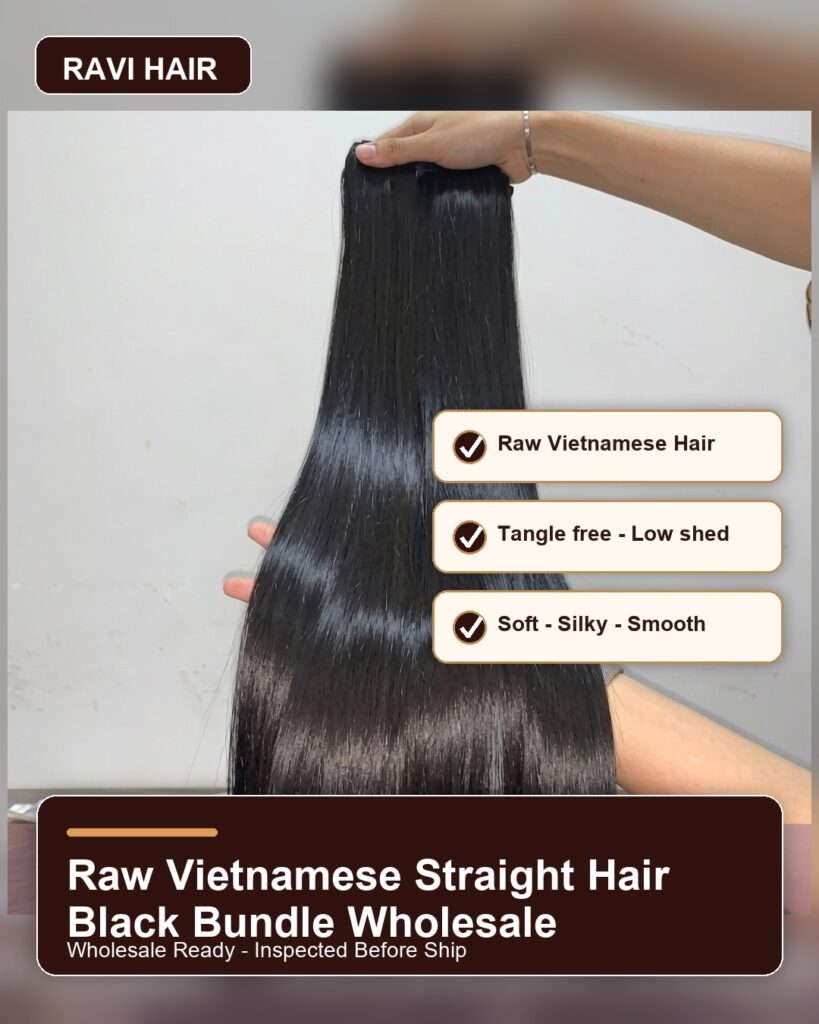
Raw Vietnamese hair bundles are often the easiest starting point for vendors and salons. They can be used for sew-ins, wigs, ponytails, leave-out styles, and resale bundles. If you are testing a new supplier, straight or body wave bundles are usually easier to inspect than complex textures.
Raw Vietnamese bundles with closure are useful when your customer wants a complete install set without the higher cost and maintenance of a frontal. Common closure sizes include 2×4, 2×6, 4×4, 5×5, and 6×6. A 4×4 closure is simple. A 5×5 closure gives more parting space. A 6×6 closure gives a wider top area and can feel more premium.
Raw Vietnamese bundles with frontal are better when your buyers want full hairline styling. Common frontal sizes include 13×4 and 13×6. A 13×4 frontal gives ear-to-ear coverage with moderate parting depth. A 13×6 frontal gives deeper parting space and more styling flexibility.
Raw Vietnamese bulk hair is useful for braiding, ventilating, custom wig work, handmade wigs, micro links, tips, and production. Since it is not sewn into a weft, you should check direction, alignment, weight, length, and texture carefully.
Raw Vietnamese wigs can work for buyers who want ready-to-sell or ready-to-wear products. But wigs have more QC points than bundles: cap construction, lace size, density, hairline, knots, parting, texture, true length, and packing all matter. For many wholesale buyers, bundles with closure or frontal may be easier to control than wigs in the first order.
Best raw Vietnamese hair option by buyer type
The best raw Vietnamese hair is not the same for every business. Choose based on your buyer type, order size, and customer promise.
|
Buyer type |
Better raw Vietnamese hair option |
Why it fits |
|
New hair vendor |
Raw straight bundles |
Easy to inspect, explain, photograph, and resell |
|
Vendor or salon |
Raw bundles, body wave, bundles with closure |
Practical for common installs and repeat orders |
|
Order collector |
Simple catalog textures with clear specs |
Easier to control than many mixed custom requests |
|
Premium salon client |
Super Double Drawn raw hair |
Fuller ends and higher perceived value |
|
Wig maker |
Raw bundles plus closure/frontal, or bulk hair |
Better control over construction and density |
|
Braider/custom maker |
Raw Vietnamese bulk hair |
Flexible for braiding, ventilating, and production |
|
Curly hair customer |
Raw deep wave, water wave, curly, or coily hair |
Stronger volume and visual appeal |
|
Fashion/color buyer |
613 or colored Vietnamese hair |
Good for bold looks, but should be treated as color-processed unless proven otherwise |
|
Importer |
Controlled bulk lot |
Better for stock planning if current-batch QC is strong |
If you are buying for the first time, start with your most sellable product. Do not test too many textures, colors, lengths, and lace types in one order. A focused sample gives you clearer feedback.
Raw Vietnamese hair textures: what to choose and what to check
Texture affects how your buyers judge the hair after installation. It also affects your QC risk.
Straight hair is usually the safest first test because it is easier to inspect. You can check smoothness, alignment, shine, weft quality, shedding, ends, weight, and length clearly. If your buyers want a natural straight look, regular straight may work well.
Bone straight hair is different from regular straight. Bone straight is expected to look flatter, sleeker, and more polished. If your customers ask for a very sleek finish, ask for wash proof and dry-after-wash proof before selling it as bone straight.
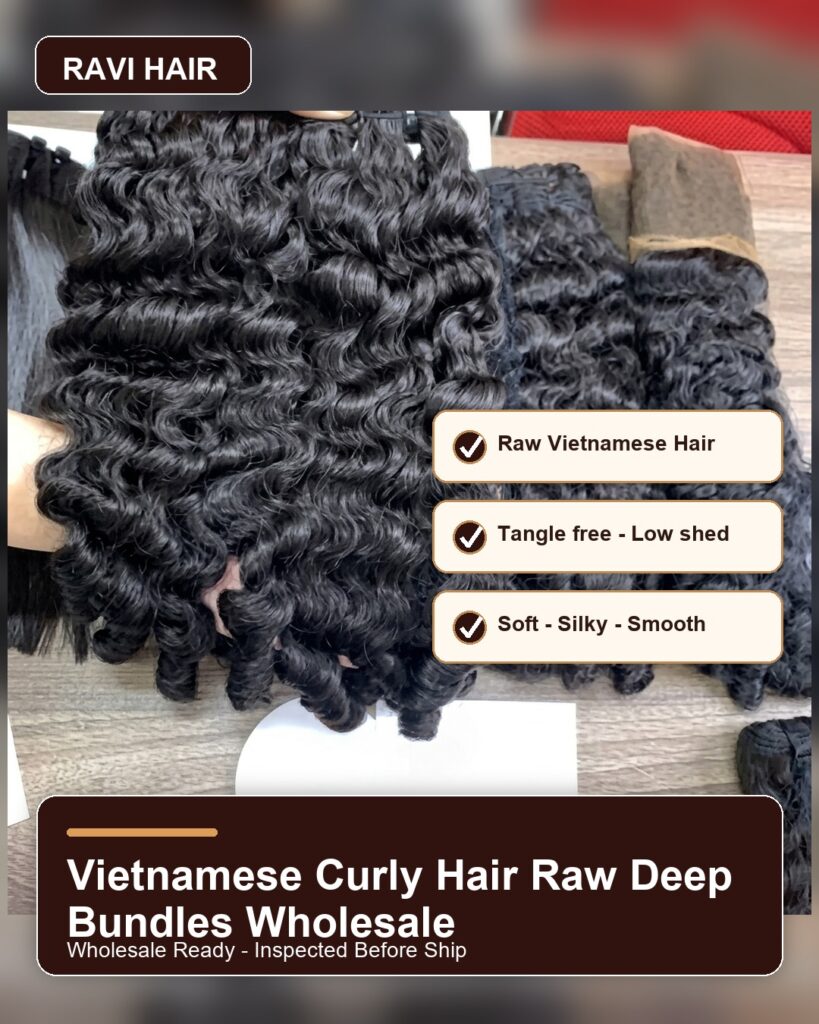
Body wave hair gives soft movement and is often easier to sell to customers who want volume without tight curls. Loose wave gives more visible movement than body wave. Deep wave gives stronger definition. Water wave gives a flowing wet-look effect. Curly textures give more volume and identity, but they need stronger proof.
For African-market catalog textures, you may also see names such as Deep Twist Curly, Round Twist, Circle Curly, Egg Curly, Tip Twist Curly, Water Curly, Bouncy Curly, Fumi Curly, Body Twist, Finger Curly, Body Tip Twist, and Tip Coily. These names should be treated as product texture names, not automatic proof of raw hair.
For any wave or curl, ask for wet-to-dry comeback proof. Your customer will not only judge the hair when it arrives. They will judge it after washing. If the curl drops too much or the texture does not match across pieces, your complaint risk increases.
Single drawn, double drawn, and super double drawn raw Vietnamese hair
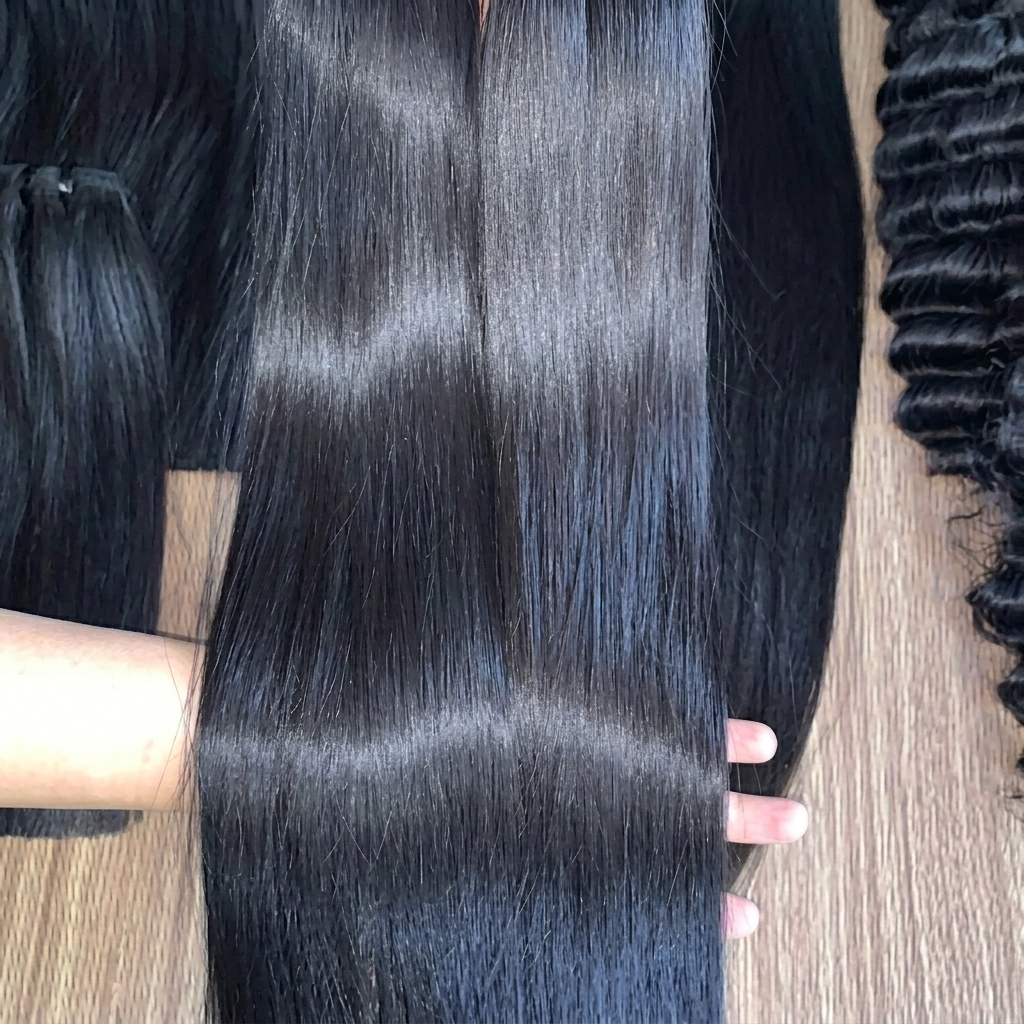
Drawn grade affects how full the hair looks from top to ends. This is important because your buyers often judge quality by the ends.
Single Drawn usually has more mixed strand lengths. In a practical RaviHair-style explanation, it may have about 40–45% of strands reaching the same length. It can look more natural and cost less, but the ends are more tapered.
Double Drawn usually has a higher percentage of longer strands, around 60–65%. It looks fuller through the length and is often the safest middle option for salons and vendors.
Super Double Drawn is expected to look fuller toward the ends, often around 80–85% of strands reaching the same length. It is usually positioned as a premium option and should feel heavier and fuller at the bottom.
Choose Single Drawn if your buyers are price-sensitive and accept a natural taper. Choose Double Drawn if your customers want fuller everyday installs without paying the highest price. Choose Super Double Drawn if your buyers expect premium fullness and are willing to pay more.
Do not trust the grade name alone. Ask for ends close-up, bundle hanging video, and hand-spread proof. A supplier’s “Double Drawn” may not match your buyer’s expectation unless you check the actual ends.
Raw Vietnamese hair price: what affects the quote
Raw Vietnamese hair price depends on product form, length, weight, drawn grade, texture, color, lace, and order size.
For bundles, a common standard is 1 bundle = 100g and 1kg = 10 bundles. That means a wholesale quote may be shown by kg, while your buyer thinks by bundle. Always confirm both.
The quote may change based on:
-
Length: longer hair costs more and thin ends become more visible.
-
Grade: Double Drawn and Super Double Drawn cost more than Single Drawn.
-
Texture: bone straight, wave, curly, and custom textures may add processing or styling cost.
-
Color: 613 blonde and fashion colors usually add processing cost and QC risk.
-
Product form: bundles, bulk hair, closure, frontal, and wig are not priced the same.
-
Lace: transparent lace, HD lace, 4×4, 5×5, 6×6, 13×4, and 13×6 change the quote.
-
Order type: sample, small wholesale, controlled bulk, and mixed custom order may be handled differently.
A cheap quote is not always cheaper if the hair is underweight, short, thin at the ends, overprocessed, or different from the approved sample. A higher quote only makes sense if the supplier can prove the spec and protect the order.
What to check before ordering a raw Vietnamese hair sample
Before approving a sample, compare the evidence you receive with Ravi Hair’s published quality-control standards. This helps you record the same checks for the sample and any later bulk batch.
A sample order should test both the hair and the supplier’s proof process. Before you pay, ask for clear written specifications.
Use this checklist:
-
Hair type: raw, virgin, Remy, processed, or mixed.
-
Product type: bundles, closure, frontal, wig, or bulk hair.
-
Texture: straight, bone straight, body wave, loose wave, deep wave, water wave, curly, kinky, or coily.
-
Length: confirm how the supplier measures straight, wavy, and curly hair.
-
Bundle weight or total hair weight.
-
Bundle conversion if buying bundles: confirm whether 1kg equals 10 bundles.
-
Drawn grade: Single Drawn, Double Drawn, or Super Double Drawn.
-
Color: natural black, 1B, 613, brown, burgundy, highlight, piano, or ombre.
-
Lace size if relevant: 2×4, 2×6, 4×4, 5×5, 6×6, 13×4, or 13×6.
-
Lace type if relevant: transparent lace, HD lace, or another lace type.
-
Processing history: ask whether the hair has been steamed, dyed, bleached, coated, acid-washed, silicone-coated, or chemically treated.
-
Shipping method and estimated delivery time.
-
Replace, refund, or credit rule if the sample does not match approved proof.
For photos, ask for hero photo, model/reference photo if available, texture close-up, weft or lace close-up, ends/hand photo, length proof, and packing proof.
For video, ask for gram scale, true length measurement, wet-to-dry comeback for wave or curl, wash proof for bone straight, comb-through, shedding check, lace close-up if relevant, knot and parting close-up if relevant, and packing proof.
What to confirm before a bulk order
A good sample is only the first step. Before bulk, you need current-batch proof because natural hair can vary by batch.
Before approving bulk shipment, confirm:
-
Final order list by SKU, length, texture, color, grade, lace type, and quantity.
-
Bundle weight per piece and total order weight.
-
True length or stretched length.
-
Texture match across all pieces.
-
Ends fullness by drawn grade.
-
Weft quality and shedding risk.
-
Closure or frontal match if included.
-
Lace type, knots, parting, density, and hairline if included.
-
Color matching proof for 613 and colored hair.
-
Dryness and shedding proof for blonde or processed colors.
-
Current-batch videos, not only old sample videos.
-
Packing list before shipping.
-
Shipping method, tracking process, and receiver details.
-
Replace, refund, or credit rule if shipped goods do not match approved proof.
Do not approve bulk shipment only because the supplier sent beautiful photos. Ask to see the actual goods being packed for your order.
Processing time and claim rule to confirm
Before you approve production or shipping, read the Quality Guarantee and make sure the written order records the specifications, proof and claim conditions that matter to your business.
Before payment, ask whether your order is a catalog product or a more complex custom product.
Simple catalog products, such as natural black straight hair or common black wavy/curly textures, are usually easier to process. More complex orders, such as special color, 613 blonde, large lace pieces, custom textures, pixie-style products, or wigs, usually need more time and stricter confirmation.
Before you promise your own customer, ask RaviHair to confirm:
-
Whether the order is catalog or custom.
-
Whether it includes color, lace, wig construction, or difficult texture.
-
Estimated processing time before payment.
-
Whether the order qualifies for claim handling.
-
Whether the hair must remain unwashed, uncut, unused, and in original condition for claim review.
-
How many days after receiving the goods you can report an issue.
This protects both sides. Your business should know the timeline and claim conditions before you resell the order.
Common mistakes to avoid when buying raw Vietnamese hair
The first mistake is trusting the word “raw” without asking about processing. Always ask whether the hair has been dyed, bleached, steamed, acid-washed, silicone-coated, or chemically treated.
The second mistake is checking only softness. Softness can come from good hair quality, but it can also come from coating. Check wash behavior, ends, weft, length, weight, and shedding.
The third mistake is not checking true length after stretching. Wavy and curly hair can look shorter when unstretched, so length proof is important.
The fourth mistake is ignoring the ends. If the top looks full but the ends are thin, your customer may feel the hair is not worth the price.
The fifth mistake is ordering too many products in the first order. If you test straight, curly, 613, closures, frontals, wigs, and bulk hair all at once, QC becomes harder.
The sixth mistake is buying lace products without checking match. If the closure or frontal does not match the bundles in texture, color, density, or quality, the install may look wrong.
The seventh mistake is selling blonde curly or blonde wavy hair without warning buyers about risk. Bleaching plus curl or wave can make hair drier and weaker. If quality safety matters more than color, darker wavy or curly hair may be safer.
The eighth mistake is not confirming the claim rule before payment. Before bulk, ask what happens if the shipped goods do not match approved proof for length, weight, texture, color, lace type, density, or packing list.
When ravihair may be a good fit
RaviHair may be a good fit if you are looking for a Vietnamese hair supplier that helps you choose raw Vietnamese hair based on your buyer type, not only product photos.
You can contact RaviHair when you need help comparing raw hair bundles, bundles with closure, bundles with frontal, wigs, bulk hair, straight hair, bone straight hair, body wave, deep wave, water wave, curly hair, drawn grades, lace sizes, and order size.
Before your next order, you can ask for texture guidance, gram proof, true length proof, weft proof, ends proof, lace matching, color matching, processing history, packing proof, and sample-to-bulk support.
Tell RaviHair your buyer type, target market, length range, grade, texture, color, budget, and destination. A safer supplier should help you choose the spec that your buyers can actually install, resell, and reorder.
Need help checking raw Vietnamese hair before your next sample or bulk order? Message RaviHair on WhatsApp: +84 971209812.
Faq
What is raw Vietnamese hair?
Raw Vietnamese hair usually means human hair sourced from Vietnam that has not been heavily processed for color or texture. Before buying, ask the supplier what “raw” means in their product and what proof they can show.
Is raw Vietnamese hair better than virgin hair?
Not automatically. Raw Vietnamese hair is often positioned as less processed, while virgin hair usually means the hair was not chemically treated. One-donor virgin hair is a stricter premium claim. The better choice depends on your buyer and the proof available.
Is Remy hair bad?
No. Remy hair can still be human hair with aligned cuticles. For many African wholesale buyers, Remy hair can be practical for curls, normal colors, and better price control. The key is not to sell Remy hair as one-donor virgin hair if it is not.
Is raw Vietnamese hair good for wholesale buyers?
Yes, it can be good for wholesale buyers if the quality is verified. You should check processing history, gram weight, true length, weft, ends, texture behavior, lace match if relevant, and packing proof before bulk.
Can raw Vietnamese hair be bleached to 613 blonde?
Do not assume every raw Vietnamese hair batch can lift safely to 613. Ask for strand test proof, bleach test results, and supplier guidance before promising blonde results. Once hair is bleached or colored, treat it as processed or color-treated hair.
What is the best raw Vietnamese hair texture to start with?
Raw Vietnamese straight hair is often a safer first sample because it is easier to inspect and resell. Body wave is also practical if your buyers prefer volume. Curly and wavy textures need stronger wet-to-dry proof.
How do I know if raw Vietnamese hair is real?
You cannot verify every claim from the name alone. Ask whether the hair has been processed, request wash proof, check gram weight, check true length, inspect ends and weft, and ask for current-batch proof before bulk shipping.
Should I order sample before buying raw Vietnamese hair in bulk?
Yes. A sample helps you test the supplier’s communication, proof process, product quality, shipping, and claim handling. After a good sample, move to a controlled small bulk order before scaling.
Ask Ravi Hair
Get advice for your next order
Factory support
Make the guide practical
Ask for current stock videos, sample guidance, packing proof, and export support before you approve an order.
- Real product video before shipping
- Sample support before bulk buying
- Clear consultation for your market