Ravi Hair Journal
Vietnamese hair factory: wholesale buyer guide
If you are searching for a Vietnamese hair factory, you may be trying to buy closer to the source, reduce middleman cost, control quality better, or build a long-term wholesale supply chain.
For product options that match the buying criteria in this guide, browse Raw Vietnamese Hair Bundles.
That is a smart direction, but “factory” is also one of the most overused words in the hair market. Some sellers are real factories. Some are factory-connected suppliers. Some are trading companies. Some are marketplace vendors using factory language because it sounds more trustworthy.
For salon owners, vendors, wig makers, order collectors, and importers, the real question is not only “Are you a factory?” The better question is: can this supplier show the actual hair, actual batch, actual QC, and actual packing before you pay the balance or approve shipping?
RaviHair is a Vietnamese hair supplier, so this article is written from a supplier-side point of view. We are not pretending to be an independent review website. Our goal is to help you check proof, avoid weak factory claims, and choose a buying process that protects your buyers and your money.
Quick answer: how to verify a Vietnamese hair factory
A Vietnamese hair factory should be able to show more than a product catalog. Before you buy, check whether the supplier can explain their sourcing, sorting, production, QC, packing, shipping, and claim process.
|
Factory claim |
What you should ask for |
Why it matters |
|
“We are a factory” |
Factory video, sorting area, stock area, packing area |
Helps you avoid fake factory claims |
|
“Factory-direct price” |
Clear price by length, texture, grade, quantity |
Helps you compare real cost, not only discount language |
|
“Raw Vietnamese hair” |
Processing history and raw hair proof |
Helps you avoid selling processed hair as raw |
|
“Stable quality” |
Sample proof and current-batch proof |
Reduces sample-to-bulk mismatch |
|
“Correct length” |
Measurement video after stretching |
Reduces length complaints |
|
“Correct weight” |
Gram scale video |
Reduces short-weight disputes |
|
“Full ends” |
Ends close-up and drawn-grade proof |
Reduces complaints about thin hair |
|
“Good lace” |
Lace close-up, knots, parting, density, hairline |
Reduces install complaints |
|
“Ready to ship” |
Packing list, carton proof, packing proof |
Reduces wrong-item and missing-item risk |
The best Vietnamese hair factory for your business is not only the one with the lowest quote. It is the one that can show enough proof before you approve the order.
Why factory choice matters for wholesale buyers
Buying from a factory or factory-connected supplier can help your business, but only if the process is real and transparent. A good factory relationship may give you better control over product specifications, sample support, batch preparation, QC proof, packing, and repeat orders.
For salon owners, this can mean fewer install complaints. For resellers, it can mean more consistent product photos and repeat SKUs. For wig makers, it can mean better matching between bundles, closures, frontals, and wigs. For importers, it can mean clearer packing lists, better stock planning, and fewer disputes.
The risk is assuming that “factory” automatically means quality. It does not. A factory can still ship weak hair if QC is poor. A supplier can still call itself factory-direct while outsourcing products from other sources. A low factory price can still be expensive if the hair arrives short, thin, mixed, overprocessed, underweight, or different from the approved sample.
Your buyers do not judge your supplier’s label. They judge the hair after install, washing, styling, and wear. That is why factory verification should focus on proof, not promises.
Vietnamese hair factory vs vendor vs supplier vs marketplace seller
These terms are often used together, but they do not always mean the same thing.
A Vietnamese hair factory usually suggests direct production, sorting, preparation, manufacturing, or packing capability.
A Vietnamese hair vendor may be a seller, factory, trading company, or distributor. Many buyers use “vendor” broadly to mean “someone I can buy hair from.”
A Vietnamese hair supplier is a broader term for any company that supplies hair products. A supplier may be a factory, factory-connected business, trading company, or exporter.
A marketplace seller sells through a platform and may or may not control the actual product source.
For wholesale buyers, the label matters less than the control level. If a factory can show sourcing, sorting, QC, packing, and current-batch proof, it may offer stronger control. If a vendor is not a factory but can still show actual product proof, honest sourcing, and reliable claim handling, it may still be useful. If a marketplace seller cannot show the actual goods, your risk is higher.
So instead of asking only:
“Are you a factory?”
Ask:
-
Can you show the actual product before shipping?
-
Can you show your sorting, preparation, or packing process?
-
Can you confirm the hair type and processing history?
-
Can you provide gram, length, texture, lace, and packing proof?
-
Can you explain what happens if the shipped goods do not match approved proof?
A real factory relationship should make your buying process clearer, not more confusing.
What a Vietnamese hair factory should be able to supply
A Vietnamese hair factory or factory-connected supplier may offer different product types depending on their capability.
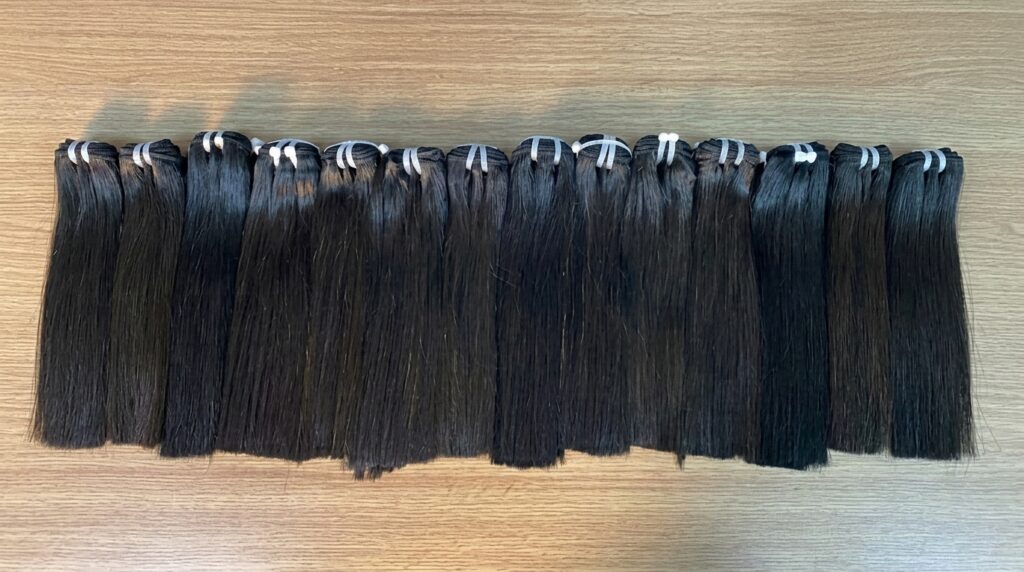
Raw Vietnamese hair bundles are often the core product for wholesale buyers. They are flexible for sew-ins, wigs, ponytails, and resale. Bundles are also easier to inspect because you can check weight, length, weft, ends, and texture clearly. A common bundle standard is 100g per bundle, and 1kg equals 10 bundles.
Bundles with closure are useful when your buyers want a complete install set with lower lace maintenance than a frontal. Common closure sizes include 2×4, 2×6, 4×4, 5×5, and 6×6.
Bundles with frontal are better for customers who want full hairline styling. Common frontal sizes include 13×4 and 13×6.
Vietnamese human hair wigs are useful for ready-to-wear buyers. For wigs, you should check cap construction, lace type, density, hairline, knots, parting, texture, and length. Wigs can be convenient, but they also create more complaint points than bundles.
Vietnamese bulk hair is useful for braiding, ventilating, handmade wigs, and custom production. For bulk hair, you should check alignment, direction, weight, length, and texture.
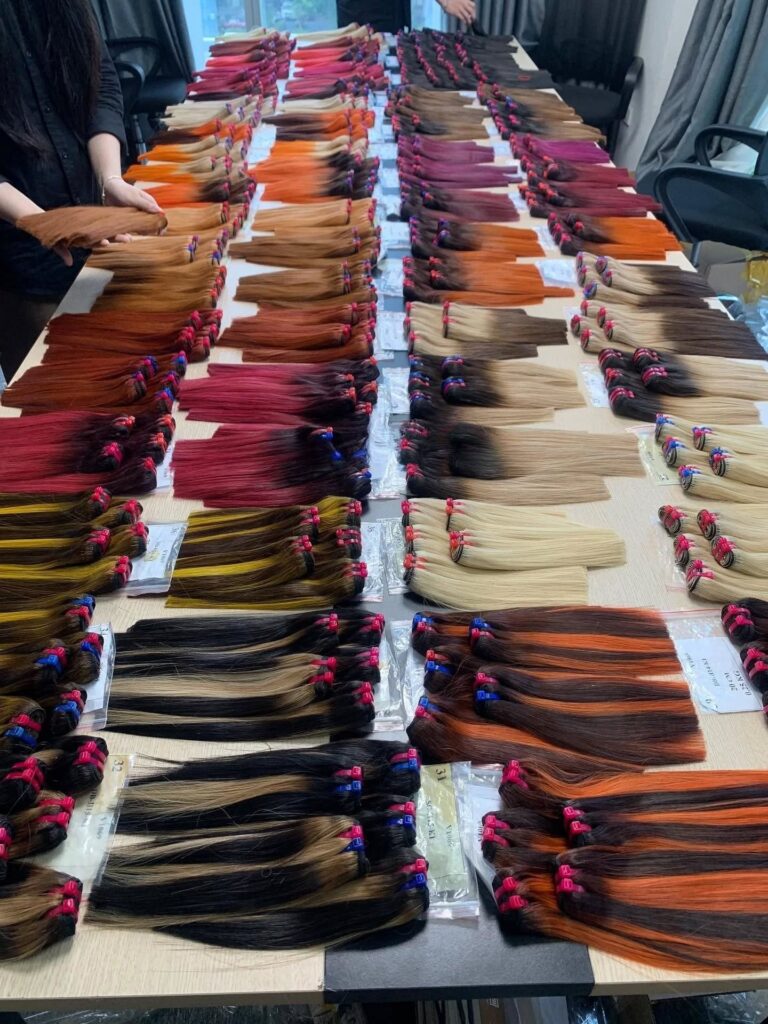
Some factories may also offer colored hair, 613 blonde, piano, highlight, ombre, tape-ins, clip-ins, or pre-bonded extensions. These can be useful, but they require stronger processing and color proof.
Raw Vietnamese hair factory: what to verify
If you are looking for a raw Vietnamese hair factory, you need to verify more than product availability. You need to verify the raw hair claim.
Raw Vietnamese hair usually refers to Vietnamese human hair that has not been heavily processed for color or texture. But in the market, “raw” can be used loosely. A supplier may call hair raw even if it was steamed, coated, or processed later.
Before buying from a raw Vietnamese hair factory, ask:
-
Has the hair been dyed, bleached, steamed, acid-washed, silicone-coated, or chemically treated?
-
Is the texture natural, selected, steamed, heat-styled, or chemically created?
-
Is the color natural black/1B, or has it been colored?
-
Is the hair raw, virgin, Remy, processed, mixed, or one-donor?
-
Can the factory show wash proof?
-
Can the factory show wet-to-dry comeback proof for wave or curl?
-
Can the factory show actual batch proof before bulk shipping?
If the factory cannot explain raw, virgin, Remy, and processed hair clearly, be careful about using strong claims on your own product pages.
Vietnamese hair factory product quality: what to check
A good factory should help you understand product quality by specification, not vague claims.
Hair type should be explained clearly: raw, virgin, Remy, processed, mixed, or one-donor. Do not accept all premium words at the same time without proof.
Drawn grade should be visible from the ends. In a practical grading explanation, Single Drawn has around 40–45% of strands reaching the same length, Double Drawn around 60–65%, and Super Double Drawn around 80–85%. If the ends do not match the grade, the label will not protect you from complaints.
Bundle weight should be checked by gram scale. If the supplier quotes 1kg, confirm whether it equals 10 bundles of 100g each.
True length should be measured clearly. For wavy and curly hair, the hair should be stretched to confirm length.
Texture should be checked before and after water. For wave and curl, wet-to-dry proof matters more than a styled catalog photo.
Weft quality should be checked with close-up video, comb-through, and shedding check.
Lace quality should be checked separately if you order closure, frontal, or wig. Ask for knots, parting, density, hairline, lace type, and bundle-to-lace match.
How to compare Vietnamese hair factories by buyer type
The best factory depends on your business model. A new vendor and a bulk importer do not need the same factory relationship.
|
Your business type |
Better factory fit |
What to prioritize |
|
New hair vendor |
Factory with sample support |
Small test order, clear proof, fast communication |
|
Salon owner |
Factory with consistent bundles and lace match |
Install result and low complaint risk |
|
Online reseller |
Factory with strong photo/video proof |
Product visuals, packing proof, repeatable SKUs |
|
Wig maker |
Factory with lace and wig capability |
Closures, frontals, wigs, density, hairline |
|
Order collector |
Factory with simple catalog support |
Clear specs, easy pricing, fewer mixed custom problems |
|
Bulk importer |
Factory with batch QC and export packing |
Packing list, carton proof, repeat supply |
|
Premium raw hair seller |
Raw hair-focused factory process |
Processing proof, ends proof, length proof |
|
Budget buyer |
Factory with honest grade options |
Clear Single/Double/Super Double Drawn difference |
Choose the factory that fits your buyer model, not only the factory that gives the lowest price.
Factory-direct price: what buyers should understand
Factory-direct pricing can be attractive, but price alone does not tell you whether the order is safe.
A lower quote may come from lower grade, thinner ends, shorter weight, processed hair, mixed sources, weaker lace, or limited QC. A higher quote may include better sorting, fuller ends, clearer proof, more stable supply, or better claim handling.
When comparing factory prices, ask what is included:
-
Hair type: raw, virgin, Remy, processed, or mixed.
-
Drawn grade: Single Drawn, Double Drawn, or Super Double Drawn.
-
Bundle weight per piece.
-
Length measurement method.
-
Texture type and processing history.
-
Color and color-processing risk.
-
Lace type and size if included.
-
Wig cap, density, knots, and hairline if buying wigs.
-
Packing type.
-
Sample MOQ and bulk MOQ.
-
Shipping method.
-
Claim rule if the goods do not match approved proof.
A quote without specifications is not a useful quote. For wholesale buying, the cheapest price is only helpful if the product still protects your buyers.
Factory qc: what proof to request before sample
Before approving a sample, compare the evidence you receive with Ravi Hair’s published quality-control standards. This helps you record the same checks for the sample and any later bulk batch.
A sample order should test the factory’s product and process. Before paying, confirm the specifications and proof.
Use this checklist:
-
Factory or supplier identity: factory-direct, factory-connected, trading company, or vendor.
-
Hair type: raw, virgin, Remy, processed, or mixed.
-
Product form: bundles, closure, frontal, wig, extension, or bulk hair.
-
Texture: straight, bone straight, body wave, loose wave, deep wave, water wave, curly, kinky, or coily.
-
Length: confirm how straight, wavy, and curly hair are measured.
-
Weight: bundle gram weight or total hair weight.
-
Bundle conversion if buying bundles: confirm whether 1kg equals 10 bundles.
-
Drawn grade: Single Drawn, Double Drawn, or Super Double Drawn.
-
Color: natural black, 1B, 613, brown, burgundy, highlight, piano, or ombre.
-
Lace size if relevant: 2×4, 2×6, 4×4, 5×5, 6×6, 13×4, or 13×6.
-
Lace type if relevant: transparent lace, HD lace, or other lace.
-
Processing history: steamed, dyed, bleached, acid-washed, silicone-coated, or chemically treated.
-
Sample shipping method and estimated delivery time.
-
Replace, refund, or credit rule if the sample does not match approved proof.
For photos, ask for hero photo, model/reference photo if available, texture close-up, weft close-up, lace close-up if relevant, ends/hand photo, length proof, and packing proof.
For video, ask for gram scale, true length measurement, wet-to-dry comeback for wave or curl, wash proof for bone straight, pull or stretch test, comb-through, shedding check, lace close-up if relevant, knot and parting close-up if relevant, and packing proof.
Factory qc: what to confirm before bulk order
Bulk proof should be stricter than sample proof. A sample shows possibility. Bulk proof confirms the actual order.
Before approving shipment, confirm:
-
Final order list by SKU, hair type, texture, length, color, grade, lace type, and quantity.
-
Factory or batch confirmation for the actual goods.
-
Bundle weight per piece and total order weight.
-
True length or stretched length.
-
Texture match across all pieces.
-
Ends fullness by drawn grade.
-
Weft quality and shedding risk.
-
Closure, frontal, or wig match if included.
-
Lace type, knots, parting, density, and hairline if included.
-
Color matching proof for 613 and colored hair.
-
Dryness and shedding proof for blonde or processed color.
-
Current-batch videos, not only old sample videos.
-
Packing list before shipping.
-
Carton, label, and packing proof.
-
Shipping method, tracking process, and receiver details.
-
Replace, refund, or credit rule if shipped goods do not match approved proof.
Do not approve bulk shipping only because you ordered from a “factory.” Approve only after the actual order proof matches what you agreed.
Processing time and claim rule to confirm
Before sending payment or approving production, use the Order & Payment Policy to make sure the final specifications and approved proof are recorded in writing.
A responsible factory or factory-connected supplier should explain the timeline before you pay.
Simple natural black straight or common black wavy/curly bundle orders are usually easier to process. More complex orders, such as special color, 613 blonde, large lace pieces, wigs, pixie-style products, or difficult custom textures, usually need more time and stricter confirmation.
Before payment, ask:
-
Is this a catalog order or custom order?
-
Does the order include color, large lace, wig construction, or difficult texture?
-
What is the estimated production or processing time?
-
When can the supplier send proof before shipping?
-
Does the order qualify for claim handling?
-
Does the hair need to remain unwashed, uncut, unused, and in original condition for claim review?
-
How many days after receiving the goods can you report an issue?
This helps you avoid promising your own customers faster delivery or easier claim handling than the factory can support.
Red flags when checking a Vietnamese hair factory
Be careful if the factory cannot show current product videos. A real supply process should be able to show actual goods before shipment.
Be careful if the factory uses factory-direct language but cannot explain sorting, grade, weight, length, processing, lace, or packing. Vague answers can create expensive problems later.
Be careful if every product is described as raw, virgin, Remy, Double Drawn, Super Double Drawn, and premium without clear differences. A reliable supplier should be able to explain different product levels.
Be careful if the factory pushes bulk payment before sample proof. For a new buyer relationship, a sample or controlled first order is usually safer.
Be careful if the factory has no clear claim rule. Before payment, you should know what happens if shipped goods do not match approved proof.
Be careful if the factory only sends beautiful catalog photos but refuses gram scale, length, ends, weft, lace, and packing proof.
Common mistakes to avoid when choosing a Vietnamese hair factory
The first mistake is assuming factory-direct always means better. A factory still needs QC, proof, and clear communication.
The second mistake is choosing only by price. A low factory price can hide short weight, thinner ends, mixed hair, weak lace, or limited quality control.
The third mistake is not checking raw hair claims. Ask whether the hair has been dyed, bleached, steamed, acid-washed, silicone-coated, or chemically treated.
The fourth mistake is approving bulk based on old sample videos. Always ask for current-batch proof.
The fifth mistake is ignoring lace if you buy closures, frontals, or wigs. Lace quality affects the most visible part of the install.
The sixth mistake is testing too many products at once. Start with your most important texture and length range, verify the factory process, then expand.
The seventh mistake is not confirming packing list before shipping. For mixed wholesale orders, missing one closure, wrong length, or wrong texture can create a dispute after the goods arrive.
When ravihair may be a good fit
RaviHair may be a good fit if you want a Vietnamese hair supplier with a factory-style buying process that helps you check product details before sample or bulk order.
You can contact RaviHair when you need help comparing raw Vietnamese hair, Vietnamese hair bundles, closures, frontals, wigs, bulk hair, straight hair, bone straight hair, body wave, deep wave, water wave, curly hair, drawn grades, lace sizes, and order quantities.
Before ordering, you can ask for raw hair claim clarification, texture guidance, gram proof, true length proof, weft proof, ends proof, wet-to-dry proof, lace matching, color matching, packing list, packing proof, and sample-to-bulk support.
Tell RaviHair your buyer type, target market, product form, length range, texture, grade, color, lace need, budget, quantity, and destination. A safer supplier should help you choose a product you can actually resell, install, and reorder.
Need help checking Vietnamese hair factory proof before your next wholesale order? Message RaviHair on WhatsApp: +84 818293277.
Faq
What is a Vietnamese hair factory?
A Vietnamese hair factory is usually a supplier involved in sourcing, sorting, preparing, producing, or packing Vietnamese human hair products. Before buying, ask for factory proof and actual product QC proof.
Is buying from a Vietnamese hair factory better than a vendor?
It can be better if the factory gives you stronger control, clearer specifications, current-batch proof, and reliable claim handling. But a factory label alone does not guarantee quality.
How do I verify a Vietnamese hair factory?
Ask for factory video, stock video, sorting or preparation proof, actual product videos, gram scale proof, true length measurement, weft close-up, ends close-up, lace proof if relevant, packing list, carton proof, and packing proof.
Can a Vietnamese hair factory supply raw hair?
Some factories or factory-connected suppliers can supply raw Vietnamese hair, but you should verify the raw claim. Ask whether the hair has been dyed, bleached, steamed, acid-washed, silicone-coated, or chemically treated.
Should I order a sample before bulk from a factory?
Yes. A sample helps you test product quality, communication, proof process, shipping, and claim handling. After a good sample, move into a controlled bulk order with current-batch proof.
What proof should I request before a bulk order?
Ask for final order list, gram scale proof, true length measurement, texture match, ends proof, weft proof, lace proof if relevant, color proof if relevant, packing list, carton proof, and shipping confirmation.
How do I avoid fake Vietnamese hair factories?
Avoid suppliers who cannot show current product videos, factory or stock proof, processing history, QC steps, packing proof, or a clear replace/refund/credit rule before bulk order.
Ask Ravi Hair
Get advice for your next order
Factory support
Make the guide practical
Ask for current stock videos, sample guidance, packing proof, and export support before you approve an order.
- Real product video before shipping
- Sample support before bulk buying
- Clear consultation for your market