Ravi Hair Journal
Vietnamese hair products: 8 types and how to choose the right one
With so many Vietnamese hair products available, choosing between bundles, bulk hair, wigs, closures, frontals and extensions can quickly become confusing. Each product is made for a different use, so the right choice depends on whether you are buying for personal wear, a salon, wig making or resale.
In this guide, you’ll compare 8 popular Vietnamese hair products, see who each type is best for, understand the key differences, and know exactly what to check before you order.
Vietnamese hair products at a glance
| Product | Best for | Main advantage | Main QC point |
|---|---|---|---|
| Hair Bundles / Weft Hair | Vendors, salons, sew-ins | Easy to stock, sell and install | Weight, weft and ends |
| Bulk Hair | Wig makers, braiders, manufacturers | Maximum construction flexibility | Direction and alignment |
| Closures | Sew-ins and wig makers | Covers the top/parting area | Lace, knots and density |
| Frontals | Premium wigs and installs | Wider hairline coverage | Lace and hairline |
| Human Hair Wigs | Personal buyers and wig sellers | Ready-to-wear solution | Construction and density |
| Tape-In Extensions | Extension salons | Flat installation | Tape and hair weight |
| Keratin / Tip Extensions | Professional salons | Strand-by-strand installation | Bond and strand weight |
| Clip-Ins / Ponytails | Retail and personal use | Fast temporary styling | Total weight and construction |
If you are starting a hair business, Vietnamese hair bundles are usually the simplest product to understand and resell. If you make wigs or extensions yourself, bulk hair gives you more control. If you operate a salon, closures, frontals, tape-ins and keratin-tip products may be more useful because you are selling an installation service as well as the hair.
1. Vietnamese hair bundles / weft hair
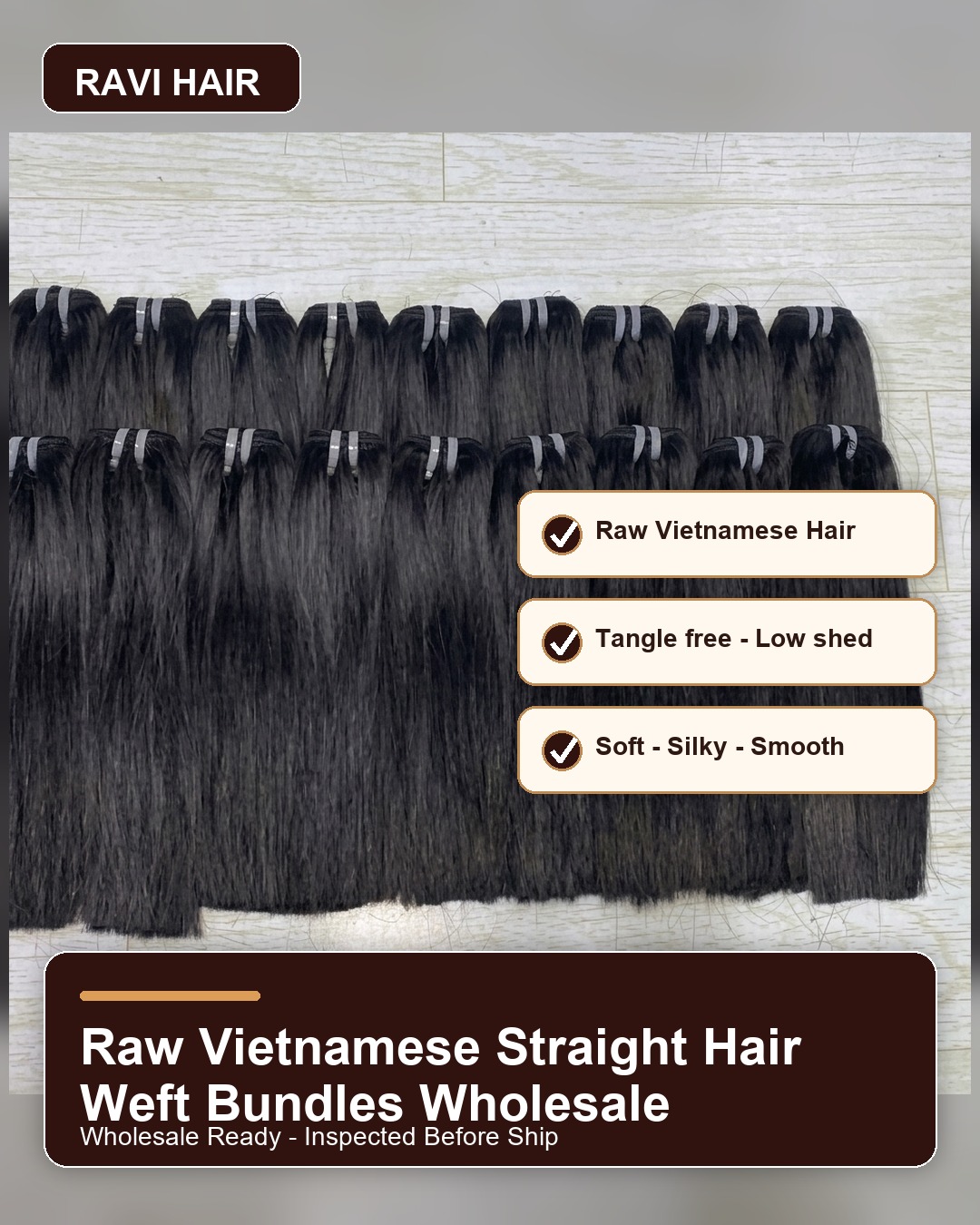
Vietnamese hair bundles are one of the most widely used product forms because they work for sew-ins, wig construction, ponytails and resale. The loose hair is aligned and sewn together along the top to create a weft. In a common Vietnamese wholesale system, one finished bundle is approximately 100 grams.
Who should buy Vietnamese hair bundles?
Bundles make sense if you are a hair vendor, salon owner, wig maker or personal buyer who wants a conventional sew-in.
They are also a good first product when you are testing a new supplier because there are fewer construction variables than with a finished wig or lace product. You can weigh the bundle, measure its length, inspect the weft and examine the ends before using it.
Why choose bundles instead of a finished wig?
A bundle gives you flexibility. You can sell it as-is, combine three or four lengths for an install, pair it with a closure or frontal, or use it to construct your own wig.
That flexibility matters for vendors because you do not need to predict every finished style your customer might request. You can stock a smaller number of core lengths and convert them into several services or products.
What should you check?
Do not judge a bundle only by how silky the top six inches look.
Check its actual weight, stretched length, weft construction and end fullness. Spread the bottom section so you can see how much hair reaches the full advertised length.
If you are buying Body Wave, Deep Wave or another styled texture, wash one sample and allow it to air-dry. You need to know what the hair looks like after normal use, not only immediately after factory styling.
When are bundles not the best choice?
If you manufacture tape-ins, tips or ventilated lace pieces, buying loose bulk hair may be more efficient because you do not need to remove an existing weft first.
If your customer wants a product she can wear with minimal construction work, a completed wig may also be more convenient.
2. Vietnamese bulk hair
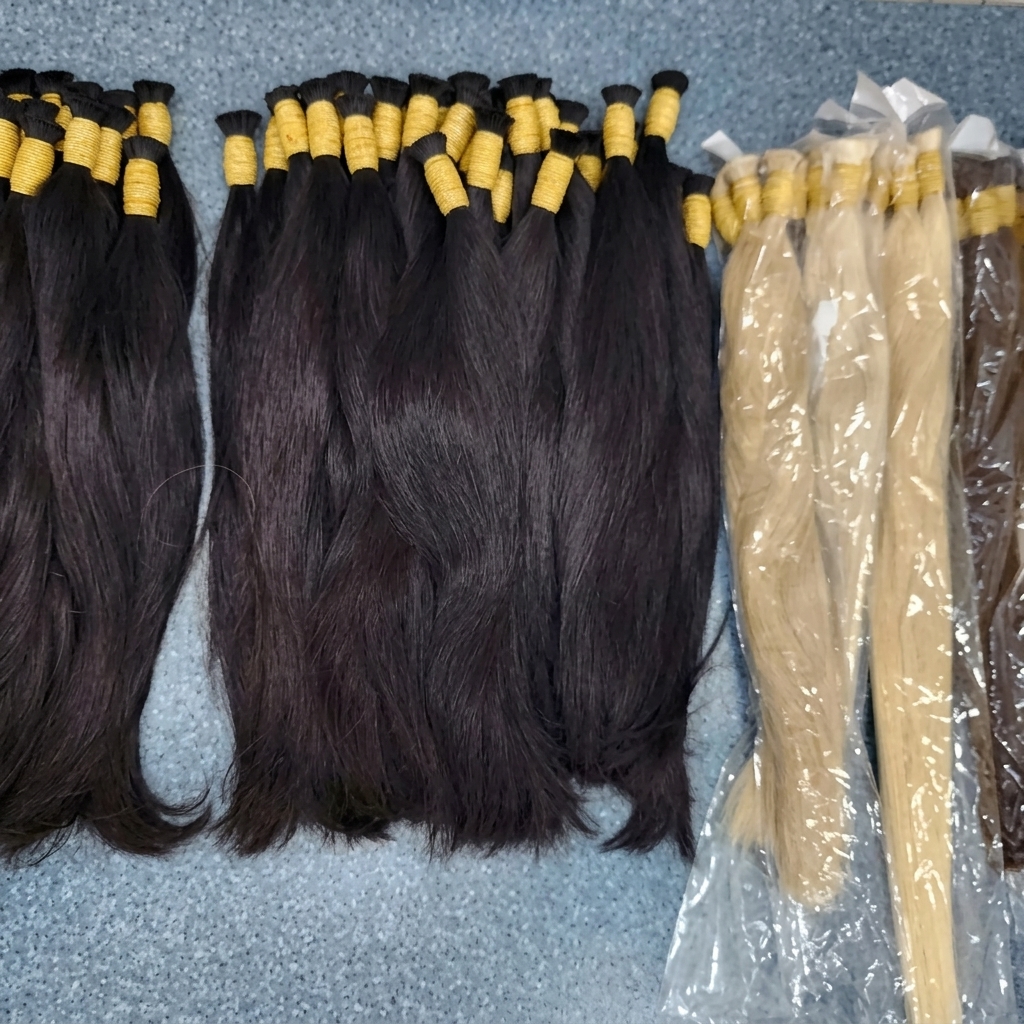
Bulk hair is loose human hair without a machine weft. That sounds like a small difference, but it changes what you can do with the product.
If you manufacture your own extensions, braiding products, lace pieces or wigs, a finished bundle has already made one construction decision for you: the hair has been sewn into a weft. Bulk hair keeps that decision in your hands.
Who is Vietnamese bulk hair best for?
Bulk hair is particularly useful for wig makers, braiders, extension manufacturers and buyers who need hair for ventilation.
You can use the same raw material to produce different finished products according to your own construction system. If you are comparing bulk, tape, tip and other installation formats, see the full Vietnamese hair extensions wholesale guide.
Why would you choose bulk hair?
Control is the biggest advantage.
You can decide how much hair goes into each strand, how the finished extension is bonded and how the product will ultimately be installed.
That makes bulk hair more valuable to a manufacturer than to a personal customer.
What should you check?
Direction becomes especially important with loose hair.
You should confirm whether the roots and ends remain consistently aligned, how the hair is tied and packed, how much the bundle weighs and whether the shorter strands match the specification you purchased.
Processing history matters too. If you need the hair for custom coloring, ask what has already been done to it before you perform your own chemical work.
When should you skip bulk hair?
If you simply want three bundles for a sew-in, buying wefted hair is usually easier.
Bulk hair gives you more control only when you actually need that control.
3. Vietnamese hair closures
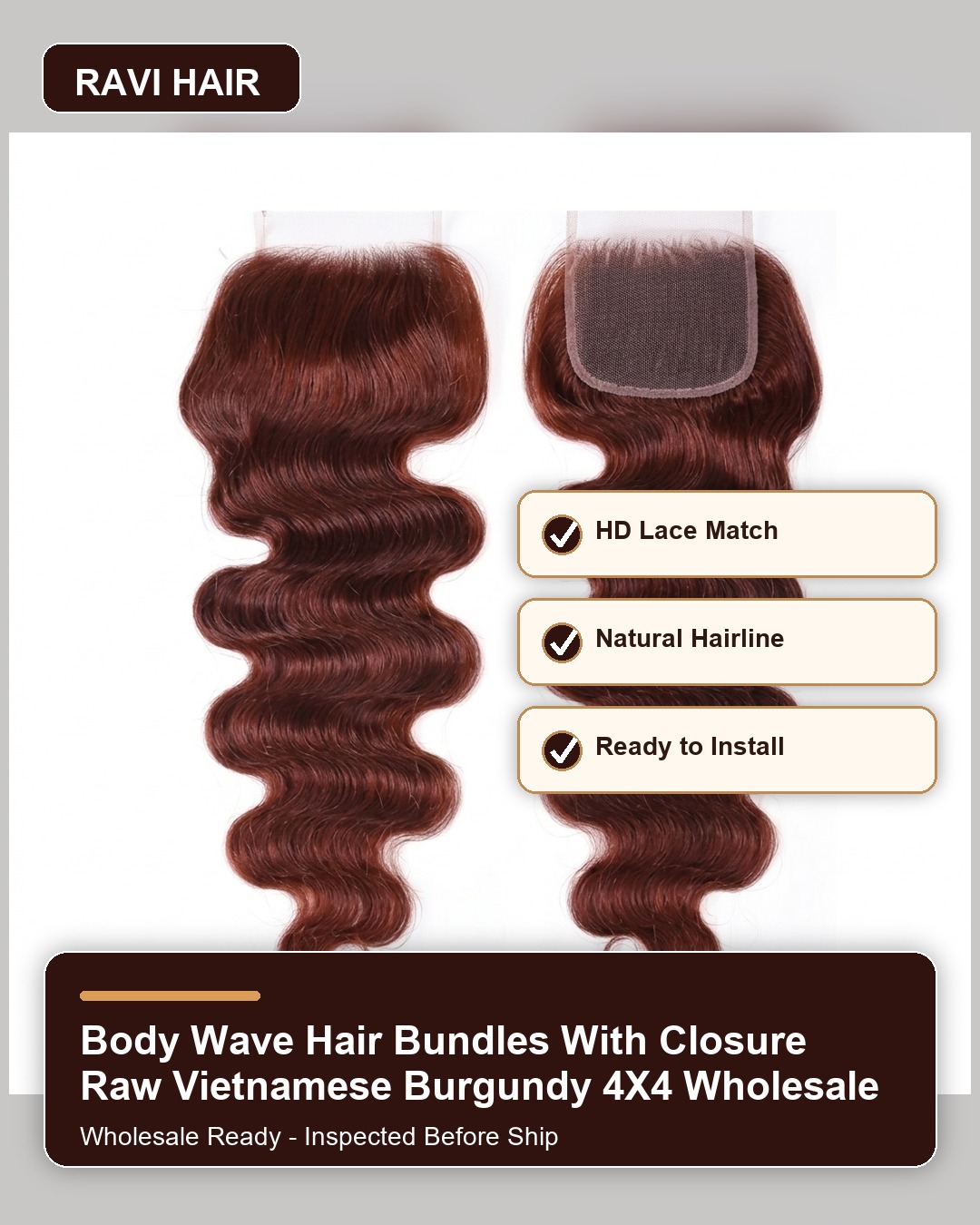
A closure is a smaller lace or mesh section with individual hair strands attached to it. It covers part of the top of the head and allows the wearer to create a part without leaving as much natural hair exposed.
Common closure dimensions include 4×4, 5×5 and 6×6, while smaller specialty sizes are also available in some product systems. You can compare current Vietnamese closures and lace components by size and construction before choosing a set.
Who should choose a closure?
Closures are useful for sew-ins, wig makers and customers who want less leave-out.
They can also be a practical middle ground for someone who wants a more finished installation but does not need the full ear-to-ear coverage of a frontal.
Why does closure size matter?
A larger closure gives you more lace area and therefore more styling and parting space.
But more lace also means more construction work and typically a higher price.
You do not automatically need the biggest closure available. Choose the lace area according to the finished hairstyle.
What should you inspect?
The hair itself is only half of the product.
Look at the lace, knots, density and parting area. Then place the closure beside the bundles you plan to use.
A beautiful closure that does not match the bundle texture or color will still make the final install look inconsistent.
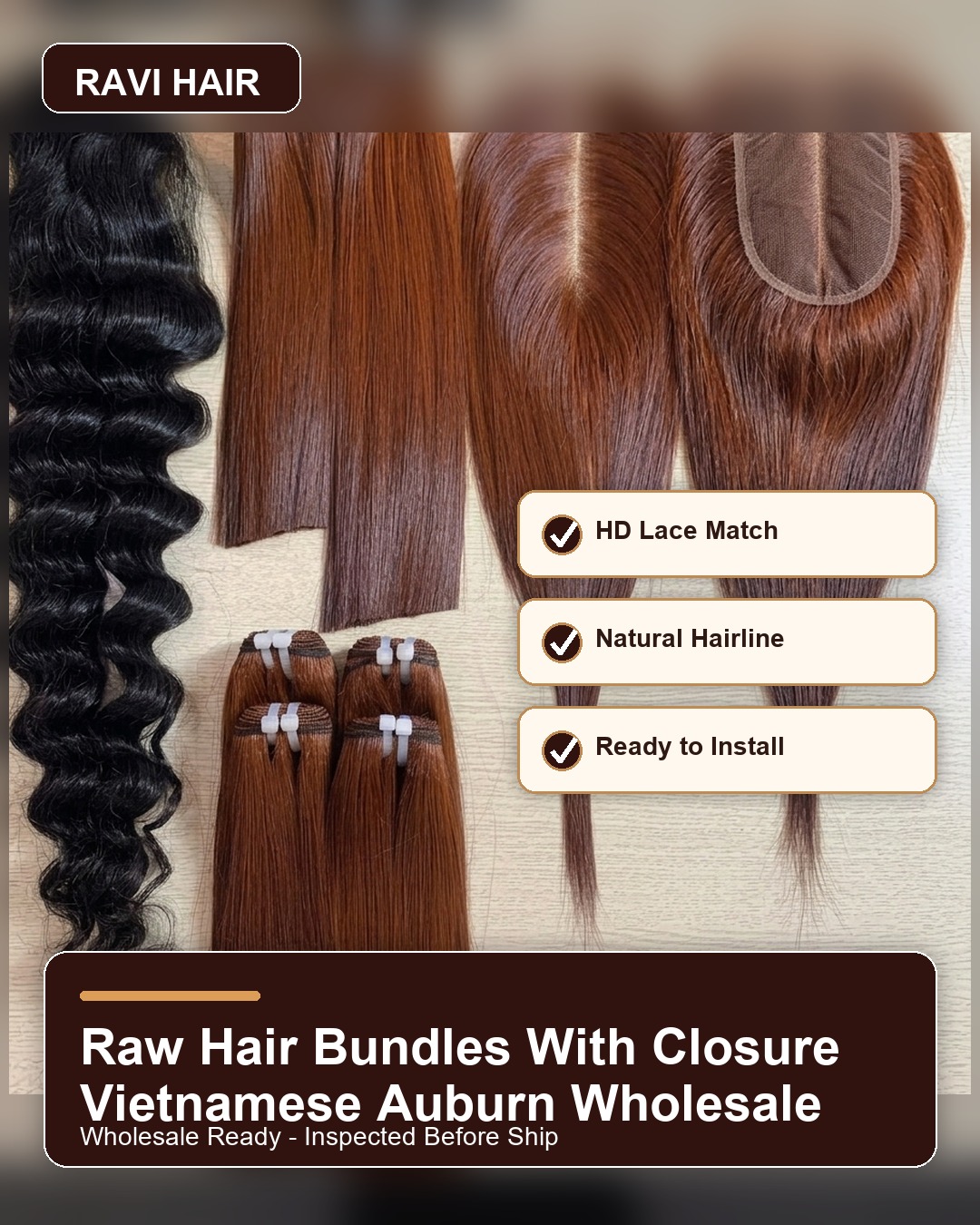
4. Vietnamese hair frontals
Closures and frontals perform similar jobs, but they cover different areas.
A closure normally covers a smaller top section. A frontal extends across much more of the front hairline.
Common frontal sizes include 13×4 and 13×6. Ravi Hair’s closure and frontal collection lets you compare the lace coverage before deciding how much styling area your customer actually needs.
Who is a frontal best for?
A frontal is most useful for premium wigs and installations where the customer wants greater hairline coverage and more styling freedom.
For example, the wearer may want a wider parting range or hairstyles that expose more of the front hairline.
Why choose a frontal instead of a closure?
The main reason is flexibility.
The wider lace area creates more styling options around the front of the head.
The trade-off is that there is also more lace to inspect, install and maintain.
What should you check?
Look closely at the hairline, knot size, density distribution, lace quality and texture match.
Do not inspect the frontal separately from the bundles if you are purchasing them for one unit.
Your customer sees the finished wig or install as one product, so your quality control should do the same.
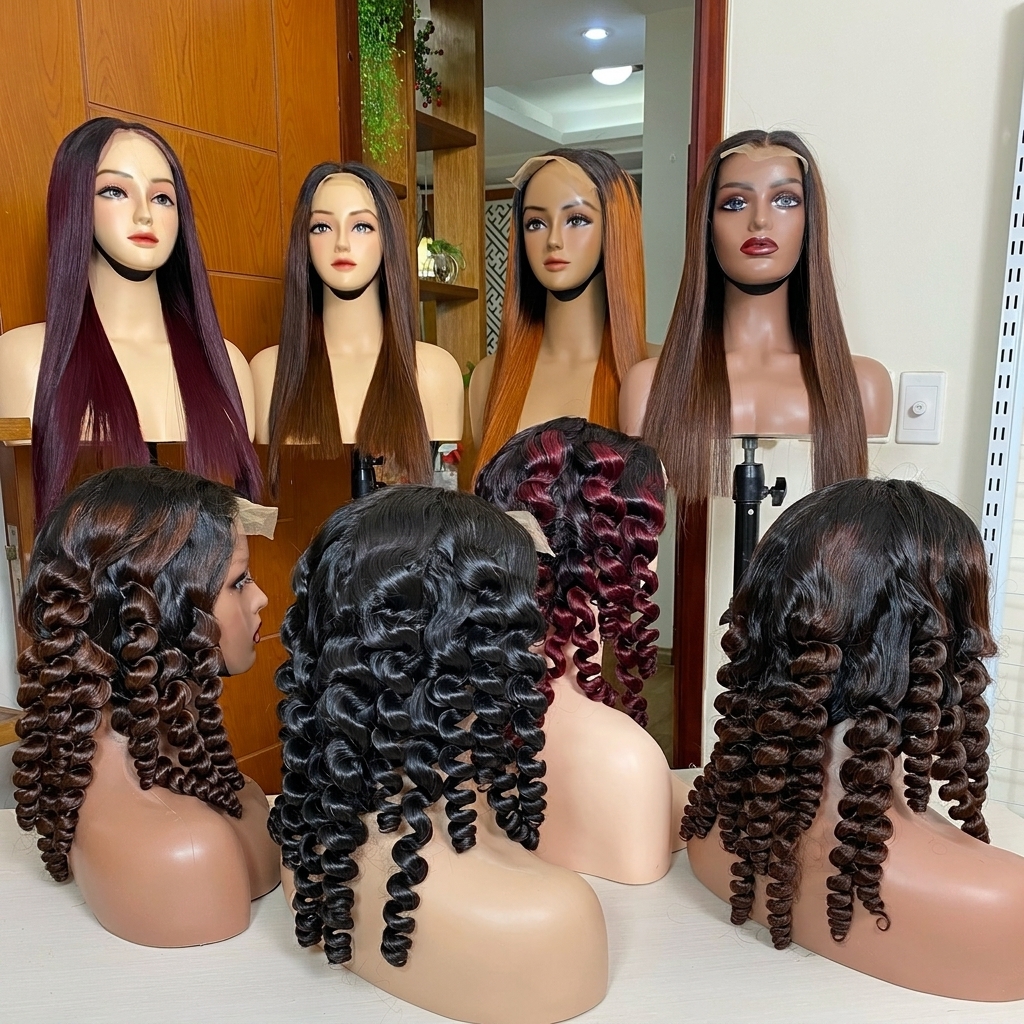
5. Vietnamese human hair wigs
A wig is the finished version of several decisions that would otherwise be made separately.
A factory-made unit may combine approximately two or three weft bundles with a closure or frontal, although the actual amount of hair depends on the requested length, density and construction.
That is why asking:
“How much is an 18-inch wig?”
usually does not provide enough information for an accurate quotation.
Wig pricing depends on details including length, texture, color, lace type or size, density and quantity.
For example, a Vietnamese Deep Wave lace-front wig already combines the texture, lace-front construction and finished cap into one product, so you need to evaluate more than hair length alone.
Who should buy a Vietnamese hair wig?
Wigs are suitable for personal users who want a more complete product and for businesses that specialize in ready-made or customized units.
They can also save a vendor construction time because the customer is purchasing the finished product instead of separate bundles and lace.
Why are wigs harder to compare than bundles?
A bundle is mostly hair plus a weft.
A wig includes hair, lace or another base, cap construction, density distribution, stitching and styling.
Two “20-inch Body Wave wigs” can therefore be very different even when the headline specification looks identical.
What should you verify?
Confirm the exact density, lace size, cap construction, texture, color and overall design before production.
When the wig is finished, inspect the hairline, knots, ends, texture and general balance of the unit.
If you are a reseller, this step matters because your customer is not buying raw material. She is buying the final appearance.
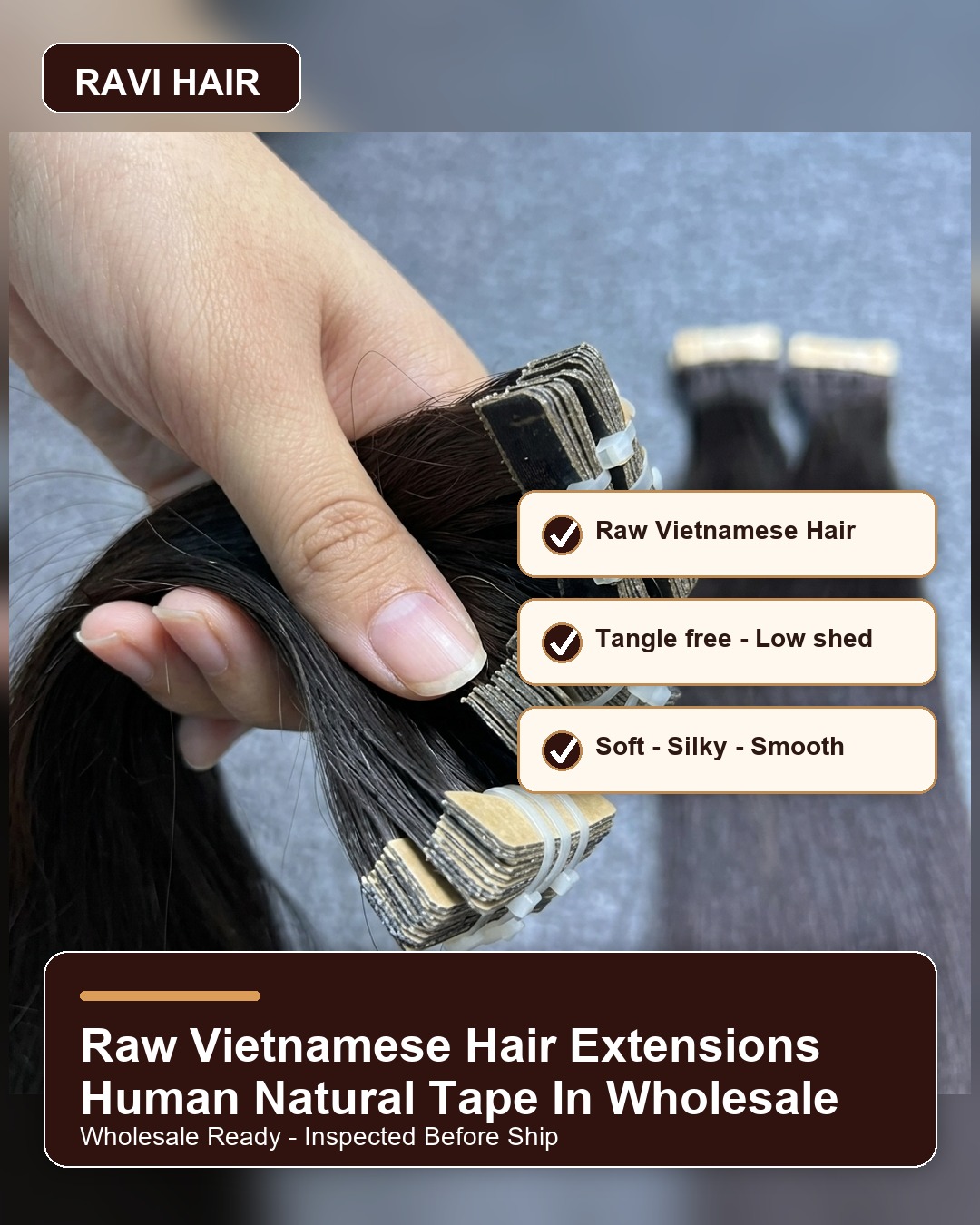
6. Vietnamese tape-in hair extensions
Vietnamese tape-in hair extensions use small sections of hair attached to a flat adhesive base. The installer sandwiches sections of natural hair between the tape tabs, creating a relatively flat extension system.
Who should choose tape-ins?
Tape-ins make the most sense for salons and professional extension specialists.
They are less useful for a beginner vendor whose customers mostly buy traditional bundles, unless there is already clear demand for this installation method.
Why choose tape-ins?
The main advantage is their flatter construction.
For the right client, the installation can feel less bulky than a conventional sewn weft.
But the adhesive becomes part of the product quality.
What should you check?
Ask about the amount of hair per piece or set, tape dimensions, adhesive construction, length and color.
You should also understand whether you are buying the finished tape-in product or hair that your own workshop will convert into tape-ins.
That distinction can materially change your cost.
7. Vietnamese keratin, i-tip and u-tip hair
Tip extensions are another product family rather than one single item. Depending on the system, you may see keratin bonds, U-tips, I-tips, flat tips or nano-tip extensions.
They all solve a similar problem: installing relatively small sections of extension hair instead of one large weft.
You can compare tip products alongside other professional systems in Ravi Hair’s Vietnamese curly hair and extension range, which includes I-tip, U-tip, flat-tip and tape-in formats for selected textures.
Who are tip extensions best for?
These products are mainly for professional salons and extension specialists.
They are especially useful when the installer wants more control over placement around the head.
Why does the tip type matter?
Because installation is different.
A keratin bond is not used in the same way as an I-tip or nano-tip system.
Therefore, buying the wrong tip is not simply a cosmetic mistake. It may make the product incompatible with your salon’s normal installation method.
What should you check?
Confirm the bond type, size, hair weight per strand, total strand count, length and hair quality.
If you order tip extensions for resale, make sure your product description is precise enough that a stylist can immediately tell whether the system matches her tools and technique.
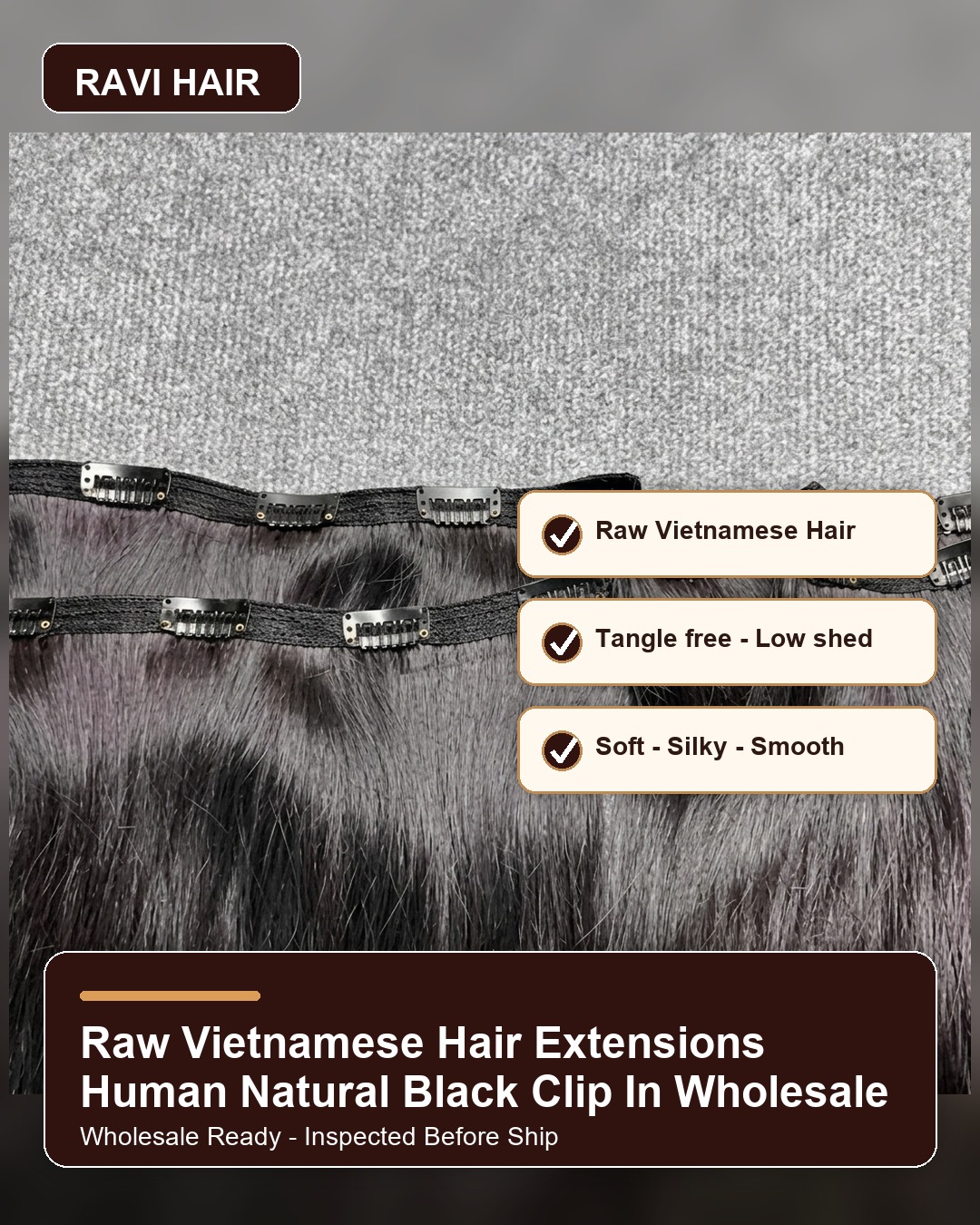
8. Vietnamese clip-in hair and ponytails
Clip-ins and ponytail extensions are more retail-oriented than many of the products above.
They are designed for customers who want to add length or volume without committing to a long-term salon installation.
Who should choose them?
They suit personal users, beauty retailers and vendors serving customers who want temporary styling.
They can also be easier to explain to a first-time extension buyer because the product already includes its attachment system.
If you are comparing clip-ins against tape-ins, tips, bulk hair and conventional bundles, the Vietnamese hair extensions comparison helps you choose by buyer type and QC risk rather than product name alone.
Why can total weight matter more than piece count?
A set containing more clips does not automatically contain more hair.
Two products can have the same number of pieces but very different total weights.
If fullness matters to your customer, ask for both.
You should also inspect clip quality, stitching, the base material and how evenly the hair is distributed across the set.
Product type is only your first decision
This is the part many buyers miss.
Choosing “Vietnamese hair bundles” tells the supplier what form you want.
It does not fully define the hair inside the product.
Two 20-inch straight bundles can differ in hair quality, end fullness, processing, color and price.
After selecting your product, you still need to make several specification decisions.
Raw vs virgin vs remy Vietnamese hair
Raw, Virgin and Remy should not be treated as different physical products in the same way that a bundle and a wig are different products.
They describe the hair specification and processing history.
Vietnamese remy hair
Remy Vietnamese hair is generally the more accessible choice when your goal is Natural Black or normal-to-moderate color customization.
It is still human hair. The decision is not “real hair versus fake hair.”
In Ravi Hair’s product system, Remy is positioned for natural black, brown, red and other normal color ranges, while Virgin becomes more relevant when demanding lightening is the priority.
That distinction can save you money.
If your customer only wants brown hair, buying the most expensive specification may not give her any meaningful benefit.
Vietnamese virgin hair
Vietnamese Virgin Hair becomes more relevant when the buyer wants a premium specification with stronger potential for custom coloring.
Natural straight is also a useful starting base when you want to evaluate the hair before adding bone-straight processing, waves or custom color.
However, you should still strand-test the actual hair before promising a specific blonde result.
Hair labels do not replace testing.
Raw Vietnamese hair
“Raw” should tell you something about how minimally the hair has been processed.
It should not be used as a magic word that automatically proves donor count, fullness, weight, lifespan or bleaching performance.
If you want to start with a straightforward product that is easier to inspect, compare the Raw Vietnamese Straight Hair Bundle before moving into more processed textures or colors.
Ask what the supplier actually means by Raw.
Then ask what processing, if any, happened after collection.
That is much more useful than buying the label alone.
Single drawn vs double drawn vs super double drawn
Drawn grade describes how much of the bundle reaches approximately the same long length.
It changes the appearance of the bottom of the hair dramatically.
In one commonly used grading benchmark, Single Drawn may contain roughly 40–45% same-length strands, Double Drawn around 60–65%, and Super Double Drawn around 80–85%.
These figures should be treated as practical benchmarks rather than a universal industry standard because suppliers may grade hair differently.
| Grade | Bottom appearance | Relative cost | Best suited to |
|---|---|---|---|
| Single Drawn | More tapered | $ | Budget-conscious buyers |
| Double Drawn | Fuller | $$ | Balanced everyday/premium market |
| Super Double Drawn | Very full | $$$ | Premium full-end look |
Why would you choose single drawn?
Price.
If your customers want an affordable bundle and do not expect a very blunt, heavy bottom, Single Drawn can make sense.
Why choose double drawn?
For many buyers, this is the balance point.
You get fuller ends without paying for the heaviest possible grade.
Why pay for super double drawn?
Because the bottom of the hair becomes part of your value proposition.
If your customers judge quality primarily by thick, full ends, the extra fullness may help you position the finished product at a higher level.
But do not buy the grade name alone.
Ask the supplier to spread the ends on camera.
Choose the right Vietnamese hair texture
Texture changes both appearance and maintenance.
Natural Straight is usually easier to inspect because you can see the full length and ends clearly.
Natural Wavy gives more movement.
Vietnamese Bone Straight Hair creates a much sleeker result, while Body Wave, Deep Wave, Loose Wave and curly textures provide progressively more visible shape.
If your customers prefer stronger volume and curl definition, you can compare current Vietnamese curly hair options before deciding which texture deserves a place in your catalog.
The question is not simply:
Which texture looks best?
Ask:
What does my customer expect this texture to look like after she washes it?
This matters most with waves and curls.
If the pattern was intentionally created during production, request a wash-and-air-dry test before you stock a large quantity.
A fresh factory curl tells you how the hair was styled.
The dried wash result tells you more about what your customer may experience.
Natural black vs colored Vietnamese hair
Color adds another processing decision.
Natural Black generally gives you the simplest starting point because fewer color-processing variables need to be evaluated.
If you want brown, burgundy or similar shades, ask whether the supplier recommends Remy or Virgin hair for your target result rather than automatically choosing the most expensive option.
For blonde and especially aggressive lightening, test the hair first.
Do not make a 613 promise to your customer based only on a supplier category name.
For customers who want ready-colored stock, review the available Vietnamese hair color options and confirm the actual shade on current-batch video before approving your order.
Custom color also deserves realistic expectations. Lighting, the original hair base and camera settings can affect how a reference photo appears.
For customized orders, Ravi Hair uses a realistic expectation of approximately 80–90% visual similarity to a reference photo rather than promising an exact 100% match.
That is a better conversation than promising a perfect match and creating a complaint later.
Which Vietnamese hair product is best for you?
The answer depends on what you are trying to sell or wear.
If you are buying for personal use
A wig gives you the most complete solution.
Bundles with a closure can be better when you want a customized sew-in or prefer to let your stylist build the finished look.
Clip-ins work when you want temporary volume or length.
If you run a salon
Your product mix can be wider.
Bundles, closures and frontals cover sew-ins and wigs. Tape-in hair extensions and keratin-tip extensions let you serve customers who want strand-based or flatter extension systems.
The important question is not how many products you can stock.
It is which installation services your salon actually performs.
If you are a new hair vendor
Start simple.
Straight bundles, Body Wave, Deep Wave and a limited selection of matching closures are usually easier to explain than a catalog containing 30 textures and six installation systems.
You can expand after your customers tell you what they repeatedly ask for.
If you make wigs
Bundles, bulk hair, closures and frontals should be more relevant to you than clip-ins or ponytails.
Your purchasing decision should focus heavily on matching: the lace piece and bundle need to look like they were designed for the same finished unit.
If you manufacture hair extensions
Bulk hair gives you the most control.
You can convert the loose hair into wefts, tape-ins, tips or other finished systems according to your own production standards.
What should you send before asking for a price?
“Price please” is not enough information for an accurate Vietnamese hair quotation.
A supplier normally needs your product type, texture, length, color, quantity and destination, and the hair quality specification may also affect the quote.
Compare these two messages:
How much is Vietnamese hair?
and:
I need 3 Virgin Vietnamese hair bundles, Natural Straight, 20”, 22” and 24”, Natural Black, shipped to Atlanta, Georgia.
The second request gives the supplier enough information to recommend the correct product and calculate a meaningful price.
For a wig, add the lace size, density and other construction requirements.
For tape-ins or tip extensions, include the installation system and required set or strand quantity.
How to check Vietnamese hair before you buy
A product name tells you what category the hair belongs to.
Quality control tells you what you are actually receiving.
If you want a deeper QC checklist before approving a sample or shipment, use Ravi Hair’s hair quality control resources together with the checks below.
Check the weight
Ask the supplier to place the complete bundle on a digital scale. Do not assume that every bundle marketed as 100g weighs exactly the same.
Measure the true length
Straight hair can be measured directly. Wavy and curly textures generally need to be stretched before measuring so you can verify the actual strand length.
Inspect the ends
Look beyond the thick top section. Spread the lower portion of the bundle so you can see how much hair reaches the bottom.
Check the weft or root direction
For bundles, inspect the stitching and weft construction. For bulk hair, check that the root-to-tip direction remains controlled and consistent.
Ask about processing
Find out whether the hair has been colored, bleached, steamed, straightened or otherwise treated.
Wash-test waves and curls
For textured hair, check what the pattern looks like after washing and complete air-drying rather than judging only the factory-finished curl.
If you are unsure how to wash a sample without creating extra friction or tangling, follow this Vietnamese hair washing guide so your QC test does not damage the hair itself.
Ask for current-batch evidence
For larger orders, request videos or photos from the hair you are actually buying whenever possible.
A perfect video from an old production lot does not guarantee that today’s order looks the same.
Vietnamese hair products faq
What are the main Vietnamese hair products?
The main product forms include weft bundles, bulk hair, closures, frontals, wigs, tape-in extensions, keratin/tip extensions, clip-ins and ponytails.
Are Vietnamese hair bundles always 100g?
A 100g bundle is a very common wholesale specification, but you should still confirm the actual weight with your supplier before purchasing.
Is Raw Vietnamese hair better than Virgin hair?
Not automatically.
Raw and Virgin describe different aspects of the hair specification, and suppliers may use these terms differently. Instead of choosing by label, compare donor structure, processing history and what you need the hair to do after purchase.
If demanding coloring is part of your plan, compare the available Virgin Vietnamese Straight Hair specification rather than assuming every Raw bundle offers the same lightening performance.
What is the difference between bulk hair and bundles?
Bulk hair is loose hair without a sewn weft. Bundles are hair sewn into a weft for installation or resale.
Choose bundles when you want a ready-to-use sew-in product. Choose bulk when you want to manufacture your own finished hair product.
Which Vietnamese hair product is best for wig making?
Bundles combined with a closure or frontal are a common option when building wigs. Bulk hair may be better when you require more manufacturing control or perform your own ventilation.
Can Vietnamese hair be bleached to 613?
Some high-quality hair may be suitable for very light coloring, but you should not assume every Vietnamese hair product can safely reach 613.
Ask what hair specification is being supplied and perform a strand test before promising a final color to your customer.
Choose the product your customer actually needs
The best way to buy Vietnamese hair is not to begin with words like Raw, Virgin or Super Double Drawn.
Begin with the finished result.
Do you need bundles for resale? Bulk hair for manufacturing? A closure for a sew-in? A frontal for a premium wig? Tape-ins for your salon? A finished wig for personal use?
Once you know the product form, choose the hair quality, fullness, texture, color and length that support that use.
That process protects you from paying for specifications your customer does not need. It also makes your quotation easier to understand and gives you clearer quality-control points before the order ships.
If you are unsure where to start, send Ravi Hair the product you need, target texture, length, color, quantity and destination. From there, you can narrow the specification before you spend money on the wrong hair.
Ask Ravi Hair
Get advice for your next order
Factory support
Make the guide practical
Ask for current stock videos, sample guidance, packing proof, and export support before you approve an order.
- Real product video before shipping
- Sample support before bulk buying
- Clear consultation for your market