Ravi Hair Journal
Vietnamese hair grade: single, double & super double explained
Vietnamese hair grades are mainly about how full the hair stays toward the ends, not whether the hair is Raw, Virgin or Remy. Single Drawn, Double Drawn and Super Double Drawn differ in strand-length distribution, end fullness and price.
This guide explains those differences clearly, shows what each grade looks like in practice, and helps you choose the right option for your budget, hairstyle and customers.
Vietnamese hair grade at a glance
| Vietnamese Hair Grade | Approx. Same-Length Strands* | Ends | Relative Cost | Best For |
|---|---|---|---|---|
| Single Drawn | About 40–45% | Natural, tapered | $ | Budget buyers, layered looks |
| Double Drawn | About 60–65% | Fuller | $$ | Most vendors and salons |
| Super Double Drawn | About 80–85% | Very full, heavier-looking | $$$ | Premium bundles, wigs and full-end styles |
*These percentages are practical grading benchmarks used in one Vietnamese hair production system, not a universal regulated standard. Another supplier may use different percentages for the same grade name.
This is why you should never buy a Vietnamese hair bundle from the grade name alone. Ask to see the actual ends and current batch before you order.
What does Vietnamese hair grade actually mean?
When Vietnamese hair suppliers use Single Drawn, Double Drawn or Super Double Drawn, they are usually describing the distribution of strand lengths inside the bundle.
Imagine two Vietnamese hair bundles that both weigh approximately 100g and are both labeled 20 inches.
They can still look completely different.
In a Single Drawn bundle, more of that 100g may consist of shorter strands mixed with the longest strands. The top therefore feels full, while the lower section gradually becomes thinner.
In a Super Double Drawn bundle, more of the total weight remains in longer strands. More hair therefore reaches the bottom, giving you visibly heavier ends.
The difference is not simply:
“Which bundle has more hair?”
Both may have similar total weight.
The better question is:
“Where is that weight distributed through the length of the bundle?”
That is what makes drawn grade useful.
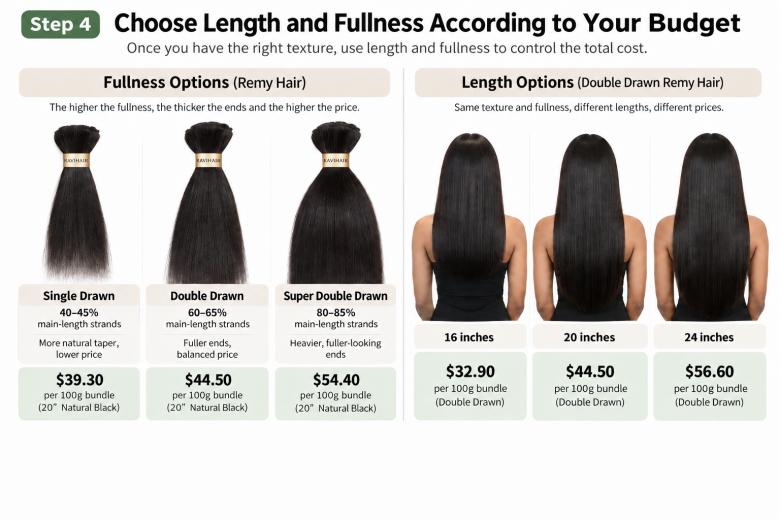
Single drawn Vietnamese hair
Single Drawn Vietnamese hair contains a larger mixture of different strand lengths.
Using the practical grading benchmark above, approximately 40–45% of the strands may reach close to the main stated length, while the remaining hair contains shorter lengths.
This creates the most noticeable taper of the three grades.
What does single drawn hair look like?
The bundle normally appears thick near the weft and gradually becomes lighter toward the bottom.
That does not automatically mean the hair is poor quality.
Real human hair on a person’s head does not naturally grow with every strand ending at exactly the same point. Because of that, some customers actually prefer the softer, layered appearance of Single Drawn hair.
Why would you choose single drawn?
The biggest reason is price.
You spend less on extreme end fullness, which can help you keep your selling price accessible or protect your margin in a price-sensitive market.
It can also work well when your finished hairstyle does not require blunt, heavy ends.
Single drawn may suit you if:
You want a more affordable bundle, prefer naturally tapered ends, sell to budget-conscious customers or plan to create layered styles where perfectly uniform bottom density is unnecessary.
What is the trade-off?
The ends will look thinner than Double Drawn or Super Double Drawn hair.
This becomes especially important if your customer specifically asks for “thick ends,” “full from root to tip” or a very dense Bone Straight finish.
Double drawn Vietnamese hair
Double Drawn hair removes more of the shorter strands and increases the proportion of longer hair inside the bundle.
In Ravi Hair’s practical grading benchmark, around 60–65% of strands are near the main length.
The result is noticeably fuller through the lower section without requiring the maximum fullness of Super Double Drawn.
Why is double drawn a useful middle option?
Because it balances appearance and cost.
You get fuller ends than Single Drawn, but you do not have to pay for the highest possible strand-length uniformity.
For many salons and vendors, this makes Double Drawn easier to position.
Your customers can see a meaningful improvement in the ends, while your cost remains below the premium Super Double Drawn level.
Who should consider double drawn?
Double Drawn makes sense if you sell everyday premium bundles, build wigs, run a salon or simply want fuller ends without making maximum density your main selling point.
It can also be a sensible specification to test first when you are building a new Vietnamese hair extensions collection because it sits between budget and luxury positioning.
What is the trade-off?
The bottom still will not look as heavy as Super Double Drawn.
If your customer’s main request is extremely thick, almost blunt ends, paying for a higher drawn grade may make more sense.
Super double drawn Vietnamese hair
Super Double Drawn Vietnamese hair is selected to keep an even larger proportion of long strands in the bundle.
Using Ravi Hair’s practical benchmark, approximately 80–85% of the strands may remain near the main length.
That gives you a much heavier-looking lower section.
Why does super double drawn look fuller?
Because less of the bundle weight is being used by short strands that stop higher up.
More of the hair continues toward the bottom.
This is why two 100g bundles can have the same total weight but produce very different silhouettes.
When is super double drawn worth paying for?
It makes the most sense when end fullness is part of the product you are selling.
For example, a customer buying sleek Vietnamese Bone Straight Hair may clearly see thin ends because the straight texture does not create the visual volume that curls can provide.
If she expects hair that remains visibly dense through the bottom, Super Double Drawn can justify its higher cost.
The same logic applies to premium wigs, luxury bundles and customers who repeatedly ask for very full ends.
When may you not need it?
You do not need to automatically upgrade every order to Super Double Drawn.
If your customer wants a layered cut, a curly style that creates significant visual volume or simply prioritizes affordability, she may be paying for fullness she does not actually need.
Single vs double vs super double drawn hair
| Feature | Single Drawn | Double Drawn | Super Double Drawn |
|---|---|---|---|
| Approx. same-length strands | 40–45% | 60–65% | 80–85% |
| Bottom fullness | Light | Full | Very full |
| Visual taper | Most visible | Moderate | Lowest |
| Natural layered look | Strong | Moderate | Lower |
| Relative price | Lowest | Middle | Highest |
| Best balance for many buyers | Budget-focused | Yes | Premium-focused |
| Best for very full ends | No | Good | Best of the three |
If you are unsure which one to start with, Double Drawn is often the easiest middle position to evaluate.
If your main goal is reducing cost, test Single Drawn. If your main goal is maximum visible fullness, compare the actual Super Double Drawn ends before paying the premium.
Why does a higher Vietnamese hair grade cost more?
You are not simply paying for a different label.
Producing fuller-end hair requires more sorting by strand length.
More short strands must be removed or separated so a greater proportion of the finished bundle reaches toward the target length.
That also changes how valuable each 100g bundle becomes from a production perspective.
With Single Drawn, more of the total weight can come from shorter strands. With Super Double Drawn, more of that same bundle weight needs to come from longer strands.
Long hair is more limited and therefore more costly to sort into a very full long bundle.
This is why the price gap can become more noticeable when you combine long lengths + high fullness.
For an accurate quote, compare the same length, texture, color and hair type. Otherwise you may think you are comparing grades when another specification is actually changing the price.
Vietnamese hair grade vs raw, virgin and remy
This is one of the most important distinctions to understand before buying.
Single Drawn, Double Drawn and Super Double Drawn describe fullness and strand-length distribution.
Raw, Virgin and Remy describe different aspects of the source hair, donor structure, alignment or processing history depending on the supplier’s terminology.
They are not interchangeable grading systems.
For example, you could potentially order:
Virgin Vietnamese Hair → Double Drawn → Natural Straight → Natural Black → 22 inches.
Here, “Virgin” describes the hair specification, while “Double Drawn” describes how full the finished bundle is toward the ends.
This distinction matters because a Super Double Drawn label does not prove that the hair is unprocessed.
Likewise, a premium Vietnamese Virgin Hair specification does not automatically tell you how full the bottom of the bundle will be.
You need to verify both.
Can raw hair also have a drawn grade?
It depends on how the supplier defines and prepares the raw-hair line.
Some raw Vietnamese hair products are sold with a specific fullness direction, while other raw lines may use only one standard sorting level rather than Single, Double and Super Double options.
If you are buying Raw Vietnamese Hair, ask the supplier exactly how the ends are sorted instead of assuming the word “Raw” guarantees maximum fullness.
What about 8a, 10a, 12a and 15a hair grades?
You may also see Vietnamese hair advertised as 8A, 10A, 12A, 15A or even higher.
Be careful with these labels.
There is no universal industry authority that forces every supplier to use A-grades in the same way.
One vendor’s “10A” hair may not match another vendor’s “10A” hair.
Some sellers publish rough conversions between A-grades and Single, Double or Super Double Drawn hair. Those conversions may describe that supplier’s own catalog, but they should not be treated as universal industry standards.
If a supplier tells you:
“This is 12A Vietnamese hair.”
ask a more useful follow-up question:
“How full are the ends, and can you show me the actual bundle?”
You can also ask what percentage of strands are close to the stated length, what the bundle weighs and whether the hair is Raw, Virgin, Remy or processed.
Those specifications give you something you can actually inspect.
How to check Vietnamese hair grade before you buy
You do not need laboratory equipment to spot major differences between drawn grades.
1. Compare the same length
Do not compare a 12-inch Double Drawn bundle with a 28-inch Single Drawn bundle and assume the visual difference comes only from grade. Compare the same length, texture and preferably the same hair type.
2. Hold the bundle vertically
Let the hair fall naturally from the weft. Look at how quickly the silhouette becomes narrower from the middle toward the bottom.
3. Spread the last 4–6 inches
The bottom section tells you much more about fullness than the top. Single Drawn should generally show more taper. Double Drawn should look noticeably fuller. Super Double Drawn should maintain the most weight near the ends.
4. Ask for a side-by-side video
If the supplier sells several grades, ask to see Single, Double and Super Double Drawn bundles of the same length placed beside one another. This is much easier to evaluate than three separate catalog photos.
5. Check the bundle weight
Ask for a digital-scale video. A very full-looking bundle is not useful evidence of grade if it simply contains more total hair. You want to compare similar bundle weights.
6. Verify true length
The bundle should actually contain the length you are paying for. For waves and curls, the hair normally needs to be stretched when checking true length.
7. Ask for current-batch proof
A beautiful Double Drawn sample from an old video does not prove that your current wholesale order has the same fullness. When possible, ask your Vietnamese hair factory or supplier to show the actual batch before shipping.
Does Vietnamese hair grade matter more at longer lengths?
It can become more visually important. On shorter hair, the distance between the weft and the ends is smaller, so moderate taper may be less noticeable in the finished hairstyle.
As you move toward 24, 26, 28 or 30 inches, more short strands can stop before reaching the bottom. This can make the difference between Single Drawn and fuller grades easier to see.
That does not mean every long-hair customer needs Super Double Drawn. It means you should pay closer attention to the bottom when your customer combines long length + straight texture + expectation of very full ends.
Which Vietnamese hair grade should you choose?
| Your Priority | Grade to Consider | Why |
|---|---|---|
| Lowest entry cost | Single Drawn | You accept more taper in exchange for a lower cost |
| Natural layered appearance | Single Drawn | Mixed lengths create a softer taper |
| Balance between price and fullness | Double Drawn | Fuller ends without maximum premium pricing |
| Salon or reseller core stock | Double Drawn | Useful middle-market position |
| Very thick ends | Super Double Drawn | More long strands remain through the bottom |
| Premium Bone Straight | Super Double Drawn | Sleek hair exposes end fullness clearly |
| Premium wigs | Double or Super Double | Choose according to your density target and selling price |
If you are buying for personal use
Do not automatically buy Super Double Drawn because it sounds like the highest grade.
Think about the hairstyle you actually want.
If you like a natural taper, Single or Double Drawn may already give you the result you need. If you want long straight hair with visibly thick ends, upgrading the fullness becomes easier to justify.
If you run a salon
Double Drawn can be a useful starting point because it balances client-visible fullness and cost.
You can reserve Super Double Drawn for clients who specifically request premium full-end installs.
If you are a new hair vendor
Your goal should be creating clear product tiers.
You could position Single Drawn as an accessible option, Double Drawn as your core range and Super Double Drawn as your premium full-end range.
That is easier for customers to understand than simply offering “10A, 12A and 15A” without showing what changes physically.
If you sell bone straight hair
Pay extra attention to drawn grade.
A sleek straight finish makes the bottom shape easy to see. If your marketing promise is “full ends,” you need the physical bundle to support that promise.
If you sell curly or wavy hair
Fullness still matters, but curl volume can change how the bottom looks.
Do not judge the grade from a freshly styled curl alone. Stretch and inspect the underlying strand distribution, then wash-test the texture separately.
Vietnamese hair grade faq
What is the best Vietnamese hair grade?
There is no single best grade for every buyer.
Single Drawn gives you a more tapered look and lower cost. Double Drawn balances fullness and price. Super Double Drawn gives you the fullest ends but costs more.
Is Super Double Drawn the highest Vietnamese hair grade?
Within the Single Drawn, Double Drawn and Super Double Drawn fullness system, Super Double Drawn represents the fullest end specification.
That does not automatically mean the hair is better in every other quality dimension.
Is Double Drawn better than Single Drawn?
Double Drawn has fuller ends, but whether it is better for you depends on your goal.
If you want maximum affordability or a naturally tapered look, Single Drawn may be the more appropriate choice.
Is Vietnamese hair grade the same as Raw, Virgin or Remy?
No.
Drawn grade describes strand-length distribution and end fullness. Raw, Virgin and Remy describe other characteristics of the hair and may be defined differently by different suppliers.
Is 12A Vietnamese hair the same as Super Double Drawn?
Not universally.
A-grades are not standardized across all suppliers. One vendor may use 12A for its premium range while another uses a different definition.
Ask for measurable specifications and actual hair proof instead of relying on the A-grade alone.
Can Single Drawn hair still be good-quality human hair?
Yes.
Single Drawn describes fullness, not whether the fiber itself is human hair or whether it has been properly sourced and processed.
How can I tell if Super Double Drawn hair is really full?
Ask to see the same-length bundle hanging vertically, spread the lower 4–6 inches, verify its weight and compare it beside Double Drawn or Single Drawn hair when possible.
Do not pay for the highest grade unless you need it
The most useful way to understand Vietnamese hair grade is not “good, better, best.”
Think: Natural taper → fuller ends → maximum end fullness.
Single Drawn can be the right product when price and a natural appearance matter most. Double Drawn is a strong middle choice when you want visibly fuller ends without moving to the highest price level. Super Double Drawn makes more sense when thick ends are part of the result your customer is specifically paying for.
Whatever grade you choose, do not approve the order from the label alone.
Check the bundle weight, actual length, lower-section fullness and current batch before shipping.
If you are still deciding, browse Ravi Hair’s Vietnamese Hair Bundles Guide or send your required length, texture, hair type, quantity and target end fullness. Ravi Hair can help you narrow the specification before you pay for a grade your market does not need.
Ask Ravi Hair
Get advice for your next order
Factory support
Make the guide practical
Ask for current stock videos, sample guidance, packing proof, and export support before you approve an order.
- Real product video before shipping
- Sample support before bulk buying
- Clear consultation for your market